
10 questions on the National Flag, the State Emblem, the anthem and song, the Saka calendar and important days, 30 seconds each, with explanations and memory tips.
National Symbols and Important Days Quiz: WBPSC Clerkship 2024
Quiz challenge
A little practice. A step forward.
10 questions
Learn with explanations
Time per question: 30 sec
0 / 10 completed
--:--
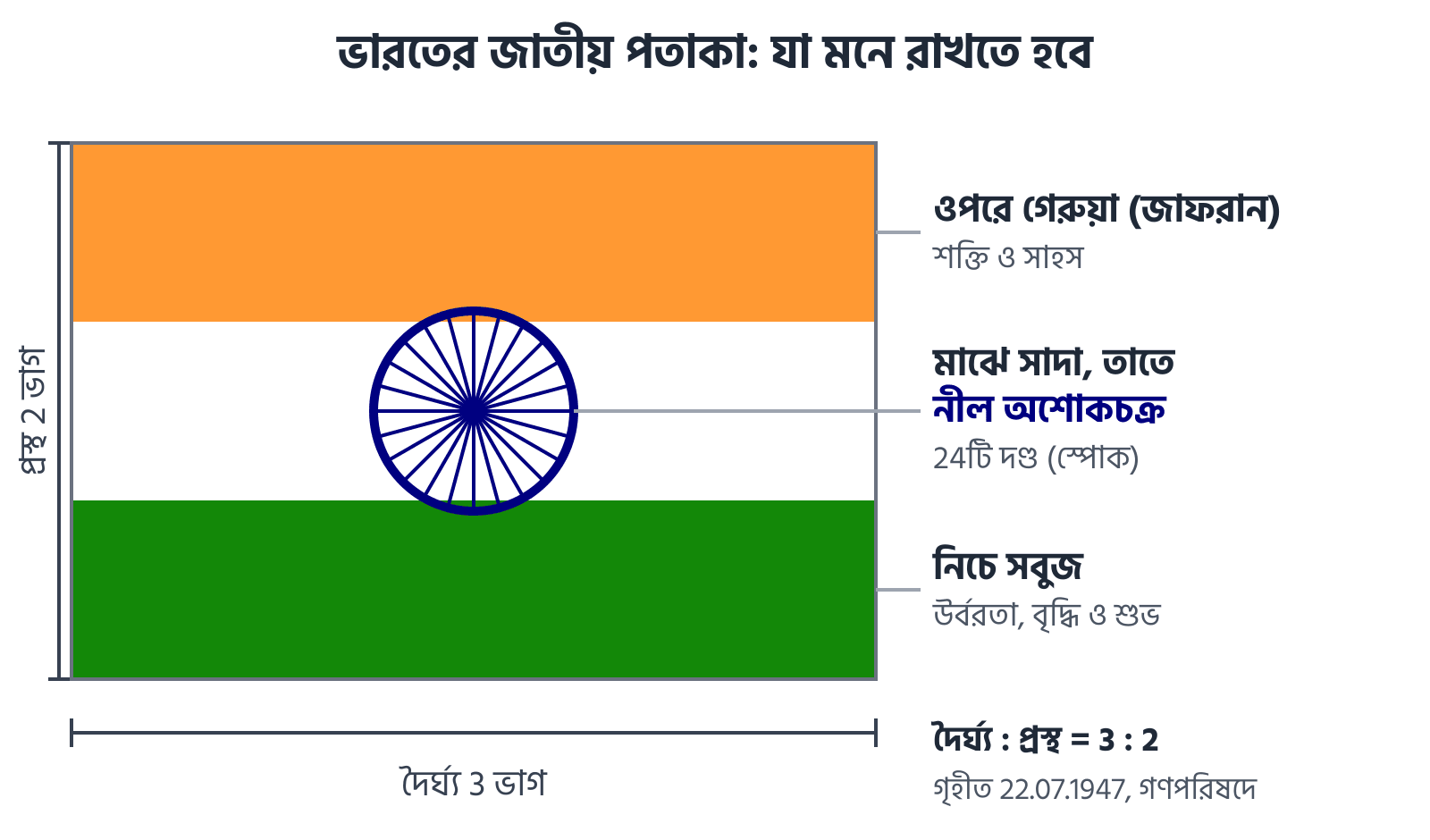
What is the ratio of the length to the width of the National Flag of India?
Explanation
The National Flag's length and width are in the ratio 3 : 2: if the length is 3 parts, the width is 2. Ratios like 2 : 1 or 5 : 3 belong to some other countries' flags, not India's.
Key Points
- Adopted by the Constituent Assembly on 22.07.1947
- Three equal horizontal bands: saffron, white, green
- Rules for the flag: the Flag Code of India, 2002
Memory Tips
- Length first, width second: 3, then 2
Additional Information
How many spokes does the Ashoka Chakra on the National Flag have?
Explanation
The Ashoka Chakra has 24 spokes and is navy blue. It comes from the Dharma Chakra on the Lion Capital of Ashoka at Sarnath and sits at the centre of the flag's white band.
Key Points
- The Chakra is navy blue
- It is at the centre of the white band
- Source: the wheel of the Sarnath Lion Capital
Memory Tips
- 24 hours in a day, 24 spokes in the Chakra
Additional Information
The motto 'Satyameva Jayate' written below the State Emblem of India is taken from which text?
Explanation
'Satyameva Jayate' (truth alone triumphs) is taken from the Mundaka Upanishad. It is written below the State Emblem in Devanagari script. The Rigveda, the Gita and the Katha Upanishad are tempting because they are ancient texts too, but they are wrong.
Key Points
- Script: Devanagari
- The emblem was adopted on 26.01.1950
- The emblem comes from the Lion Capital of Ashoka at Sarnath
Memory Tips
- Motto and Mundaka both start with M
Additional Information

When was the State Emblem of India (the Lion Capital of Ashoka) adopted?
Explanation
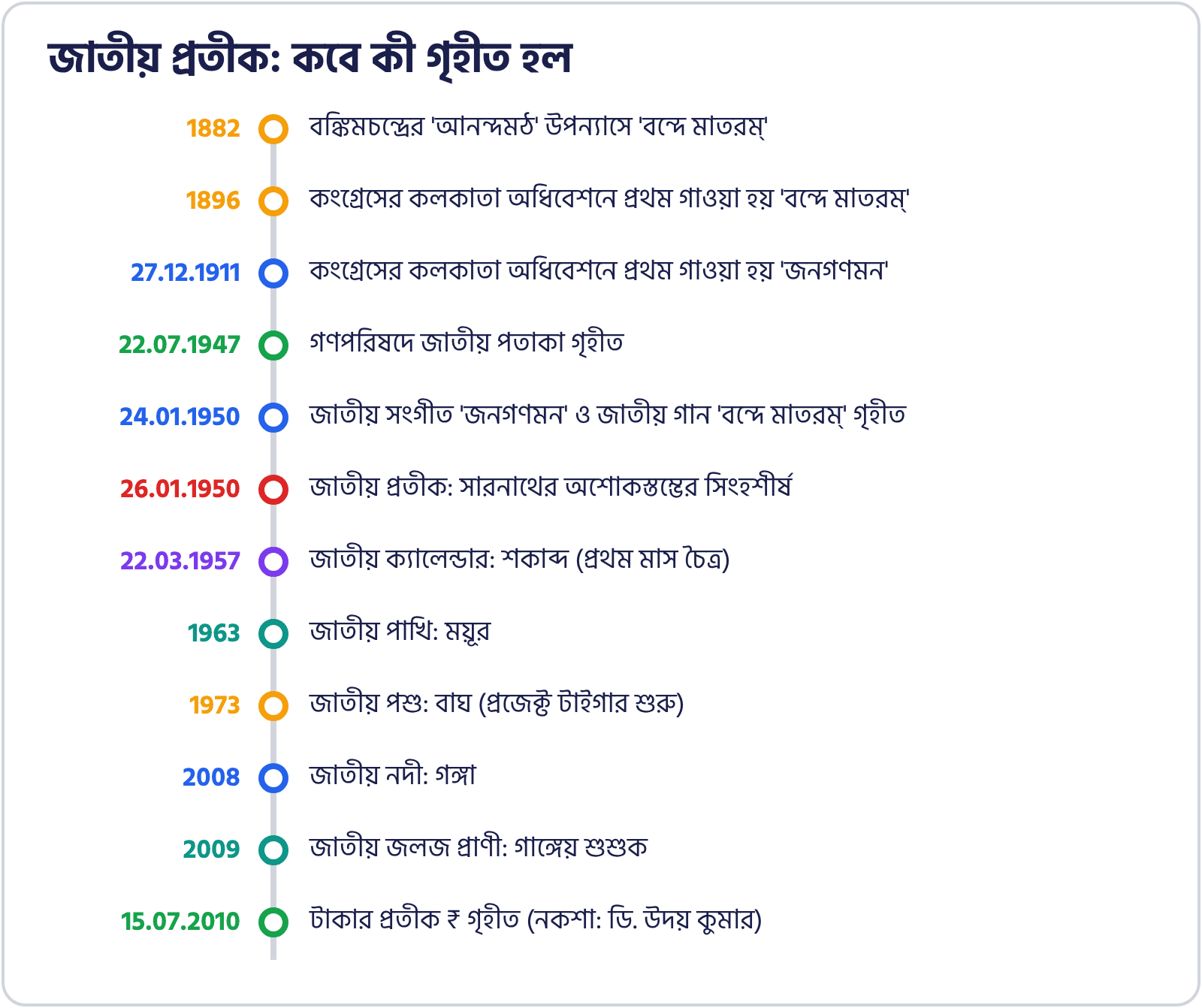
The State Emblem was adopted on 26.01.1950, the day the Constitution came into force. 22.07.1947 is when the National Flag was adopted and 24.01.1950 is when the National Anthem and National Song were adopted, so both are traps.
Key Points
- Three lions are visible, the fourth is hidden behind
- On the abacus: a bull to the right of the wheel, a horse to the left
- 'Satyameva Jayate' is written below
Confusion Points
- 24.01.1950 = anthem and song; 26.01.1950 = emblem
Memory Tips
- Songs first (24th), emblem and Constitution after (26th): January 1950
Additional Information
In which year was 'Jana Gana Mana' first sung?
Explanation
'Jana Gana Mana' was first sung on 27.12.1911 at the Calcutta session of the Indian National Congress. 'Vande Mataram' was the song first sung at the 1896 Calcutta session, and 1950 is the year it was adopted as the National Anthem.
Key Points
- Written by Rabindranath Tagore
- The first stanza of the song 'Bharata Bhagya Vidhata'
- Adopted as the National Anthem on 24.01.1950
Confusion Points
- 1896 = Vande Mataram first sung; 1911 = Jana Gana Mana first sung (both at Calcutta sessions)
Additional Information
In which novel of Bankim Chandra Chattopadhyay does the National Song 'Vande Mataram' appear?
Explanation
'Vande Mataram' appears in Bankim Chandra Chattopadhyay's novel 'Anandamath' (1882). Durgeshnandini, Kapalkundala and Bishabriksha are also Bankim's novels, so knowing the author is not enough: remember the novel.
Key Points
- Adopted as the National Song on 24.01.1950
- It has equal status with Jana Gana Mana
- First sung in 1896 at the Calcutta session of the Congress
Memory Tips
- Ananda-math, a hymn of joy to the motherland: Vande Mataram
Which is the first month of the Saka calendar, India's national calendar?
Explanation
The Saka calendar begins with Chaitra; 1 Chaitra normally falls on 22 March, and on 21 March in a leap year. Many pick Vaishakha because the Bengali year begins with Baishakh, which is the trap. The Saka calendar was adopted as the national calendar on 22.03.1957.
Key Points
- Adopted on 22.03.1957
- Used alongside the Gregorian calendar for official purposes
- 1 Chaitra = 22 March (21 March in a leap year)
Confusion Points
- Bengali year: starts with Baishakh; Saka calendar: starts with Chaitra
Memory Tips
- The Saka year starts in Chaitra, and it was adopted in March too (22.03.1957)
Which is India's National Aquatic Animal?
Explanation
India's National Aquatic Animal is the Ganges river dolphin, declared in 2009. The gharial, the Olive Ridley turtle and the dugong live in Indian waters but are not national symbols.
Key Points
- The Ganges river dolphin is nearly blind and finds its way by echoes
- National river Ganga (2008), national aquatic animal the Ganges dolphin (2009)
- National Heritage Animal: the elephant (2010)
Memory Tips
- The river is the Ganga, and so is the animal: the Ganges dolphin
Additional Information
National Science Day on 28 February commemorates which discovery?
Explanation
On 28 February 1928 C. V. Raman announced the discovery of the Raman effect (the scattering of light); the day is marked as National Science Day. Raman won the 1930 Nobel Prize in Physics for it. The other options are famous events but are not linked to this day.
Key Points
- Raman effect: scattering of light
- Raman won the Nobel Prize in Physics in 1930
- 11 May is National Technology Day (Pokhran, 1998)
Confusion Points
- 28 ফেব্রুয়ারি = জাতীয় বিজ্ঞান দিবস; 11 মে = জাতীয় প্রযুক্তি দিবস
Memory Tips
- The last day of February (28) is Raman's day
National Doctors' Day on 1 July honours which doctor?
Explanation
1 July is both the birthday (1882) and the death anniversary (1962) of Dr Bidhan Chandra Roy, so it is National Doctors' Day. He was the second Chief Minister of West Bengal and received the Bharat Ratna in 1961. The other three are famous Bengali doctors too, but the day is not named after them.
Key Points
- Born 01.07.1882, died 01.07.1962
- Second Chief Minister of West Bengal
- Bharat Ratna in 1961
Memory Tips
- Born and died on the same date: 1 July
0/10


Leave a Comment
Commenting as ·