
Ten TET-style questions on the cell, tissues and the classification of living things, more than half of them classroom situations, each with an explanation.
Cell, Tissue and Classification Quiz: WB TET Upper Primary Science
Quiz challenge
A little practice. A step forward.
10 questions
Learn with explanations
Time per question: 45 sec
0 / 10 completed
--:--
Who first used the name 'cell' in 1665 after examining a thin slice of cork?
Explanation
In 1665 Robert Hooke saw honeycomb-like compartments in cork under his microscope and called them cells; they were the walls of dead cells. Leeuwenhoek was the first to see living cells (1674), Robert Brown discovered the nucleus (1831) and Schleiden was one of the founders of the cell theory.
Key Points
- Hooke, 1665: dead cells in cork, named them cells
- Leeuwenhoek, 1674: first living cells
- Robert Brown, 1831: the nucleus
Confusion Points
- The first cell seen (Hooke) and the first living cell seen (Leeuwenhoek) are different questions
Memory Tips
- Hooke = Hole: the holes in cork
Additional Information
| Scientist | Year | Contribution |
|---|---|---|
| Robert Hooke | 1665 | Named the cell (cork) |
| Leeuwenhoek | 1674 | First living cell |
| Robert Brown | 1831 | Nucleus |
| Schleiden and Schwann | 1838–1839 | Cell theory |
Which of the following is found in a plant cell but not in an animal cell?
Explanation
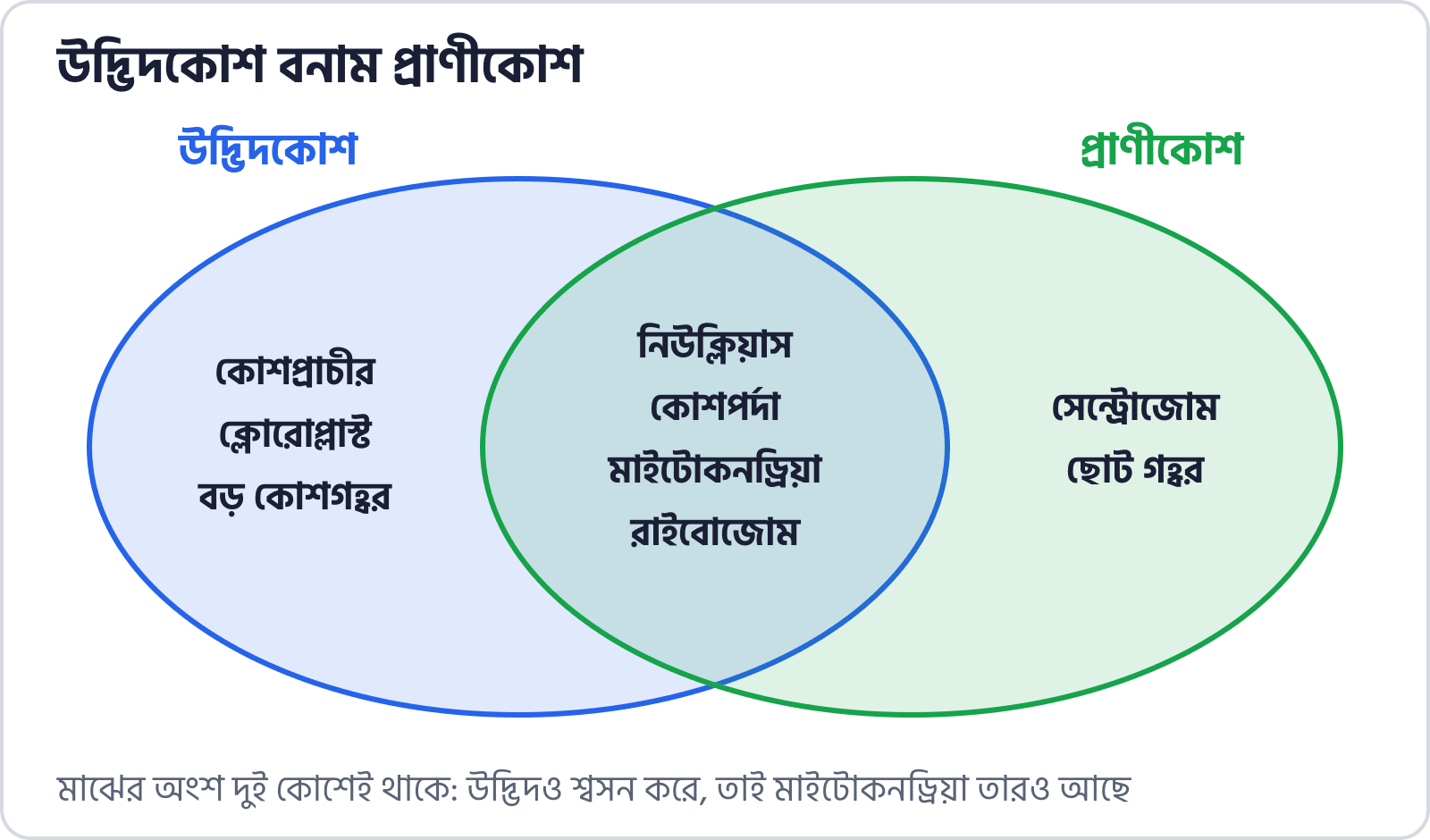
The cellulose cell wall is found only in plant cells and gives them rigidity and a fixed shape. Mitochondria, ribosomes and the cell membrane are present in both plant and animal cells; in an animal cell the membrane is the outer boundary.
Key Points
- Only in plant cells: cell wall, chloroplasts, a large vacuole
- In both: nucleus, cell membrane, mitochondria, ribosomes
- The plant cell wall is made of cellulose
Confusion Points
- Many think mitochondria belong to animal cells only: plants respire too, so plant cells have mitochondria
Memory Tips
- Plants' three extras: Wall, Plastids, a Whopping vacuole
Additional Information
A Class VII student says, 'Plants make their own food, so plant cells have no mitochondria.' What is the most suitable step for the teacher?
Explanation
This is a misconception. In constructivism a concept changes for good when learners see the evidence themselves: plants respire day and night, and the energy of respiration is released in mitochondria. Simply marking it wrong or making them copy a list leaves the misconception in place, and accepting it reinforces the error.
Key Points
- Bring out the misconception first, then change it with evidence
- Plants carry out both photosynthesis (chloroplasts) and respiration (mitochondria)
- Learners comparing for themselves = constructivist teaching
Memory Tips
- The chloroplast cooks the food, the mitochondrion burns it
Additional Information
What is the most effective first activity to begin the chapter on 'the cell' in Class VI?
Explanation
Science teaching starts with observation: when learners see the small compartments (cells) in onion peel themselves, they move from a concrete experience to an abstract idea. Copying a definition, reading aloud or memorising a chart are teacher-centred and do not raise curiosity. This is the inquiry-based, child-centred approach.
Key Points
- From concrete to abstract, from known to unknown
- Onion peel is stained with safranin, cheek cells with methylene blue
- Seeing and drawing for themselves = hands-on learning
A teacher keeps a soft-stemmed seedling in water mixed with red dye for a few hours. When the stem is later cut across, red marks are seen inside. The work of which tissue does this experiment show?
Explanation
Xylem carries water and minerals upward from the root; the dyed water rises along that path and colours the xylem red. Phloem carries the food made in the leaves, not water. Collenchyma gives support and meristematic tissue divides for growth.
Key Points
- Xylem: water and minerals, upward from the root
- Phloem: food, to all parts of the plant
- Xylem and phloem are complex permanent tissues
Confusion Points
- The jobs of xylem and phloem get swapped: water = xylem
Memory Tips
- Phloem and Food both start with an 'f' sound; xylem is the water pipe
Additional Information
| Tissue | Carries | Direction |
|---|---|---|
| Xylem | Water and minerals | Upward from the root |
| Phloem | Food made in the leaves | To all parts |
A student asks, 'Blood is a liquid, so why is it called a tissue?' Which is the teacher's most accurate explanation?
Explanation
A tissue is a group of cells doing one job; whether they sit in a solid or a fluid matrix does not matter. Blood cells lie in a fluid matrix, the plasma, and blood links all parts of the body by transport, so it is a fluid connective tissue. The heart is made of muscle, but blood itself is not muscle.
Key Points
- Connective tissues: blood, bone, cartilage, tendon, ligament
- Plasma = the fluid matrix of blood
- Four kinds of animal tissue: epithelial, connective, muscular, nervous
Confusion Points
- Not counting blood as a tissue because it is liquid is a common misconception
Additional Information
| Animal tissue | Example |
|---|---|
| Epithelial | Outer layer of the skin |
| Connective | Blood, bone, tendon |
| Muscular | Limb muscles, heart muscle |
| Nervous | Brain, nerves |
In Whittaker's five-kingdom classification, in which kingdom is the mushroom placed?
Explanation
A mushroom has no chlorophyll, cannot make its own food, takes food from dead organic matter and has a cell wall of chitin, so it belongs to the kingdom Fungi. The older two-kingdom system put fungi among plants, which is the trap here. Monera holds the prokaryotic bacteria and Protista the unicellular eukaryotes.
Key Points
- Whittaker, 1969: Monera, Protista, Fungi, Plantae, Animalia
- Fungi are saprophytes with a chitin cell wall
- Yeast and bread mould are fungi too
Confusion Points
- Growing from soil does not make a mushroom a plant: it has no chlorophyll
Memory Tips
- Order of the five kingdoms: 'My Pet Fish Plays Ably' (simple to complex)
Additional Information
| Kingdom | Cells | Example |
|---|---|---|
| Monera | Prokaryotic, unicellular | Bacteria |
| Protista | Eukaryotic, unicellular | Amoeba |
| Fungi | Eukaryotic, chitin wall | Mushroom, yeast |
| Plantae | Multicellular, cellulose wall | Mango tree |
| Animalia | Multicellular, no wall | Human |
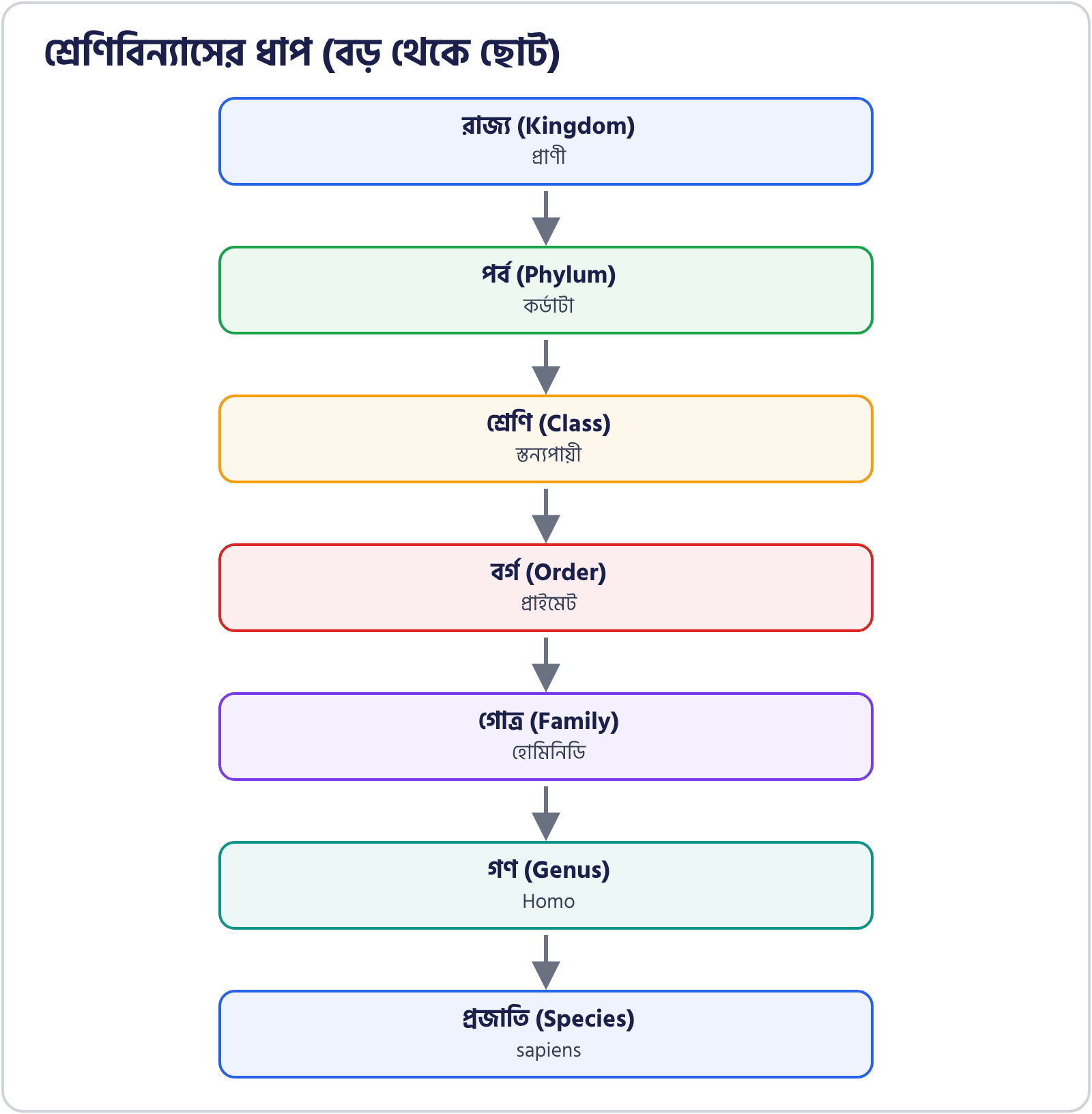
The scientific name of human beings is Homo sapiens. Which statement about binomial nomenclature is correct?
Explanation
In binomial nomenclature the first word is the genus, with a capital first letter; the second is the species, all in small letters. In print the name is in italics; handwritten, each word is underlined separately. Linnaeus introduced this system.
Key Points
- Genus first (capital initial), species second (small letters)
- Italics in print, each word underlined separately by hand
- Mango Mangifera indica, tiger Panthera tigris, rice Oryza sativa
Memory Tips
- Genus big, species small
Additional Information
Which method of teaching 'classification of living things' in Class VIII fits the constructivist approach best?
Explanation
In constructivism learners build knowledge from their own experience and the teacher is a facilitator. Sorting by their own criteria lets learners discover why classification is needed and which features it uses (the inductive path). Memorising and board explanations are teacher-centred, and a test at the start is not a teaching method.
Key Points
- Constructivism: learners build knowledge, the teacher facilitates
- Inductive method: from examples to the general rule
- Sorting activities teach the core idea of classification
Assertion (A): Bacteria are placed in the kingdom Monera. Reason (R): Bacterial cells have no well-formed nucleus enclosed by a membrane. Which option is correct?
Explanation
The kingdom Monera was made for prokaryotes, whose nucleus has no surrounding membrane. Bacteria are exactly such organisms, so both statements are true and R directly explains A. Blue-green algae (cyanobacteria) are in Monera for the same reason.
Key Points
- Prokaryotes: no nuclear membrane, no membrane-bound organelles
- Monera: bacteria and blue-green algae
- Amoeba is eukaryotic, hence in Protista
0/10


Leave a Comment
Commenting as ·