
WBPSC Clerkship 2024 Part-I, General Studies: 20 everyday science questions (round 7).
Everyday Science Mixed Quiz 7: Light, Heat, Metals and Diseases, WBPSC Clerkship GS
Quiz challenge
A little practice. A step forward.
20 questions
Learn with explanations
Time per question: 30 sec
0 / 20 completed
--:--
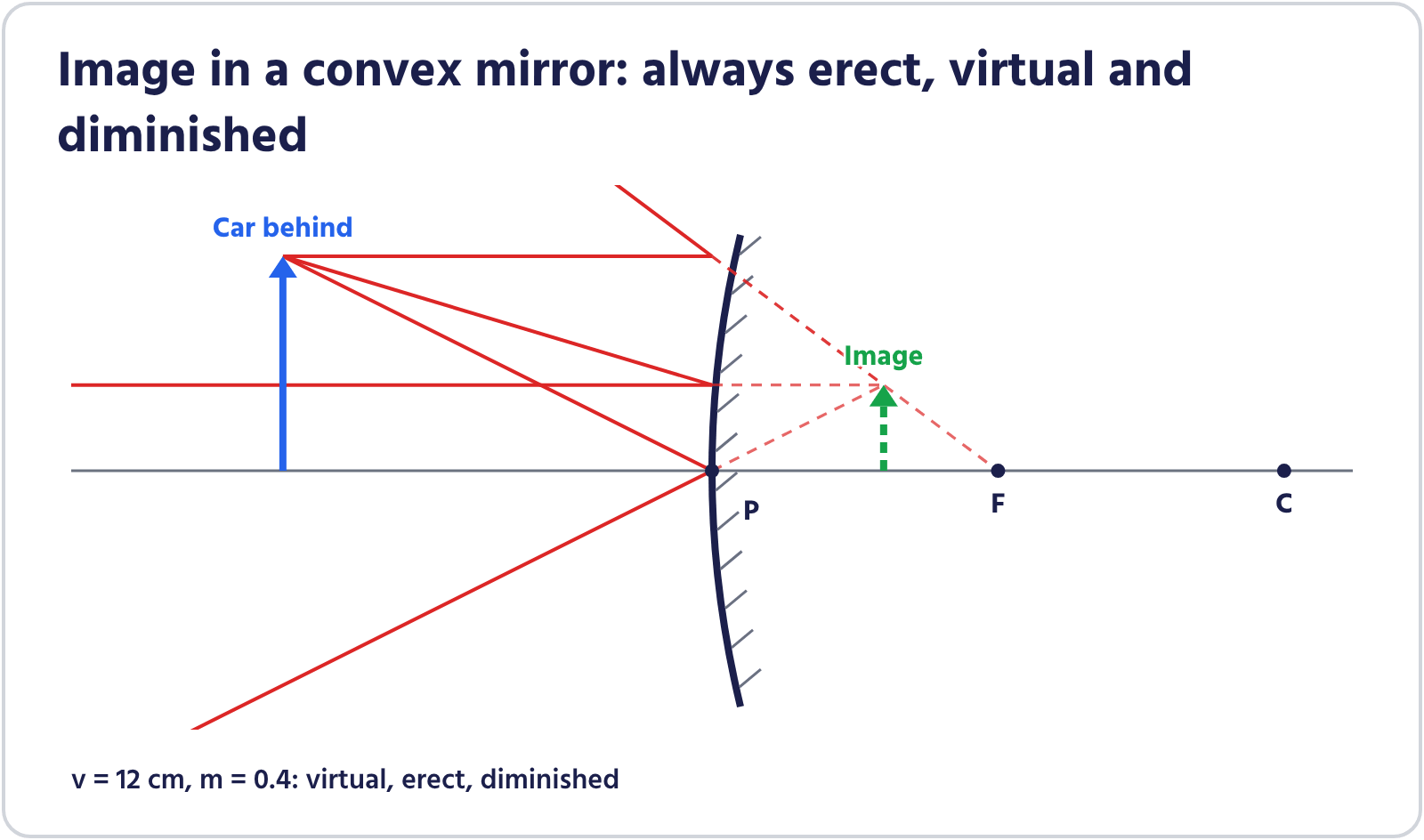
Which mirror is used as the rear-view mirror of a vehicle?
Explanation
A convex mirror always forms an erect, virtual and diminished image, so a small mirror shows a wide area behind. A concave mirror magnifies nearby objects (dentists, shaving mirrors) and a plane mirror has a narrow field of view. A lens refracts light and cannot serve as a mirror.
Key Points
- Convex mirror: wide field of view, small upright image
- Mirrors at sharp road bends are convex too
- Concave mirror: reflector of torches and headlights, dentist's mirror
Confusion Points
- A headlight reflector is concave, but the rear-view mirror is convex
Memory Tips
- Convex bulges out and shows more of what is behind
Additional Information
What is the approximate speed of light in vacuum?
Explanation
Light travels at about $3 \times 10^{8}$ m/s in vacuum, that is about 3 lakh kilometres a second. The figure $3 \times 10^{5}$ is right only in km/s; in m/s it is far too small. 340 m/s is the speed of sound in air. In denser media such as water, glass or diamond light slows down.
Key Points
- $3 \times 10^{8}$ m/s = $3 \times 10^{5}$ km/s
- Sunlight takes about 8 minutes 20 seconds to reach the Earth
- Sound travels at about 340 m/s in air
Confusion Points
- $3 \times 10^{5}$ km/s and $3 \times 10^{8}$ m/s are the same speed; check the unit
Memory Tips
- Light: 3 lakh kilometres every second
Additional Information
Speed of light in different media (approx.)
Vacuum · 3 lakh km/s
Water · 2.25 lakh km/s
Glass · 2 lakh km/s
Diamond · 1.24 lakh km/s
What is absolute zero (0 K) on the Celsius scale, approximately?
Explanation
Zero on the Kelvin scale, absolute zero, is about −273°C (exactly −273.15°C); no temperature can be lower. To go from kelvin to Celsius subtract 273, and add 273 to go the other way. 0°C is the freezing point of water, which is 273 K.
Key Points
- K = °C + 273
- Water freezes at 0°C = 273 K and boils at 100°C = 373 K
- The SI unit of temperature is the kelvin (K)
Memory Tips
- Add 273 to reach kelvin, subtract 273 to return to Celsius
Additional Information
| State | Celsius | Fahrenheit | Kelvin |
|---|---|---|---|
| Absolute zero | −273°C | about −460°F | 0 K |
| Water freezes | 0°C | 32°F | 273 K |
| Human body | 37°C | 98.6°F | 310 K |
| Water boils | 100°C | 212°F | 373 K |
Which instrument measures very high temperatures, such as those of a furnace or molten metal?
Explanation
A pyrometer measures very high temperatures from a distance by the radiation a hot body gives off, so nothing has to be placed in the furnace or the molten metal. A calorimeter measures a quantity of heat, not temperature. A lactometer tests the purity of milk and a barometer measures air pressure.
Key Points
- 'Pyro' means fire
- The mercury of an ordinary thermometer boils near 357°C, so it cannot be used in a furnace
- Heat (quantity) is measured by a calorimeter, temperature by a thermometer
Confusion Points
- A calorimeter measures heat, not temperature
Memory Tips
- Pyro = fire: a pyrometer reads the temperature of fire
Additional Information
| Instrument | What it measures |
|---|---|
| Pyrometer | Very high temperatures (furnaces, molten metal) |
| Calorimeter | Quantity of heat |
| Hygrometer | Relative humidity of the air |
| Hydrometer | Specific gravity (density) of liquids |
| Ammeter | Electric current (ampere) |
| Voltmeter | Potential difference (volt) |
| Seismograph | Earthquake waves |
Which instrument measures the electric current in a circuit?
Explanation
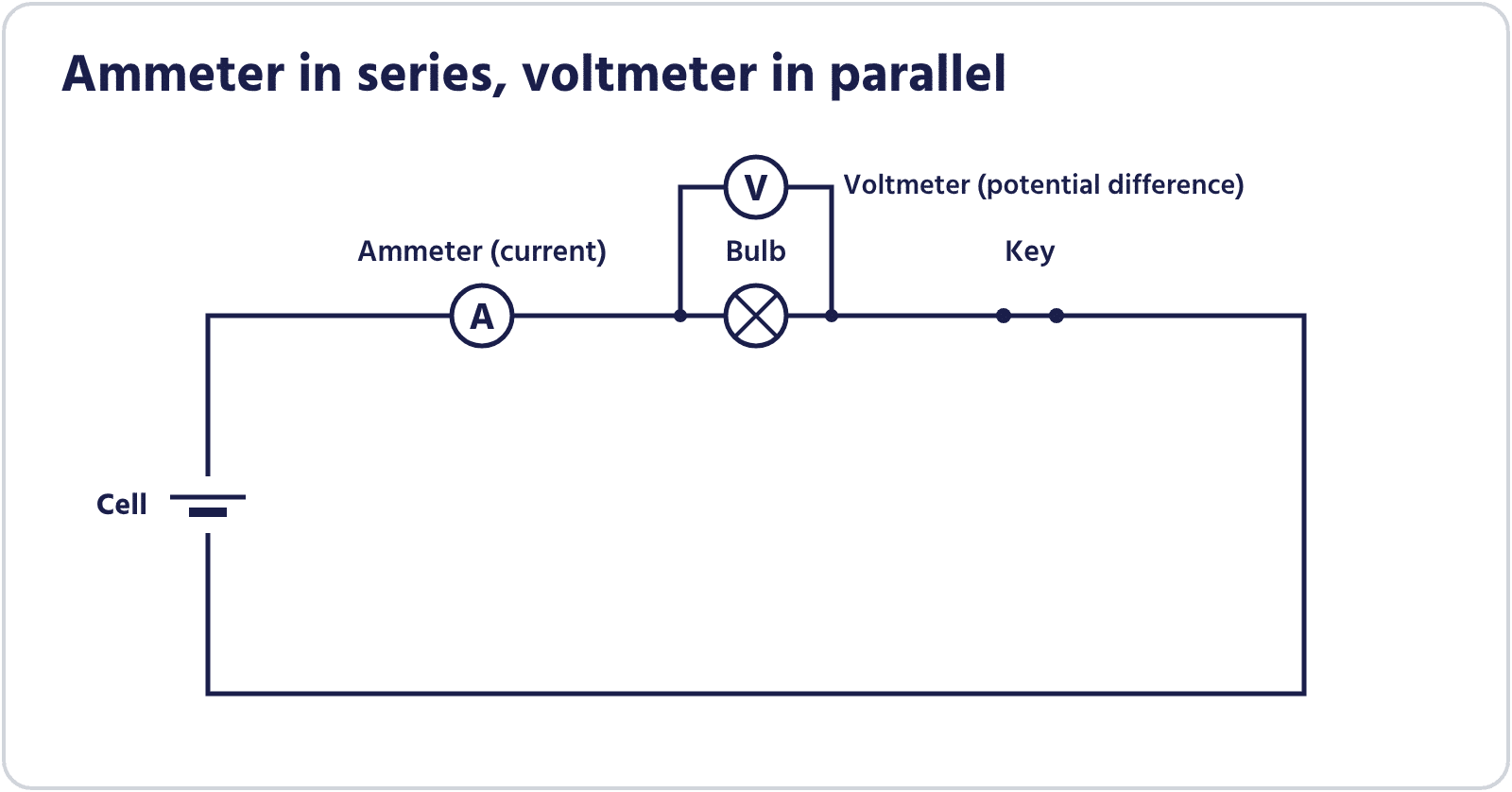
An ammeter measures current in amperes and is connected in series, so that the whole current flows through it. A voltmeter measures the potential difference between two points and is connected in parallel. A wattmeter measures power and a speedometer the speed of a vehicle.
Key Points
- The SI unit of current is the ampere (A)
- An ammeter has very low resistance, a voltmeter very high
- Ammeter: series; voltmeter: parallel
Memory Tips
- Amperes by the ammeter, volts by the voltmeter
Additional Information
The heating coil of an electric heater or iron is usually made of which metal or alloy?
Explanation
Nichrome is an alloy of nickel and chromium. Its high resistance turns current into plenty of heat, and it does not oxidise easily even when red-hot in air. Copper and aluminium have low resistance, so they carry electricity rather than make heat. Tungsten oxidises when heated in open air, so it is used inside a bulb.
Key Points
- Nichrome = nickel + chromium (with iron)
- High resistance and a high melting point: the two needs of a heating coil
- Nichrome in heaters, irons, geysers and toasters
Confusion Points
- A bulb filament is tungsten, but a heater coil is nichrome
Memory Tips
- Heater = nichrome, bulb = tungsten
Additional Information
| Material | Property | Used in |
|---|---|---|
| Tungsten | Very high melting point (about 3422°C) | Filament of a bulb |
| Nichrome | High resistance, does not oxidise even when red-hot | Coils of heaters, irons, geysers |
| Copper | Very low resistance | Wires that carry electricity |
| Tin-lead alloy | Low melting point | Fuse wire |
The filament of an ordinary electric (filament) bulb is made of which metal?
Explanation
Tungsten has a very high melting point, about 3422°C, so it does not melt even when it glows white-hot. To stop it oxidising, the air is removed from the bulb and an inert gas is filled in. Nichrome is used in heater coils; copper and iron cannot stand such high temperatures.
Key Points
- Tungsten has the highest melting point of all metals
- Most of a filament bulb's energy is lost as heat, which is why LEDs save power
Memory Tips
- Tungsten takes the heat: bulbs glow on tungsten
Additional Information
| Material | Property | Used in |
|---|---|---|
| Tungsten | Very high melting point (about 3422°C) | Filament of a bulb |
| Nichrome | High resistance, does not oxidise even when red-hot | Coils of heaters, irons, geysers |
| Copper | Very low resistance | Wires that carry electricity |
| Tin-lead alloy | Low melting point | Fuse wire |
A diamond sparkles mainly because of which phenomenon of light?
Explanation
Diamond has a very high refractive index (about 2.42), so its critical angle is very small, about 24°. Light entering a diamond is trapped by repeated total internal reflection and leaves strongly through a few faces, which makes it sparkle. Dispersion splits white light into seven colours (a prism) and scattering makes the sky blue.
Key Points
- Total internal reflection needs light going from a denser to a rarer medium at an angle larger than the critical angle
- Other examples: mirage, optical fibre
- The critical angle of diamond is about 24°
Confusion Points
- A prism splits colours by dispersion, but a diamond's sparkle is mainly total internal reflection
Memory Tips
- Diamond, mirage, optical fibre: all three are total internal reflection
Additional Information
Speed of light in different media (approx.)
Vacuum · 3 lakh km/s
Water · 2.25 lakh km/s
Glass · 2 lakh km/s
Diamond · 1.24 lakh km/s
What is sound of frequency above 20,000 Hz, which humans cannot hear, called?
Explanation
Humans hear sounds from about 20 Hz to 20,000 Hz. Sound above that range is ultrasonic: bats and dolphins use it, and doctors use it in ultrasonography. Sound below 20 Hz is infrasonic. Supersonic is about speed, not frequency: moving faster than sound.
Key Points
- Audible range: 20 Hz to 20,000 Hz
- Bats find their way by the echoes of ultrasonic waves
- The SI unit of frequency is the hertz (Hz)
Confusion Points
- Supersonic (speed) and ultrasonic (frequency) are different things
Memory Tips
- Ultra = beyond (above 20,000), infra = below (under 20)
Additional Information
| Type | Frequency | Examples |
|---|---|---|
| Infrasonic | Below 20 Hz | Earthquakes, elephant calls |
| Audible sound | 20 Hz to 20,000 Hz | Speech, music |
| Ultrasonic | Above 20,000 Hz | Bats, dolphins, ultrasonography |
Which acid is present in vinegar?
Explanation
Vinegar is a dilute solution of acetic acid in water (usually about 5 to 8 per cent), which is why it is used in pickles and to preserve food. Citric acid is found in lemons, lactic acid in curd and sour milk, and tartaric acid in tamarind.
Key Points
- Vinegar = dilute acetic acid
- The formula of acetic acid is $CH_{3}COOH$
- Food acids are organic (weak) acids
Memory Tips
- Vinegar-acetic, lemon-citric, curd-lactic, tamarind-tartaric
Additional Information
| Food | Acid |
|---|---|
| Vinegar | Acetic |
| Lemon, orange | Citric |
| Curd, sour milk | Lactic |
| Tamarind, grapes | Tartaric |
| Apple | Malic |
| Tomato | Oxalic |
Which gas is burnt with oxygen to weld and cut metals?
Explanation
Acetylene ($C_{2}H_{2}$) burnt with oxygen gives the oxy-acetylene flame, hotter than 3,000°C, which melts iron and so welds and cuts metal. Methane (the main part of CNG) and butane (the main part of LPG) are fuels for cooking and vehicles. Nitrogen does not burn at all.
Key Points
- Oxy-acetylene flame: welding and cutting metal
- Acetylene is also called ethyne
- The main constituent of LPG is butane
Memory Tips
- Welding fire = oxy + acetylene
What is 'dry ice'?
Explanation
Dry ice is solid carbon dioxide. At about −78.5°C it turns straight into gas without becoming liquid (sublimation), so it leaves nothing wet behind, hence 'dry'. It keeps food and medicines cold and makes the fog effect on stage.
Key Points
- Solid straight to gas: sublimation
- Dry ice is at about −78.5°C
- Camphor and naphthalene also sublime
Memory Tips
- Dry ice does not melt, it vanishes into gas
In galvanisation, iron is coated with which metal to stop rusting?
Explanation
Galvanisation is coating iron or steel with zinc. Zinc is more reactive than iron, so even if the coating is scratched the zinc corrodes first and the iron is saved. A coat of tin is called tinning (food cans), and coats of chromium or nickel are electroplating.
Key Points
- Galvanised iron: corrugated roofing sheets, water pipes
- Other ways to stop rust: paint, oil and grease, chromium plating
Confusion Points
- Corrugated 'tin' roof sheets are really zinc-coated iron; tinning is for food cans
Memory Tips
- Galvanised = zinc-coated; tinned = tin-coated
Brass is an alloy of which two metals?
Explanation
Brass is an alloy of copper and zinc. Copper and tin make bronze, iron and carbon make steel, and aluminium with copper (and a little magnesium and manganese) makes duralumin, used in aircraft.
Key Points
- Brass = copper + zinc
- Bronze = copper + tin
- Stainless steel = iron + chromium + nickel (+ carbon)
Confusion Points
- Mixing up brass (copper + zinc) and bronze (copper + tin) is the commonest mistake
Memory Tips
- Learn them in pairs: brass-zinc, bronze-tin
Additional Information
| Alloy | Made of | Used for |
|---|---|---|
| Brass | Copper + zinc | Utensils, tap fittings |
| Bronze | Copper + tin | Statues, bells, medals |
| Stainless steel | Iron + chromium + nickel | Cooking vessels |
| Solder | Tin + lead | Soldering wire |
| Duralumin | Aluminium + copper | Aircraft frames |
What is the 'lead' of a pencil actually made of?
Explanation
A pencil 'lead' is a mixture of graphite and clay; it contains no lead at all, the name comes from an old mistaken belief. Graphite is a form of carbon whose layers slide easily, so it leaves a mark on paper. Diamond is also a form of carbon, but the hardest.
Key Points
- Graphite is soft, slippery and conducts electricity
- Diamond and graphite are both allotropes of carbon
- Graphite is also used as a lubricant and as electrodes
Confusion Points
- Despite the name, a lead pencil contains no lead
Memory Tips
- A 'lead' pencil has no lead, only graphite
Additional Information
| Property | Diamond | Graphite |
|---|---|---|
| Hardness | Hardest natural substance | Soft, slippery |
| Conducts electricity | No | Yes |
| Uses | Jewellery, cutting glass | Pencil leads, electrodes, lubricant |
Dengue is spread by the bite of which mosquito?
Explanation
Dengue is a viral disease spread by the bite of the Aedes mosquito (mainly Aedes aegypti). It lays eggs in standing clean water and bites by day, so water must not collect in pots, tyres or vases. The female Anopheles spreads malaria, while Culex and Mansonia spread filaria (elephantiasis).
Key Points
- Aedes: dengue, chikungunya, Zika, yellow fever
- Aedes has black-and-white stripes and bites by day
- Dengue is caused by a virus, malaria by a protozoan
Memory Tips
- Aedes bites by day and brings dengue; Anopheles bites at night and brings malaria
Additional Information
| Mosquito | Disease it spreads |
|---|---|
| Female Anopheles | Malaria |
| Aedes | Dengue, chikungunya, Zika, yellow fever |
| Culex | Filaria, Japanese encephalitis |
| Mansonia | Filaria |
The BCG vaccine protects against which disease?
Explanation
The BCG (Bacillus Calmette-Guérin) vaccine protects against tuberculosis and is given in India soon after birth. TB is a bacterial disease, mainly of the lungs. Polio is prevented by the polio vaccine (OPV/IPV), measles by MR and tetanus by DPT or TT.
Key Points
- The TB germ: Mycobacterium tuberculosis
- BCG is given at birth
- DPT: diphtheria, whooping cough (pertussis), tetanus
Memory Tips
- BCG = Baby's first vaccine, against TB
Additional Information
| Vaccine | Protects against |
|---|---|
| BCG | Tuberculosis |
| OPV / IPV | Polio |
| MR | Measles and rubella |
| DPT | Diphtheria, whooping cough, tetanus |
Which is the largest organ of the human body?
Explanation
The skin is the largest organ of the human body: it covers the whole body, keeps germs out, controls body temperature through sweat and makes vitamin D in sunlight. The liver is the largest internal organ and the largest gland, but not the largest organ of the body.
Key Points
- Largest organ: skin
- Largest gland and largest internal organ: liver
- The sweat glands of the skin cool the body
Confusion Points
- The largest gland is the liver, but the largest organ is the skin
Memory Tips
- Organ: skin; gland: liver
Where is the image of an object formed in the human eye?
Explanation
The eye lens focuses light to form an image on the retina, the light-sensitive screen at the back of the eye; that image is real and inverted. The rods and cones of the retina turn light into signals that the optic nerve carries to the brain, which reads the picture upright. Light first enters through the cornea, and the iris changes the size of the pupil.
Key Points
- The image on the retina is real, inverted and diminished
- Rods: vision in dim light; cones: colour vision
- The eye lens is a convex lens
Confusion Points
- The lens focuses light, but the image falls on the retina
Memory Tips
- Retina = the film (screen) of the eye's camera
Additional Information
| Part | Job |
|---|---|
| Cornea | Clear front cover, light enters first |
| Iris | Colour of the eye, changes the pupil's size |
| Lens | Focuses light |
| Retina | Forms the image, rods and cones |
| Optic nerve | Carries signals to the brain |
Which instrument measures the relative humidity of the air?
Explanation
A hygrometer measures the amount of water vapour in the air, that is the relative humidity, and weather offices use it. Though the name looks alike, a hydrometer measures the specific gravity (density) of liquids. A thermometer measures temperature and an altimeter height.
Key Points
- 'Hygro' means moisture
- In high humidity sweat does not dry, so we feel hotter
- An altimeter shows an aircraft's height
Confusion Points
- Hygrometer (humidity) and hydrometer (liquid density) are easily confused
Memory Tips
- Hydro = water or liquid (as in hydrant); hygro = moisture in the air
Additional Information
| Instrument | What it measures |
|---|---|
| Pyrometer | Very high temperatures (furnaces, molten metal) |
| Calorimeter | Quantity of heat |
| Hygrometer | Relative humidity of the air |
| Hydrometer | Specific gravity (density) of liquids |
| Ammeter | Electric current (ampere) |
| Voltmeter | Potential difference (volt) |
| Seismograph | Earthquake waves |
0/20


Leave a Comment
Commenting as ·