
10 WBPSC Clerkship 2024 Part-I level questions on the Constituent Assembly, the structure of the Constitution, the Preamble, borrowed features, Fundamental Rights and Duties.
Basic Facts of the Indian Constitution Quiz: Clerkship GS Revision
Quiz challenge
A little practice. A step forward.
10 questions
Learn with explanations
Time per question: 30 sec
0 / 10 completed
--:--
When did the Constituent Assembly of India hold its first session?
Explanation
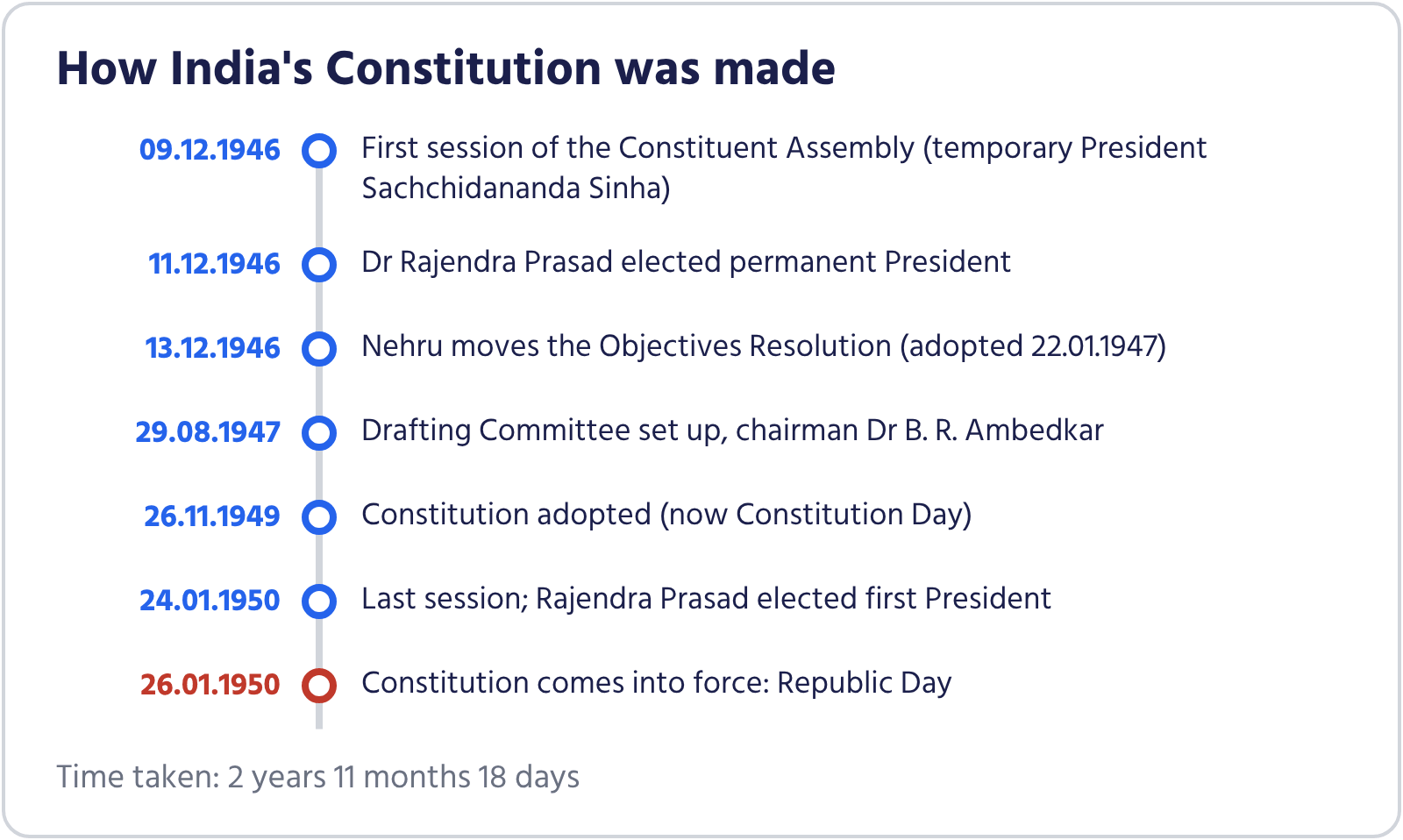
The Constituent Assembly first met on 9 December 1946, with Dr Sachchidananda Sinha as temporary President. 26 November 1949 is when the Constitution was adopted, 26 January 1950 when it came into force, and 15 August 1947 is Independence Day.
Key Points
- The Assembly was formed under the Cabinet Mission Plan (1946)
- It had 389 seats at first, 299 after Partition
- Making the Constitution took 2 years 11 months 18 days
Memory Tips
- December 1946: 9 first session, 11 permanent President, 13 Objectives Resolution
Additional Information
Who was the permanent President of the Constituent Assembly?
Explanation
Dr Rajendra Prasad was elected permanent President of the Constituent Assembly on 11 December 1946 and later became India's first President. Dr Sachchidananda Sinha was the temporary President, Ambedkar chaired the Drafting Committee and Nehru moved the Objectives Resolution.
Key Points
- Temporary President: Sachchidananda Sinha (the oldest member)
- Permanent President: Rajendra Prasad, 11.12.1946
- 24.01.1950: Rajendra Prasad elected first President of India
Confusion Points
- Temporary President = Sachchidananda Sinha; permanent President = Rajendra Prasad
Additional Information
Who chaired the Drafting Committee of the Constitution?
Explanation
Dr B. R. Ambedkar chaired the Drafting Committee set up on 29 August 1947, which is why he is called the chief architect of the Constitution. B. N. Rau was the constitutional adviser (not a member), K. M. Munshi was a member of the committee and Rajendra Prasad presided over the Constituent Assembly.
Key Points
- Drafting Committee set up: 29.08.1947
- Constitutional adviser: B. N. Rau, who prepared the first draft
Confusion Points
- President of the Assembly (Rajendra Prasad) and chairman of the Drafting Committee (Ambedkar) are different posts
On which date did the Constitution of India come into force?
Explanation
The Constitution came into force on 26 January 1950, which is why that day is Republic Day. The date recalls Purna Swaraj Day of 26.01.1930. The Constitution was adopted on 26 November 1949, and 24 January 1950 was the Assembly's last session.
Key Points
- Adopted: 26.11.1949
- Came into force: 26.01.1950 (Republic Day)
- Some provisions, such as citizenship and elections, applied from 26.11.1949
Confusion Points
- Adopted = 26 November 1949; came into force = 26 January 1950
Additional Information
On which day is Constitution Day observed in India?
Explanation
The Constituent Assembly adopted the Constitution on 26 November 1949, and since 2015 that day is observed as Constitution Day (earlier it was marked as National Law Day). 26 January is Republic Day and 9 December the day of the Assembly's first session.
Key Points
- Constitution Day: 26 November (since 2015)
- Republic Day: 26 January
Memory Tips
- November: adopted; January: in force
How many Schedules did the original Constitution have when it came into force in 1950?
Explanation
The original Constitution had 395 Articles, 22 Parts and 8 Schedules. The Ninth (1951), Tenth (1985), Eleventh and Twelfth (1992) Schedules were added later, so there are 12 now. 22 is the number of Parts in the original Constitution, not Schedules.
Key Points
- Original Constitution: 395 Articles, 22 Parts, 8 Schedules
- There are 12 Schedules now
Confusion Points
- 'Original Constitution' means 8; 'at present' means 12
Memory Tips
- Remember 395-22-8 in one breath
Additional Information
| Schedule | Added | Subject |
|---|---|---|
| Ninth | 1951 (1st Amendment) | Land reform laws |
| Tenth | 1985 (52nd Amendment) | Anti-defection law |
| Eleventh | 1992 (73rd Amendment) | Panchayats |
| Twelfth | 1992 (74th Amendment) | Municipalities |
From which country's constitution were the Directive Principles of State Policy taken?
Explanation
The Directive Principles (Part IV, Articles 36–51) were taken from the Irish constitution. Fundamental Rights came from the United States, a federation with a strong centre from Canada and the parliamentary system from Britain.
Key Points
- Directive Principles cannot be enforced in court
- The method of electing the President also comes from Ireland
Confusion Points
- Fundamental Rights from the USA, Directive Principles from Ireland: the two are often mixed up
Additional Information
| Country | Borrowed feature |
|---|---|
| Britain | Parliamentary system, single citizenship, rule of law |
| USA | Fundamental Rights, judicial review |
| Ireland | Directive Principles |
| Canada | Federation with a strong centre |
| Australia | Concurrent List |
| Soviet Union | Fundamental Duties |
Which Amendment added the words 'Socialist' and 'Secular' to the Preamble?
Explanation
The 42nd Amendment of 1976 added 'Socialist', 'Secular' and 'Integrity' to the Preamble, the only time the Preamble has been amended. The 44th (1978) removed the right to property from the Fundamental Rights, the 86th (2002) brought the right to education and the 73rd (1992) dealt with panchayats.
Key Points
- The Preamble begins 'We, the people of India'
- Sovereign, Socialist, Secular, Democratic Republic
- The same 42nd Amendment added the Fundamental Duties
Memory Tips
- 42 = the 'mini-Constitution': three words in the Preamble and the Fundamental Duties
Which Article did Dr B. R. Ambedkar call 'the heart and soul of the Constitution'?
Explanation
Article 32, the right to constitutional remedies: the right to go straight to the Supreme Court when a Fundamental Right is violated. Without it the other rights could not be enforced, which is why Ambedkar called it the heart and soul. Article 21 is life and personal liberty, 14 equality before law and 356 President's rule.
Key Points
- Fundamental Rights: Part III, Articles 12–35
- There are 6 Fundamental Rights now
- Under Article 32 the Supreme Court can issue writs
Which Article of the Constitution contains the Fundamental Duties?
Explanation
The Fundamental Duties are in Article 51A of Part IVA: the 42nd Amendment (1976) added 10 duties on the Swaran Singh Committee's advice, and the 86th Amendment (2002) the 11th. Article 21A is the right to education, 32 constitutional remedies and 368 the procedure for amending the Constitution.
Key Points
- The original Constitution had no Fundamental Duties
- The idea comes from the Soviet constitution
- There are 11 Fundamental Duties now
Confusion Points
- 51A is the Fundamental Duties, 21A the right to education: both are linked to the 86th Amendment, so they get mixed up
0/10
📊 Topic Analysis
About this quiz
More for Clerkship 2024

Everyday Science Mixed Quiz 7: Light, Heat, Metals and Diseases, WBPSC Clerkship GS

Average Practice Quiz Part 2: WBPSC Clerkship 2024

Independence and Partition Quiz: Clerkship 2024 GS

Leave a Comment
Commenting as ·