
Percentage and Profit-Loss Mixed Sums Quiz: Clerkship 2024
A little practice. A step forward.
12 sums on mark-up and discount, false weights, chains of sales, CP of x = SP of y and price versus consumption, each solved step by step. 📖 Read the detailed topic
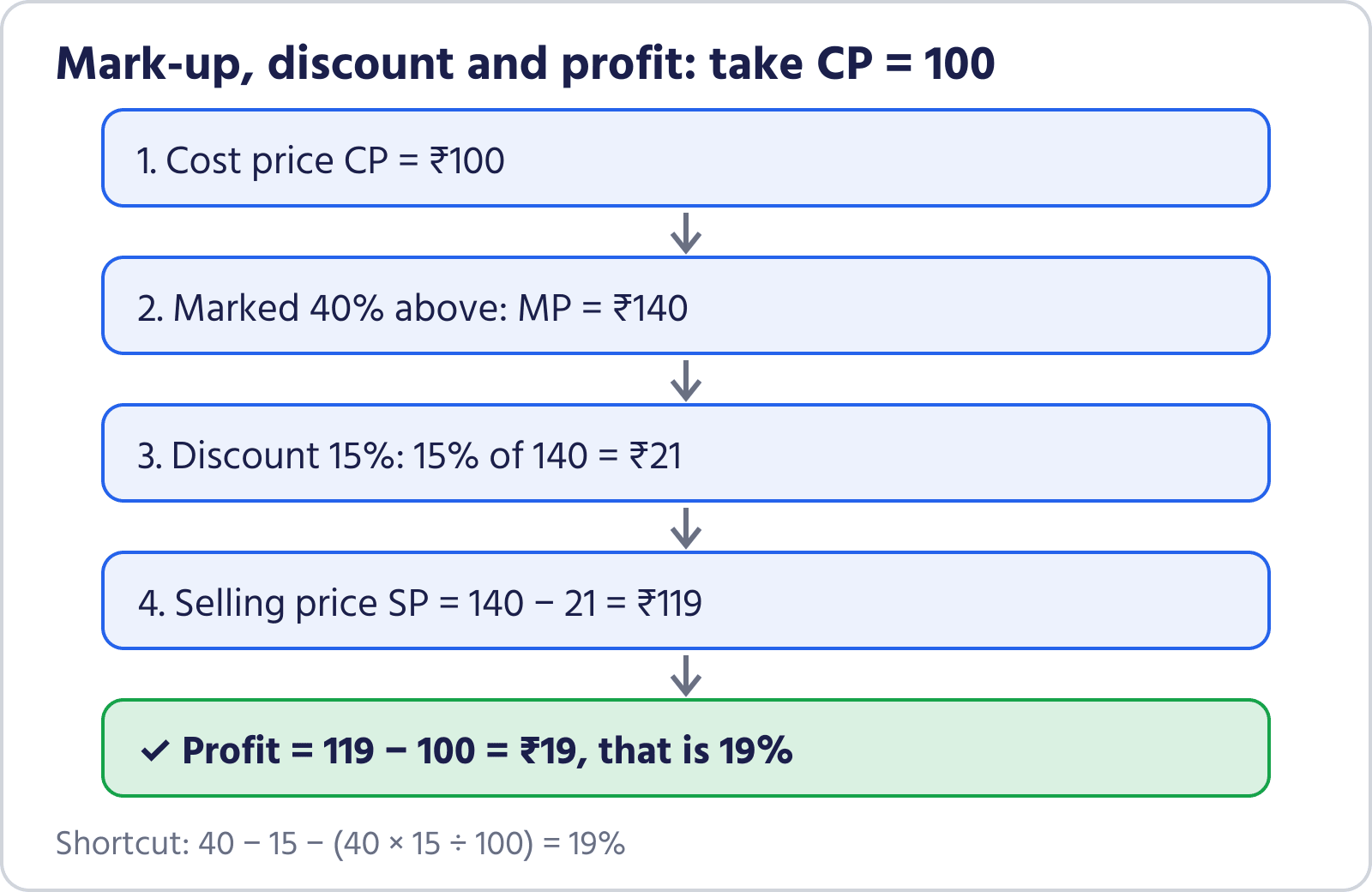
An article is marked 25% above its cost price. If it is sold at a discount of 10%, what is the profit percent?
Take CP = 100: the marked price is 125, and a 10% discount gives SP = 125 − 12.5 = 112.5, so the profit is 12.5%. Shortcut: $25 - 10 - \frac{25 \times 10}{100} = 12.5$. The 15% comes from 25 − 10, forgetting that the discount is on the marked price.
- Discount is on the marked price, profit on the cost price
- Net profit% = $x - y - \frac{xy}{100}$
- 25% − 10% is not 15%: the discount's base is 125, not 100
- Taking CP = 100 turns every percentage into rupees
A shopkeeper marks an article 50% above its cost price and sells it for ₹960 after a 20% discount. What is its cost price?
Marked price = $960 \div 0.8$ = ₹1,200, and the marked price is 150% of CP, so CP = $1200 \div 1.5$ = ₹800. Check: 150% of 800 is 1200, and 80% of that is 960. ₹768 comes from taking 80% of 960, working the wrong way round.
- SP = CP × 1.5 × 0.8 = CP × 1.2
- The net profit here is 20%, so CP = 960 ÷ 1.2
- Going backwards means dividing, not multiplying
In one line: $CP = \frac{960}{1.5 \times 0.8} = \frac{960}{1.2} = 800$
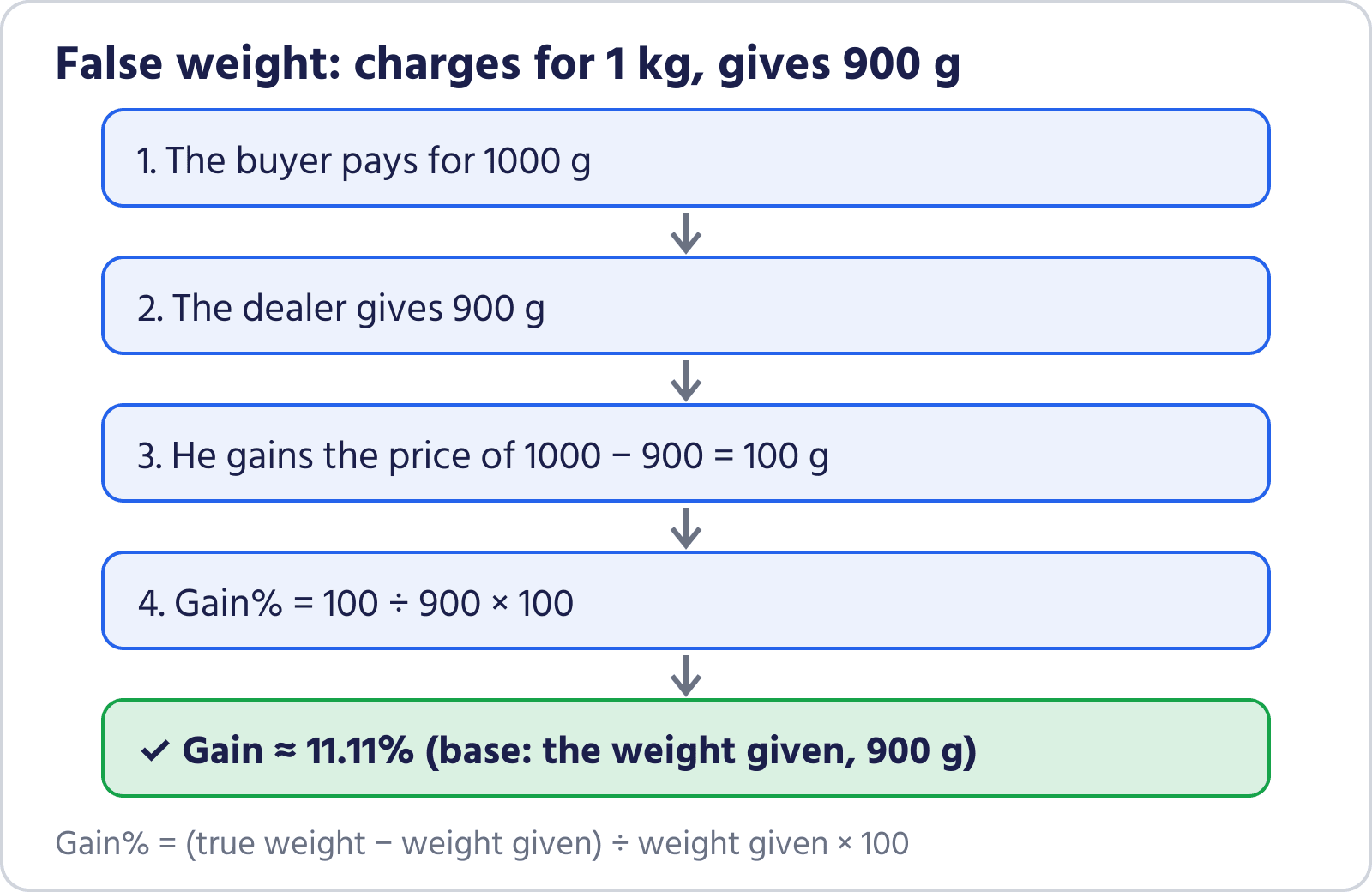
A dealer sells at cost price but uses a weight of 800 g for 1 kg. What is his gain percent?
He charges for 1000 g and gives 800 g, so he gains the price of 200 g on a cost of 800 g. Gain% = $\frac{200}{800} \times 100 = 25$%. 20% comes from dividing by 1000, but what he spent was the price of 800 g.
- With a false weight, gain% = $\frac{\text{true} - \text{given}}{\text{given}} \times 100$
- The base is the weight given, not the true weight
- 200 ÷ 1000 = 20% is wrong: divide by 800
- Divide by what is given
A shopkeeper sells at a loss of 4% but gives 840 g for 1 kg. What is his actual gain or loss?
Take the CP of 1 g as ₹1. The price of 1 kg is ₹1,000; at a 4% loss he takes ₹960 and gives 840 g, which cost ₹840. Gain ₹120, gain% = $\frac{120}{840} \times 100 = 14\frac{2}{7}$%. 16% comes from subtracting 4% from the 160 g shortfall, which is the wrong method.
- Write the money taken and the cost of the goods given separately
- Gain% = $\frac{960 - 840}{840} \times 100$
- Two sides: what came in, what it cost
| ₹ | |
|---|---|
| The buyer pays (96% of 1 kg) | ₹960 |
| Cost of the 840 g given | ₹840 |
| Gain | ₹120 |
A sells an article to B at a profit of 25%, and B sells it to C at a loss of 20%. C pays ₹1,500. What was A's cost price?
Final price = A's CP × 1.25 × 0.8 = A's CP × 1, so A's CP is ₹1,500. The 25% profit and the 20% loss cancel, because 1.25 × 0.8 = 1. Adding the percentages to get a 5% profit gives a wrong answer.
- In a chain of sales the multipliers multiply
- A loss multiplier is $1 - \frac{r}{100}$
- 25% − 20% is not a 5% profit: multiplied, there is neither profit nor loss
- 1.25 × 0.8 = 1: remember this pair
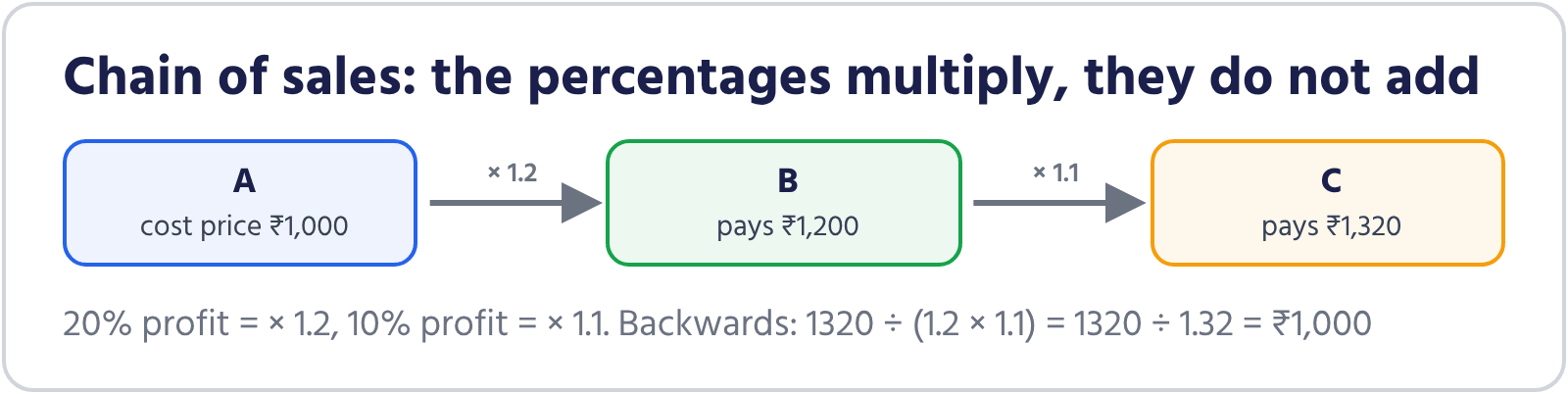
A sells an article to B at a profit of 10%, and B sells it to C at a profit of 20%. C pays ₹3,960. What was A's cost price?
Final price = CP × 1.1 × 1.2 = CP × 1.32, so CP = $3960 \div 1.32$ = ₹3,000. Check: 110% of 3000 is 3300, and 120% of that is 3960. Adding 10% and 20% to get 30% and dividing 3960 by 1.3 does not work out.
- Successive profits of 10% and 20% make 32% in all
- Total percent = $a + b + \frac{ab}{100}$
- Check by multiplying forwards
The cost price of 20 articles equals the selling price of 16 articles. What is the profit percent?
Take the CP of each as ₹1: 20 articles cost ₹20, which is the SP of 16. The CP of 16 is ₹16, so the profit is ₹4 and profit% = $\frac{4}{16} \times 100 = 25$%. 20% comes from dividing by 20, but the divisor is the 16 sold.
- Profit% = $\frac{x - y}{y} \times 100$
- x = number bought, y = number sold
- 4 ÷ 20 = 20% is wrong: divide by 16
- Divide by the number sold
The cost price of 12 articles equals the selling price of 15 articles. What is the gain or loss percent?
Take the CP of each as ₹1: 12 articles cost ₹12, which is the SP of 15. The CP of 15 is ₹15, so the loss is ₹3 and loss% = $\frac{3}{15} \times 100 = 20$%. Selling more articles for less money is a loss. 25% comes from dividing by 12.
- If x is less than y, it is a loss
- Loss% = $\frac{y - x}{y} \times 100$
- 3 ÷ 12 = 25% is wrong: divide by the 15 sold
- Giving more for less is a loss
| CP of x = SP of y | Result |
|---|---|
| 15 = 12 | 25% gain |
| 20 = 16 | 25% gain |
| 12 = 15 | 20% loss |
| 10 = 8 | 25% gain |
Always divide by the number sold
By selling an article for ₹1,120 a man loses 20%. At what price should he sell it to gain 10%?
CP = $1120 \times \frac{100}{80}$ = ₹1,400, and at a 10% gain SP = 110% of 1400 = ₹1,540. Directly by ratio: $1120 \times \frac{110}{80} = 1540$. ₹1,456 comes from adding 30% to 1120, the wrong base.
- $\frac{SP_1}{SP_2} = \frac{100 - 20}{100 + 10}$
- Finding CP first leaves less room for error
- Loss: 100 − r, gain: 100 + r
In two steps: $1120 \div 0.8 = 1400$, then $1400 \times 1.1 = 1540$
The price of sugar rises by 20%. By what percent must a family reduce its consumption so that its expenditure stays the same?
The price goes from 100 to 120, so the same money buys $\frac{100}{120}$ of the old amount: consumption falls by $\frac{20}{120} \times 100 = 16\frac{2}{3}$%. 20% is wrong because the cut is reckoned on the new price, 120.
- Cut consumption by $\frac{r}{100 + r} \times 100$%
- If the price falls, consumption can rise by $\frac{r}{100 - r} \times 100$%
- Cutting consumption by 20% after a 20% rise does not keep spending equal: 1.2 × 0.8 = 0.96
- A 20% rise: cut $\frac{1}{6}$; a 25% rise: cut $\frac{1}{5}$
If an article is sold at a 12% profit instead of an 8% profit, the seller gets ₹60 more. What is its cost price?
The two selling prices differ by (12 − 8)% = 4% of CP. 4% = ₹60, so CP = $60 \times \frac{100}{4}$ = ₹1,500. Check: 12% of 1500 is 180, 8% is 120, the difference 60. ₹750 comes from treating the difference as 8%.
- The difference of two profits is a percentage of CP
- CP = difference × $\frac{100}{r_1 - r_2}$
- Match the difference in percent to the difference in rupees
A shopkeeper wants a profit of 20% even after a discount of 10%. By what percent above the cost price must he mark the article?
SP = 120% of CP and SP = 90% of MP, so MP = CP × $\frac{120}{90}$ = $133\frac{1}{3}$% of CP, that is $33\frac{1}{3}$% above. 30% comes from adding 20 and 10, but 90% of 130 is 117, not 120.
- MP = CP × $\frac{100 + \text{profit}\%}{100 - \text{discount}\%}$
- Check: 90% of 133.33 is 120
- Marking 20% + 10% = 30% above gives a 17% profit, not 20%
- Profit on top, discount below: $\frac{120}{90}$
📊 Topic Analysis
12 sums on mark-up and discount, false weights, chains of sales, CP of x = SP of y and price versus consumption, each solved step by step.


Leave a Comment
Commenting as ·