
Ratio and Proportion Quiz: 12 Questions, Clerkship 2024
A little practice. A step forward.
12 practice questions on ratio and proportion with worked solutions. 📖 Read the detailed topic
₹4,500 is divided among A, B and C in the ratio 2 : 3 : 4. How much does B get?
The sum of the ratio is 2 + 3 + 4 = 9, so 1 part = 4500 ÷ 9 = ₹500. B gets 3 parts = ₹1,500. ₹1,000 is A's share (2 parts) and ₹2,000 is C's (4 parts).
- Add the ratio terms before dividing
- Value of 1 part = total ÷ sum of ratio
- The three shares must add up to the total: 1,000 + 1,500 + 2,000 = 4,500
- Dividing 4,500 by 3 alone instead of by 2 + 3 + 4
- First add, then divide, then multiply
| Person | Parts | Share (₹) |
|---|---|---|
| A | 2 | 1,000 |
| B | 3 | 1,500 |
| C | 4 | 2,000 |
| Total | 9 | 4,500 |
If $7 : 9 = 28 : x$, what is the value of $x$?
In a proportion, product of means = product of extremes: $7 \times x = 9 \times 28$, so $x = \frac{252}{7} = 36$. Check: $28 \div 7 = 4$ and $36 \div 9 = 4$, so both ratios are equal.
- If $a : b = c : d$ then $ad = bc$
- Check: both sides use the same multiplier (here 4)
- Cross-multiplying the wrong pair of terms
- Cross-multiply and equate
What is the mean proportional between 9 and 16?
The mean proportional of $a$ and $b$ is $\sqrt{ab}$. Here $\sqrt{9 \times 16} = \sqrt{144} = 12$. Check: $9 : 12 = 3 : 4$ and $12 : 16 = 3 : 4$. Neither 10 nor 11 satisfies this.
- Mean proportional = $\sqrt{ab}$
- From $a : x = x : b$ we get $x^{2} = ab$
- Taking the average $(9 + 16) \div 2 = 12.5$, which is not the mean proportional
- Multiply the two numbers, then take the square root
What is the third proportional to 4 and 6?
Take $4 : 6 = 6 : x$, so $4x = 36$ and $x = 9$. In a third proportional the second number appears twice. For 8, $4 \times 8 = 32 \ne 36$, so it fails.
- Third proportional to $a$ and $b$ = $\frac{b^{2}}{a}$
- Here $\frac{6^{2}}{4} = 9$
- Mixing it up with the formula for the fourth proportional
- Square of the middle number ÷ the first
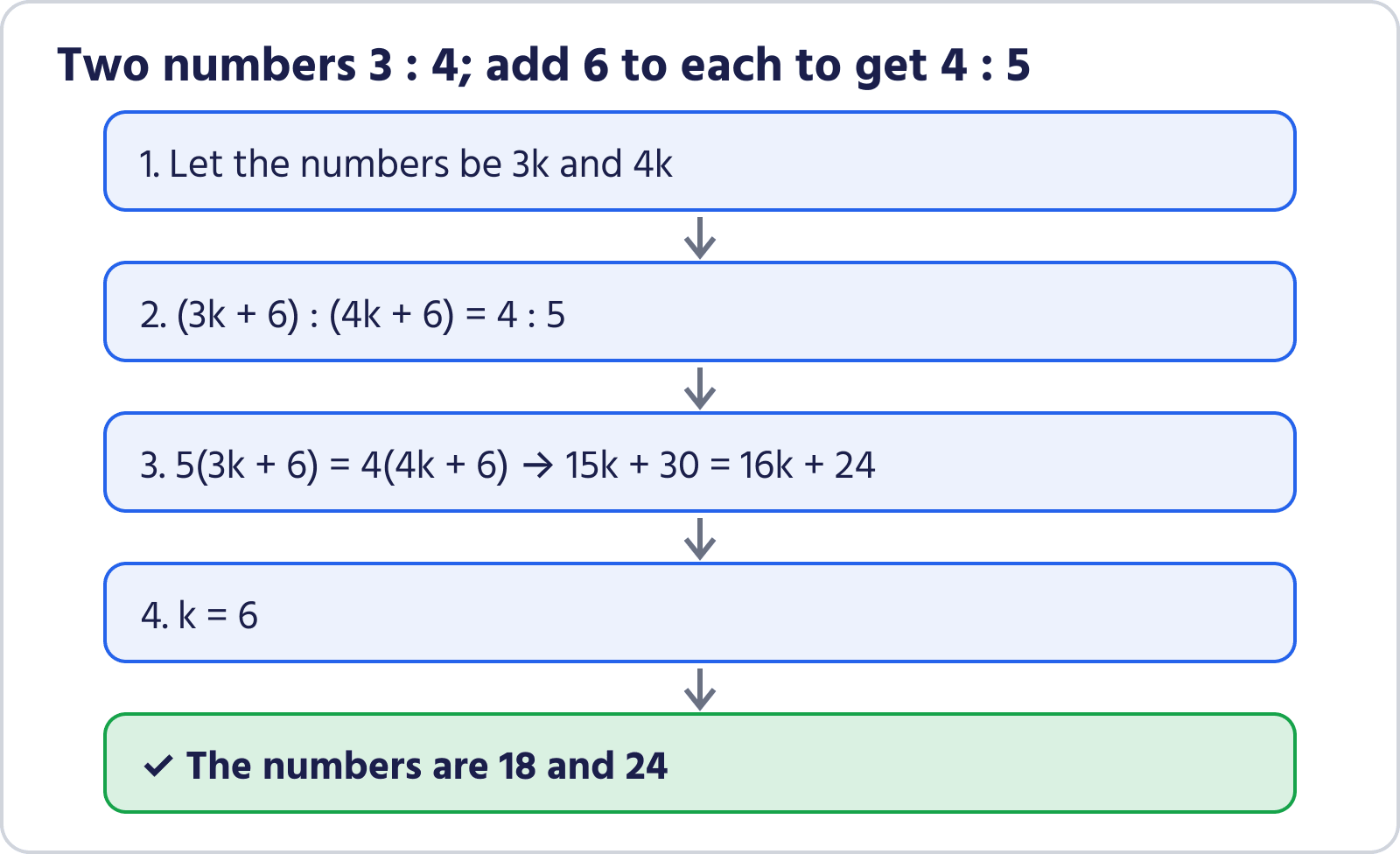
Two numbers are in the ratio 3 : 4. When 6 is added to each, the ratio becomes 4 : 5. What is the larger number?
Let the numbers be $3k$ and $4k$. From $\frac{3k + 6}{4k + 6} = \frac{4}{5}$ we get $15k + 30 = 16k + 24$, so $k = 6$. The numbers are 18 and 24. Check: $24 : 30 = 4 : 5$. The larger number is 24.
- Write the unknown numbers as $ak$ and $bk$
- Always verify at the end
- Writing the smaller number 18 as the answer
- In ratio problems always assume $k$
What is the compounded ratio of 2 : 3, 3 : 4 and 4 : 5?
Compounded ratio = product of the first terms : product of the second terms = $(2 \times 3 \times 4) : (3 \times 4 \times 5) = 24 : 60$. Dividing both by 12 gives 2 : 5.
- Compounded ratio = product of antecedents : product of consequents
- Reduce to the lowest terms at the end
- Stopping at 24 : 60 without simplifying
- Multiply tops with tops and bottoms with bottoms
The ages of two brothers are in the ratio 5 : 7 and the sum of their ages is 60 years. What will the elder brother's age be after 5 years?
There are 5 + 7 = 12 parts in all, so 1 part = 60 ÷ 12 = 5 years. The elder is 7 × 5 = 35 years old and the younger 25. After 5 years the elder will be 35 + 5 = 40. The value 35 is his present age.
- Find the present ages first, then add the years
- After 5 years the ratio is no longer 5 : 7
- Taking the present age 35 as the answer
- Read the last line of the question twice
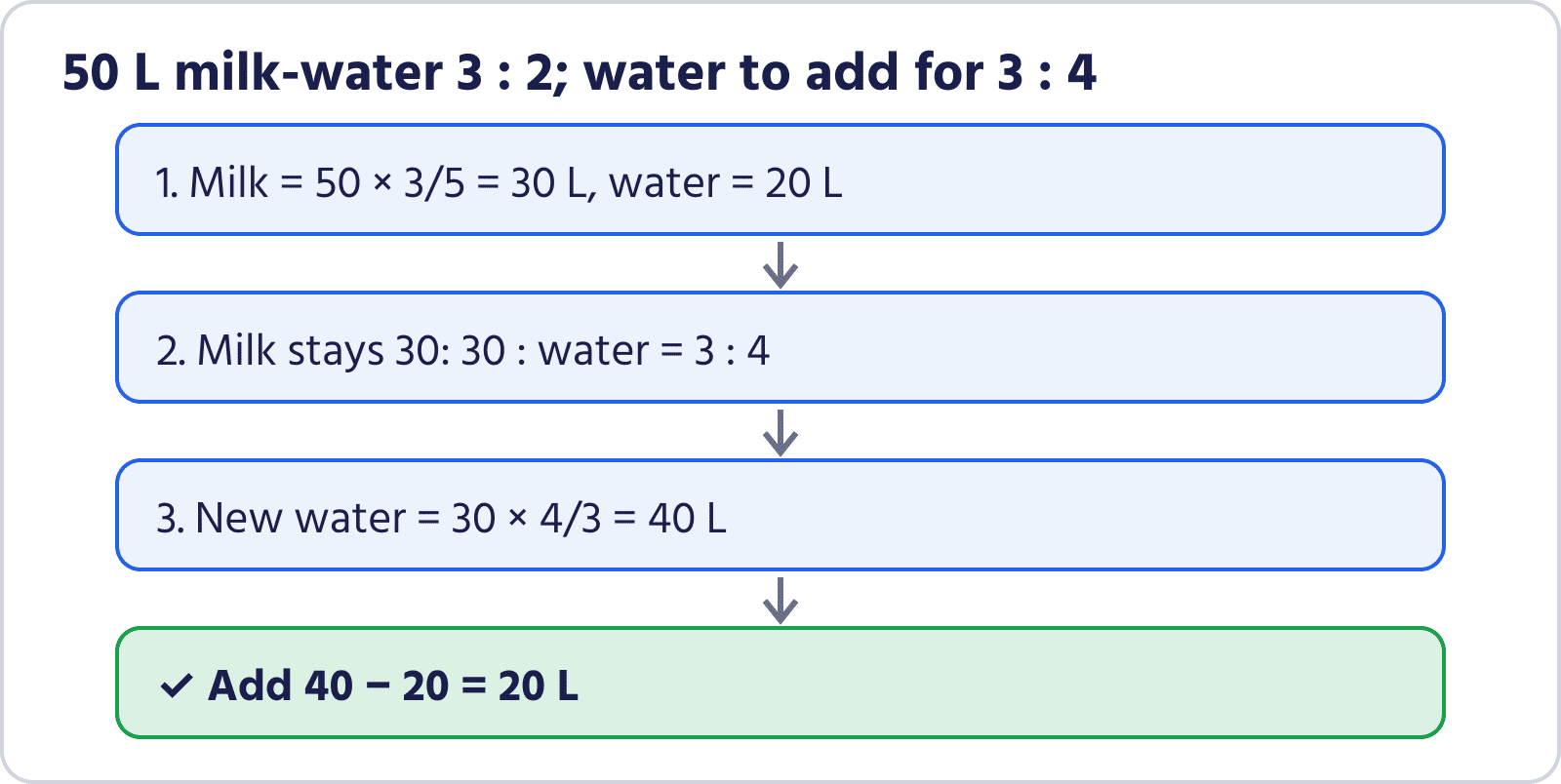
In a 50 litre mixture the ratio of milk to water is 3 : 2. How many litres of water must be added to make the ratio 3 : 4?
Milk = 50 × $\frac{3}{5}$ = 30 L and water = 20 L. Milk stays the same, so for 3 : 4 water = 30 × $\frac{4}{3}$ = 40 L. Water to add = 40 − 20 = 20 L. The 40 L is the new total water, not the water added.
- Work from the part that does not change (milk)
- Water added = new water − old water
- Treating the new water 40 L as the water added
- The unchanged part is your anchor
12 men finish a piece of work in 15 days. In how many days will 9 men finish the same work?
More men means fewer days, so this is inverse proportion: men × days = constant. 12 × 15 = 180, so 9 men need 180 ÷ 9 = 20 days. Men decreased, so days must exceed 15; for 18 days, 9 × 18 = 162 ≠ 180.
- Men and days are inversely proportional
- Total work = men × days
- Using direct proportion: 9 ÷ 12 × 15
- Fewer men means more days: the answer is above 15
| Men | Days | Men × days |
|---|---|---|
| 9 | 20 | 180 |
| 12 | 15 | 180 |
| 15 | 12 | 180 |
| 18 | 10 | 180 |
If $A : B = 2 : 3$ and $B : C = 4 : 5$, what is $A : C$?
To make B equal, multiply the first ratio by 4 and the second by 3: $A : B = 8 : 12$ and $B : C = 12 : 15$. So $A : B : C = 8 : 12 : 15$ and $A : C = 8 : 15$. Taking just 2 and 5 ignores B, so 2 : 5 is wrong.
- Make the common term (B) equal in both ratios
- LCM of 3 and 4 is 12
- Writing 2 : 5 by copying the two outer numbers
- Match the middle term, then read the two ends
| Ratio | A | B | C |
|---|---|---|---|
| A : B = 2 : 3 (×4) | 8 | 12 | |
| B : C = 4 : 5 (×3) | 12 | 15 | |
| A : B : C | 8 | 12 | 15 |
A and B start a business investing ₹6,000 and ₹9,000 respectively for the same period. If the profit is ₹3,000, what is A's share?
Time is equal, so profit is shared in the ratio of capital: 6,000 : 9,000 = 2 : 3. With 5 parts in all, 1 part = 3000 ÷ 5 = ₹600. A gets 2 × 600 = ₹1,200 and B gets ₹1,800. ₹1,500 would be an equal split.
- For equal time, profit ratio = capital ratio
- Reduce first: 6,000 : 9,000 = 2 : 3
- Splitting the profit equally to get ₹1,500
- With equal time, money does the weighing
If 8 pens cost ₹96, what is the cost of 15 pens?
Let $a = 3k$ and $b = 5k$. Then $a + b = 8k$ and $b - a = 2k$, so the ratio is $8k : 2k = 4 : 1$. The $k$ cancels, so any value of $k$ gives the same answer; for $k = 1$ it is $8 : 2 = 4 : 1$.
- If $a : b = m : n$, write $a = mk$ and $b = nk$
- The $k$ cancels in a ratio
- Writing 8 : 3 by putting 3 in place of $b - a$
- See a ratio, put in $k$
In a school the ratio of boys to girls is 7 : 5. If there are 1,200 students in all, how many boys are there?
There are 7 + 5 = 12 parts, so 1 part = 1200 ÷ 12 = 100. Boys = 7 × 100 = 700 and girls = 500. The 500 is the number of girls, and 600 would need the ratio to be 1 : 1.
- Find the value of 1 part and multiply
- Verify the total: 700 + 500 = 1,200
- Taking the number of girls, 500, as the answer
- Underline what the question asks for
If 8 pens cost ₹96, what is the cost of 15 pens?
More pens cost more, so this is direct proportion. 1 pen = 96 ÷ 8 = ₹12, so 15 pens cost 12 × 15 = ₹180. ₹150 would need a pen to cost ₹10, but here it is ₹12.
- Find the unit price first
- Number of pens and cost are in direct proportion
- Treating it as inverse proportion: 8 × 96 ÷ 15
- Starting from the unit value reduces mistakes
📊 Topic Analysis
12 practice questions on ratio and proportion with worked solutions.



Leave a Comment
Commenting as ·