
Clerkship Arithmetic Quiz: Percentage (12 Questions)
A little practice. A step forward.
12 percentage questions at the level of WBPSC Clerkship 2024 Part-I arithmetic, each answer explained step by step. 📖 Read the detailed topic
What is 20% of 350?
20% = $\frac{1}{5}$ and $350 \div 5 = 70$. Taking 10% = 35 and doubling it also gives 70; the other options come from wrong multiplications.
- 20% means one fifth
- Find 10% and double it for speed
- 20% = ÷5, 25% = ÷4, 50% = ÷2
45 is what percent of 60?
$\frac{45}{60} \times 100 = \frac{3}{4} \times 100 = 75\%$. Divide by the number that follows "of" (60). 80% would need $\frac{48}{60}$.
- Percent = part ÷ whole × 100
- $\frac{3}{4}$ = 75%
- The number after 'of' goes in the denominator
What is $\frac{3}{8}$ as a percentage?
$\frac{1}{8} = 12.5\%$, so $\frac{3}{8} = 3 \times 12.5 = 37.5\%$. Directly: $\frac{3}{8} \times 100 = 37.5$. 40% is $\frac{2}{5}$, close but different.
- $\frac{1}{8}$ = 12.5%
- $\frac{3}{8}$ = 37.5%, $\frac{5}{8}$ = 62.5%
- Steps of 12.5: 12.5, 25, 37.5, 50, 62.5, 75, 87.5, 100
| Fraction | Percent |
|---|---|
| $\frac{1}{8}$ | 12.5% |
| $\frac{3}{8}$ | 37.5% |
| $\frac{5}{8}$ | 62.5% |
| $\frac{7}{8}$ | 87.5% |
A number increased by 25% becomes 150. What is the number?
If the number is $N$, then $N \times \frac{125}{100} = 150$, so $N = 150 \times \frac{100}{125} = 120$. Check: 25% of 120 is 30 and $120 + 30 = 150$. Subtracting 25% of 150 is wrong because the percentage is on the original.
- After an increase: new = original × (100 + x)/100
- Divide to go backwards; do not subtract 25% of the new value
- Taking 25% off the new value is wrong: the percentage is always on the original
- 125% is $\frac{5}{4}$ of the original, so 150 × 4 ÷ 5
An item costs ₹800. What is the selling price after a 15% discount?
Discount = 15% of 800 = 120 (10% = 80, 5% = 40). Selling price = 800 − 120 = 680, or directly $800 \times \frac{85}{100} = 680$. ₹700 would be a 12.5% discount and ₹640 a 20% discount.
- The discount is on the original price
- Selling price = price × (100 − discount%)/100
- 15% = 10% + 5%: find each and add
A price falls from ₹500 to ₹425. By what percent did it fall?
The fall is $500 - 425 = 75$. Percent fall = $\frac{75}{500} \times 100 = 15\%$. Dividing by 425 gives about 17.6%, which is wrong: always divide by the original value.
- Percent change = change ÷ original × 100
- The original is the 'before' value
- Dividing by the new value gives a wrong answer near 17
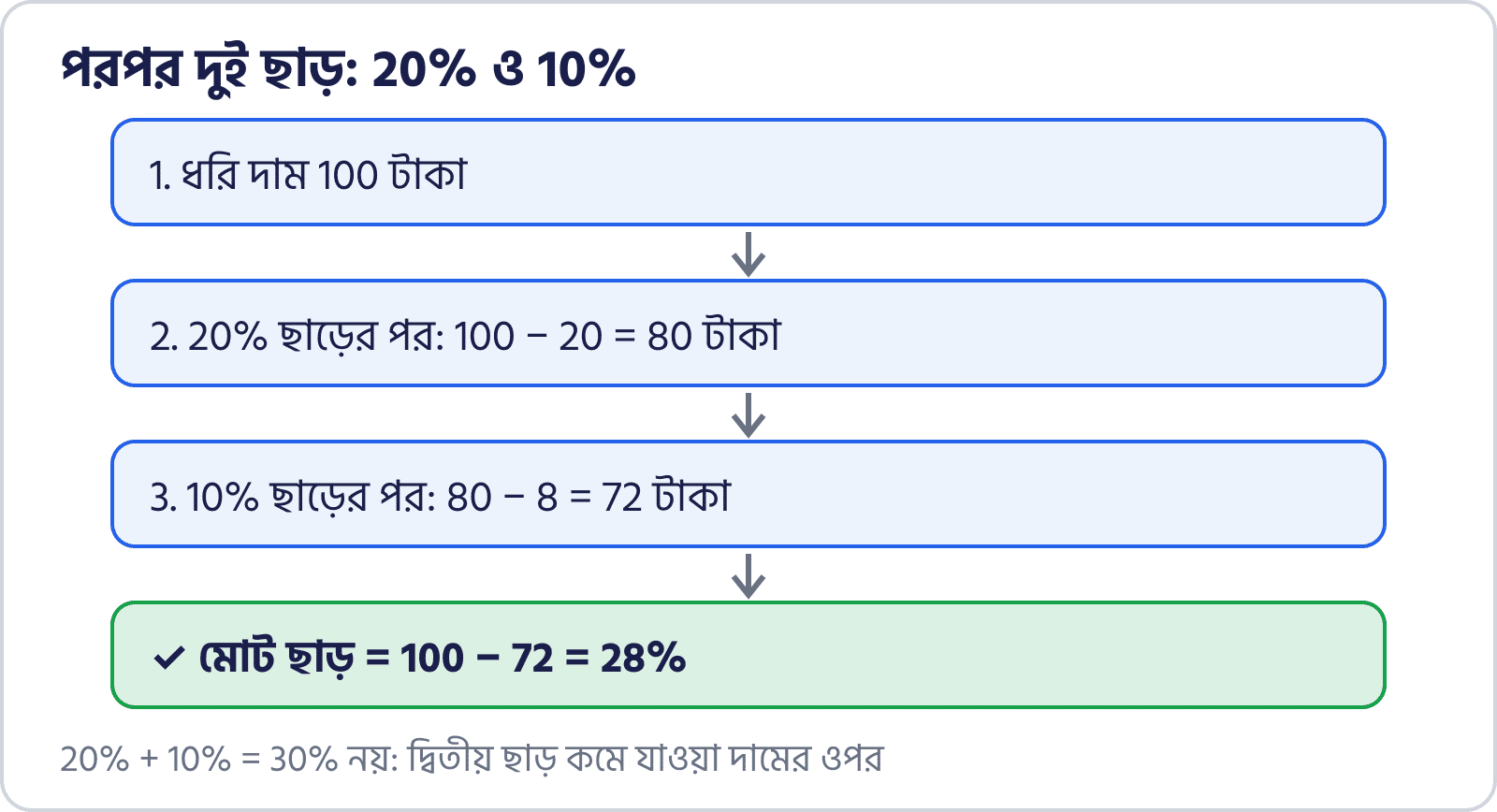
What single discount equals successive discounts of 20% and 10%?
Take the price as 100: after 20% it is 80, then 10% of 80 = 8 gives 72. Total discount = 28%. By formula $20 + 10 - \frac{20 \times 10}{100} = 28$. It would be 30% only if both discounts were on the same original price.
- $a + b - \frac{ab}{100}$ (both discounts)
- The second discount is on the reduced price
- Adding 20 + 10 = 30 is the most common mistake
- Assume the price is 100 to keep numbers easy
If A is 25% more than B, by what percent is B less than A?
Take B = 100, so A = 125. B is less than A by $125 - 100 = 25$, and the comparison is with A: $\frac{25}{125} \times 100 = 20\%$. It is not 25% because the base is now A (125), not B (100).
- If one is x% more, the other is $\frac{x}{100 + x} \times 100$ % less
- The one you compare with is the base
- B is not the same percent less as A is more: the base changes
40% is needed to pass. A candidate scored 140 and failed by 20 marks. What are the maximum marks?
Pass marks = $140 + 20 = 160$. This is 40% of the maximum, so maximum = $\frac{160}{40} \times 100 = 400$. Check: 40% of 400 = 160. 40% of 350 is 140, which is the score, not the pass mark.
- Pass marks = scored + shortfall
- Find 1% then multiply by 100
- If 40% = 160 then 10% = 40, so 100% = 400
Monthly income is ₹25,000. If someone spends 64% of it, what are the savings?
Savings = $100 - 64 = 36\%$. 36% of 25,000 = $250 \times 36 = 9000$. Check: spending is 16,000 and $25000 - 16000 = 9000$. ₹10,000 would be 40% savings.
- Savings% = 100 − spending%
- 1% of 25,000 = 250
- Find the percent left first, then multiply
A town has 20,000 people and grows 10% every year. What will it be after 2 years?
Year 1: $20000 \times 1.1 = 22000$. Year 2: $22000 \times 1.1 = 24200$. 24,000 comes from adding 2,000 twice, but in year 2 the base is 22,000.
- Two-year growth = $10 + 10 + \frac{100}{100} = 21\%$
- Each year grows on the new value
- Using 20% (10 + 10) gives 24,000: wrong, 21% is right
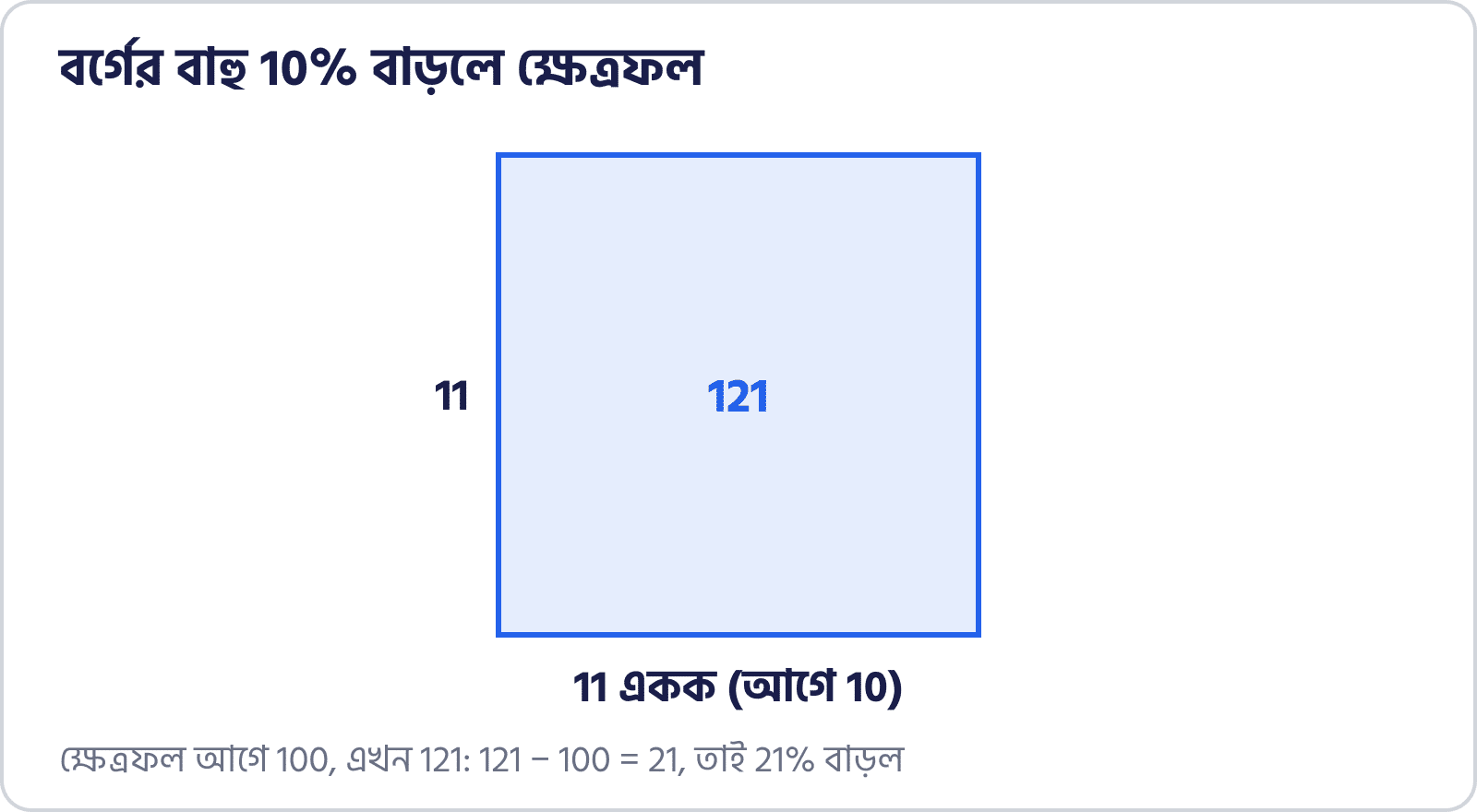
If the side of a square is increased by 10%, by what percent does its area increase?
Take the side as 10, so the area is 100. The side becomes 11 and the area 121. The increase is 21, so 21%. By formula $10 + 10 + \frac{10 \times 10}{100} = 21$. The area grows in both directions, so it is 21%, not 20%.
- Area of a square = side × side
- Formula $a + a + \frac{a^2}{100}$
- Take the side as 10: the areas are 100 and 121
📊 Topic Analysis
12 percentage questions at the level of WBPSC Clerkship 2024 Part-I arithmetic, each answer explained step by step.



Leave a Comment
Commenting as ·