
Electricity and Magnetism Quiz: WBPSC Clerkship GS
A little practice. A step forward.
10 questions on the notes: units, Ohm’s law, series and parallel, fuse, electricity bill and magnetism. 📖 Read the detailed topic
What is the unit of electric current?
Current is 1 ampere (A) when 1 coulomb of charge passes a cross-section every second. Volt is the unit of potential difference, ohm of resistance and watt of power.
- Current = charge ÷ time
- An ammeter measures current
- 1 A = 1 coulomb per second
- Current A, pressure V, obstruction Ω, power W
| Quantity | Unit | Symbol | Instrument |
|---|---|---|---|
| Current | Ampere | A | Ammeter |
| Potential difference | Volt | V | Voltmeter |
| Resistance | Ohm | Ω | Ohmmeter |
| Power | Watt | W | Wattmeter |
By Ohm's law, what is the resistance of a conductor that carries 2.2 A at a potential difference of 220 V?
Ohm's law: V = I × R, so R = V ÷ I = 220 ÷ 2.2 = 100 Ω. The figure 484 comes from wrongly multiplying 220 × 2.2.
- V = I R
- At constant temperature V ÷ I is constant
- Unit of resistance is the ohm (Ω)
- To find resistance you divide, not multiply: R = V ÷ I
- The V-I-R triangle: V on top
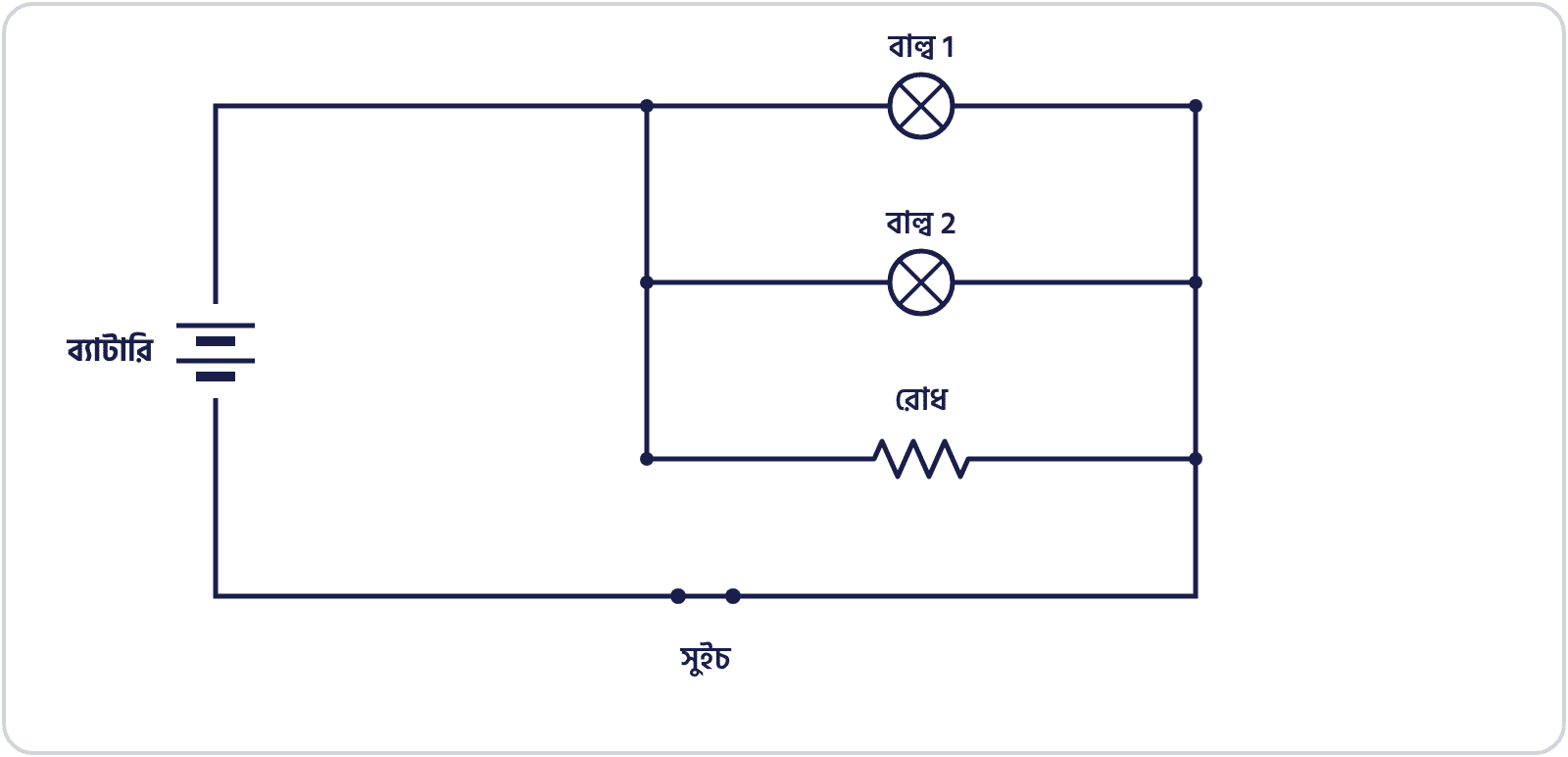
How are the electrical appliances in a home connected?
Household appliances are connected in parallel, so each gets the full 220 V and switching one off leaves the rest running. In series, one faulty appliance would break the whole circuit.
- In series the current is the same and resistances add
- In parallel the voltage is the same
- In parallel the total resistance is less than any single branch
- Parallel = each has its own road
What is the equivalent resistance of 4 Ω and 6 Ω resistors joined in series?
In series resistances add: 4 + 6 = 10 Ω. 2.4 Ω would be the parallel value ($\frac{4 \times 6}{4 + 6}$). 24 Ω is just the product, which is not the equivalent resistance in any arrangement.
- Series: $R = R_1 + R_2$
- Parallel: $\frac{1}{R} = \frac{1}{R_1} + \frac{1}{R_2}$
- In series the same current flows through each resistor
- Series adds, parallel gets smaller
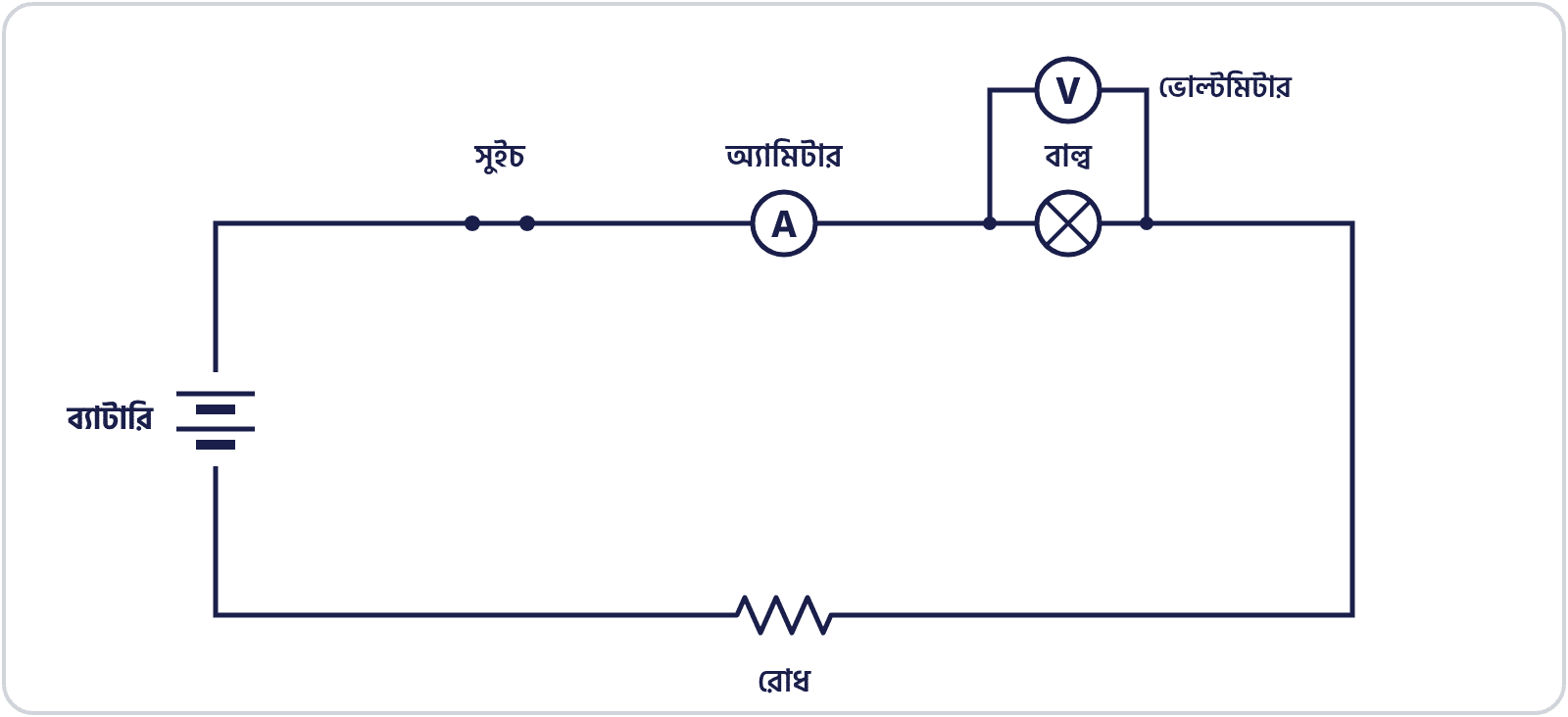
Which statement about an electric fuse wire is correct?
A fuse wire is made of a low-melting alloy such as tin-lead. On excessive current it melts and breaks the circuit. It is placed in the live wire, in series with the circuit.
- A fuse melts to protect the appliance
- Works on short circuit and overload
- In the live wire, in series
- The fuse sacrifices itself to save the appliance
The kilowatt-hour (kWh), i.e. 1 unit on an electricity bill, is a unit of what?
Power × time = energy, so the kWh is a unit of energy. 1 kWh = 1000 W × 3600 s = 36,00,000 J (3.6 × 10^6 J). Power itself is measured in watts or kilowatts, with no 'hour' in it.
- 1 kWh = 1 unit = 36,00,000 J
- A 100 W bulb lit for 10 hours uses 1 unit
- Power P = V × I
- 1 horsepower (HP) = 746 W
- kW is a unit of power, kWh of energy: nearly the same name, different quantities
- Kilowatt is power, kilowatt-hour is energy
Who first observed that an electric current creates a magnetic field around it?
In 1820 Oersted of Denmark saw a compass needle near a wire deflect when current was switched on. Faraday discovered electromagnetic induction in 1831, Volta built the battery and Ohm gave the law of resistance.
- Oersted, 1820: current gives magnetism
- Faraday, 1831: magnet gives current
- Volta: first battery
- Ohm: V = I R
- Oersted (current gives a magnetic field) and Faraday (a magnet gives current) discovered opposite effects
- Oersted = current to magnet, Faraday = magnet to current
On which principle does an electric generator or dynamo work?
When a coil is rotated in a magnetic field an emf is induced in it: this is electromagnetic induction. A dynamo converts mechanical energy into electrical energy; an electric motor does the reverse.
- Dynamo: mechanical to electrical energy
- Motor: electrical to mechanical energy
- Dynamo rule: Fleming's right hand
- Motor rule: Fleming's left hand
- Left hand for the motor, right hand for the generator: students swap them
- Right hand for the dynamo, left hand for the motor
Which of the following is not a magnetic material?
Iron, nickel and cobalt are strongly attracted by a magnet: they are ferromagnetic. Copper is not noticeably attracted: it conducts electricity but is non-magnetic.
- Ferromagnetic: iron, nickel, cobalt
- Copper, aluminium, glass and wood are not attracted
- Electromagnets use a soft iron core, permanent magnets use steel
- Remember the trio: iron, nickel, cobalt
In which direction do magnetic field lines run outside a bar magnet?
Outside the magnet the field lines leave the north pole and enter the south pole. Inside the magnet the direction is reversed, so the lines are closed curves. Field lines never cross one another.
- Outside: N to S
- Inside: S to N
- Field lines are closed curves
- Where lines are closer, the field is stronger
- N to S outside but S to N inside: remember the two separately
- Outside, north to south
📊 Topic Analysis
10 questions on the notes: units, Ohm’s law, series and parallel, fuse, electricity bill and magnetism.



Leave a Comment
Commenting as ·