
12 questions for WBPSC Clerkship 2024 Part-I arithmetic: area, perimeter, diagonals, paths, fencing, tiles and percentage change, each with a full worked answer.
Area and Perimeter of Rectangles and Squares: Practice Quiz (WBPSC Clerkship)
Practice session
A little practice. A step forward.
12 questions
Learn with explanations
At your own pace
0 / 12 completed
00:00
The length of a rectangle is 25 m and its breadth is 16 m. What is its area?
Explanation
Area = length × breadth = $25 \times 16 = 400$ m². 82 is the perimeter $2(25 + 16)$ and 41 is just length plus breadth; neither is the area.
Key Points
- Area of a rectangle = $l \times b$
- Area is measured in square units (m²)
Memory Tips
- $25 \times 4 = 100$, so $25 \times 16 = 100 \times 4 = 400$: split the multiplier into fours.
The perimeter of a square is 48 cm. What is its area?
Explanation
Side = perimeter ÷ 4 = $48 \div 4 = 12$ cm, so the area = $12^{2} = 144$ cm². Halving the perimeter and squaring gives 576, squaring the perimeter itself gives 2304: both are wrong.
Key Points
- Perimeter of a square = $4a$
- Area = $a^{2}$
Confusion Points
- For a square divide the perimeter by 4 to get the side; for a rectangle divide by 2 to get length + breadth
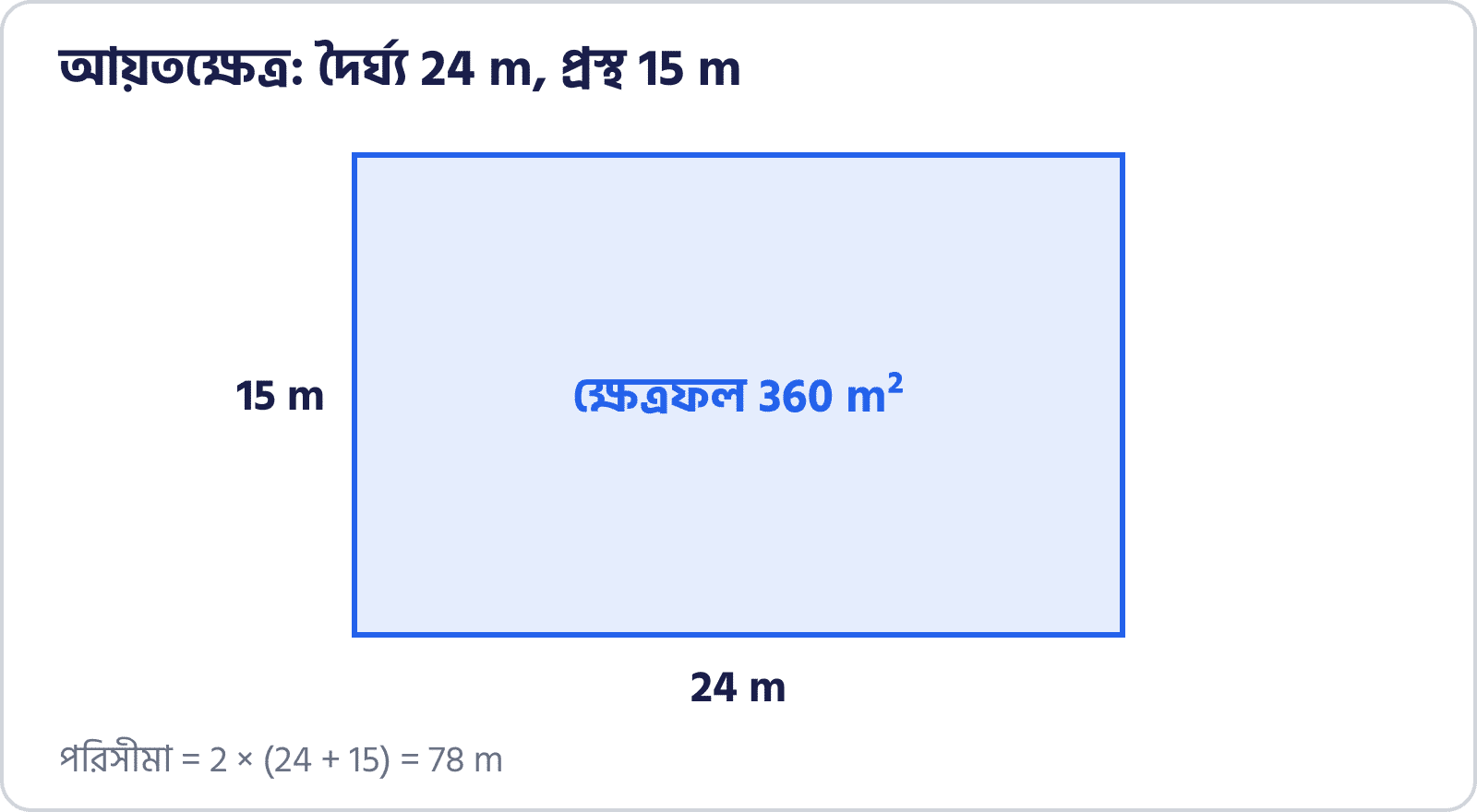
The area of a rectangle is 360 m² and its breadth is 15 m. What is its perimeter?
Explanation
Length = $360 \div 15 = 24$ m. Perimeter = $2(24 + 15) = 2 \times 39 = 78$ m. 24 is only the length and 39 is half the perimeter: do not forget to double it.
Key Points
- Length = area ÷ breadth
- Perimeter = $2(l + b)$
Additional Information
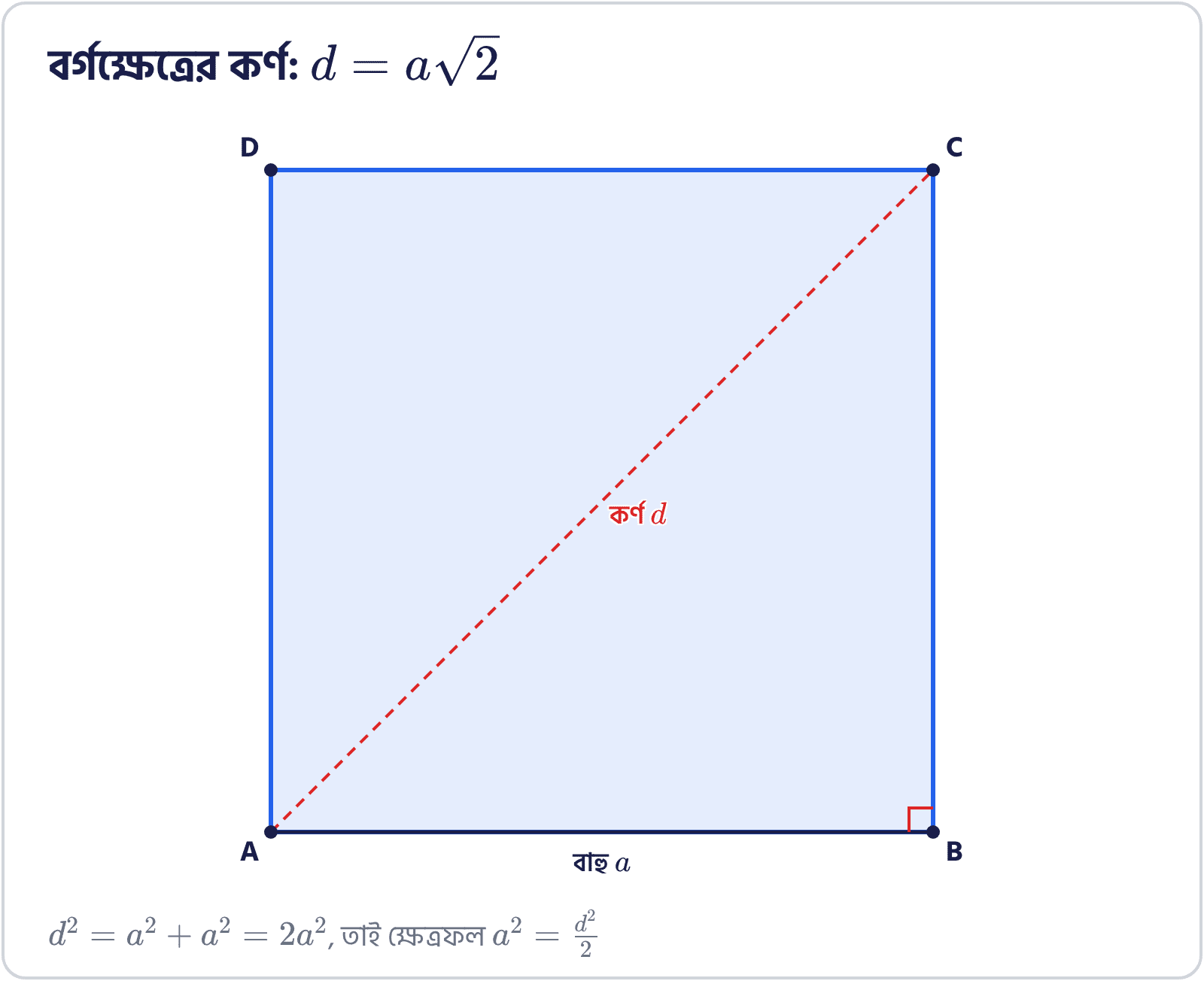
The diagonal of a square is 16 cm. What is its area?
Explanation
When the diagonal is known, the area of a square = $\frac{d^{2}}{2} = \frac{256}{2} = 128$ cm². 256 is the square of the diagonal not halved; treating the diagonal as the side is the usual mistake here.
Key Points
- In a square $d = a\sqrt{2}$
- Area = $\frac{d^{2}}{2}$
Confusion Points
- Given the diagonal of a square, skip the side: area = diagonal² ÷ 2
Additional Information
The length of a rectangle is 12 cm and its breadth is 5 cm. What is the length of its diagonal?
Explanation
Diagonal = $\sqrt{l^{2} + b^{2}} = \sqrt{144 + 25} = \sqrt{169} = 13$ cm. 17 is length plus breadth; two sides of a triangle always add up to more than the third, so the diagonal cannot be 17.
Key Points
- Diagonal of a rectangle = $\sqrt{l^{2} + b^{2}}$
- (5, 12, 13) is a Pythagorean triple
Memory Tips
- Known triples: (3, 4, 5), (5, 12, 13), (6, 8, 10), (8, 15, 17)
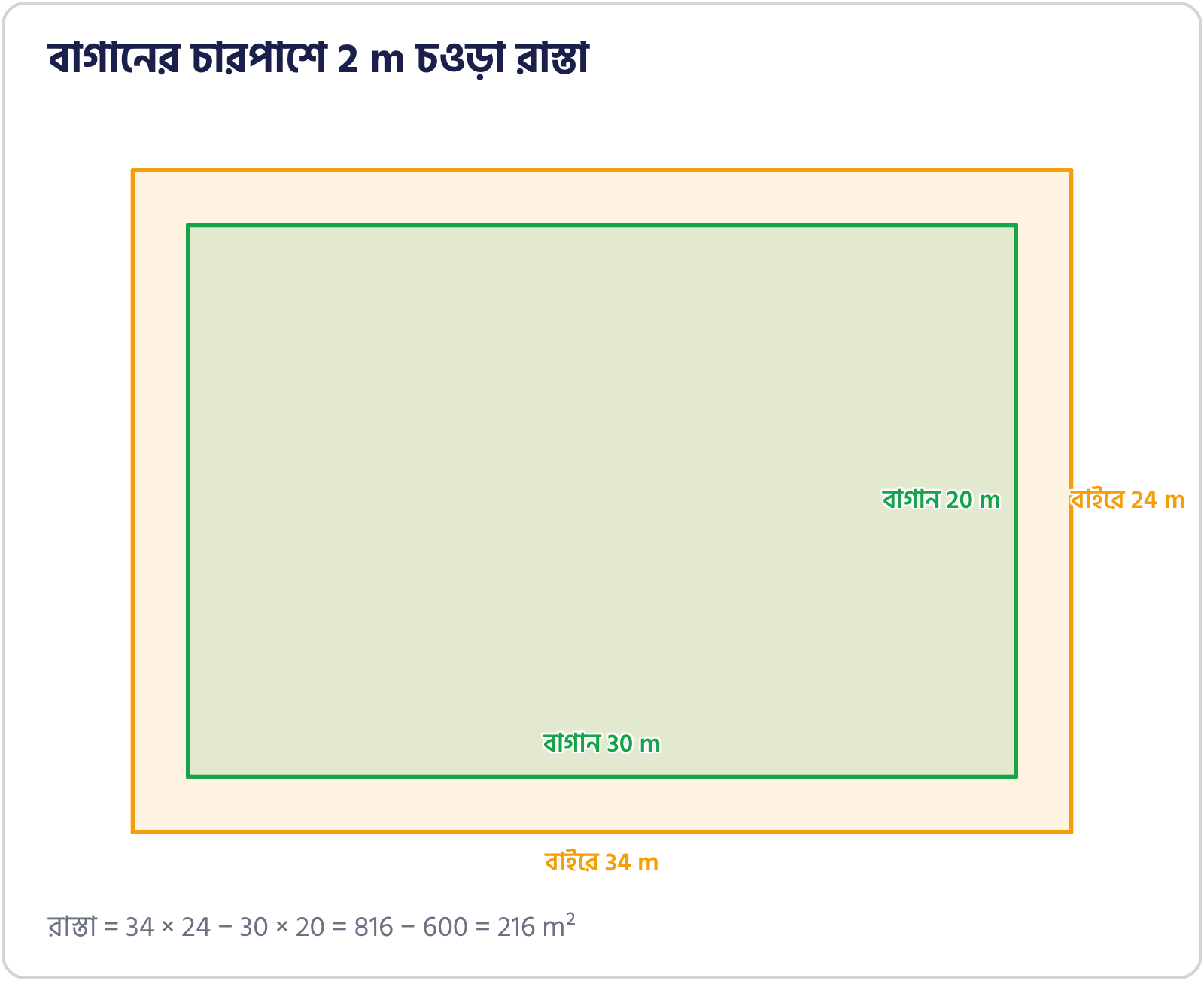
A rectangular garden 30 m × 20 m has a path 2 m wide all round it on the outside. What is the area of the path?
Explanation
Outer size $34 \times 24 = 816$ m², garden $30 \times 20 = 600$ m², so the path = $816 - 600 = 216$ m². Shortcut: $2w(l + b + 2w) = 4 \times 54 = 216$. A path inside would give 184 m², and adding the width on one side only gives 200 m².
Key Points
- Path outside: each side grows by $2w$
- Area of the path = outer − inner
Confusion Points
- Check whether the path is outside or inside: outside the sides grow, inside they shrink
Memory Tips
- Outside: $2w(l + b + 2w)$, inside: $2w(l + b - 2w)$
Additional Information
Each side of a square is increased by 10%. By what percentage does its area increase?
Explanation
With $x + y + \frac{xy}{100}$ and $x = y = 10$: $10 + 10 + 1 = 21$%. Check: $1.1 \times 1.1 = 1.21$. Both sides grow, so it is not 10%, and leaving out $\frac{xy}{100}$ gives a wrong 20%.
Key Points
- Percentage change in area = $x + y + \frac{xy}{100}$
- In a square $x = y$
Confusion Points
- 10% + 10% is not 20%: the extra $\frac{xy}{100}$ is added
Memory Tips
- If a square's side grows by $x$%, its area grows by $2x + \frac{x^{2}}{100}$ per cent
Additional Information
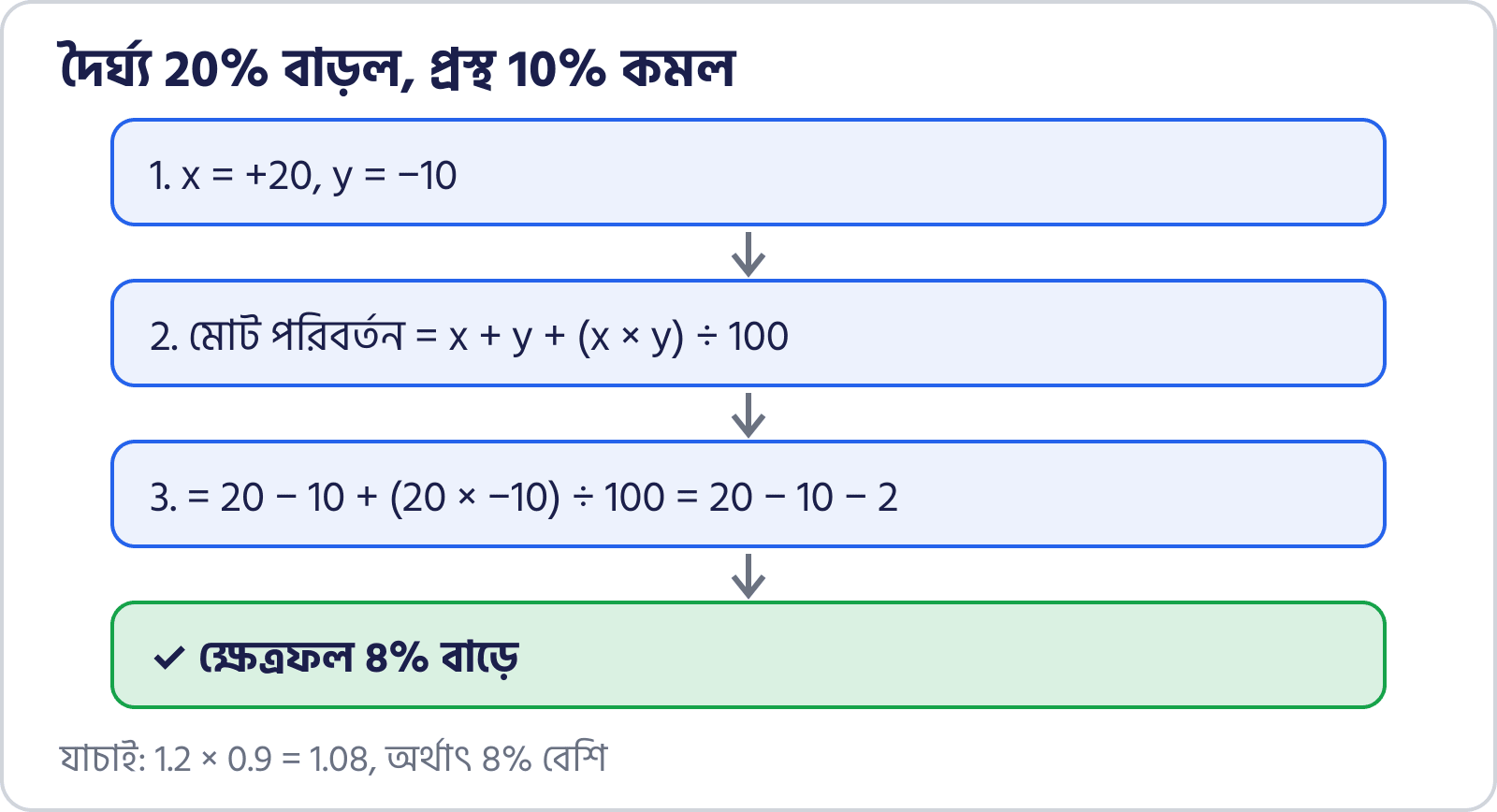
The length of a rectangle is increased by 20% and its breadth decreased by 20%. What happens to its area?
Explanation
$x = 20$, $y = -20$: $20 - 20 + \frac{20 \times (-20)}{100} = -4$, so the area falls by 4%. Check: $1.2 \times 0.8 = 0.96$. An equal rise and fall never cancel out; the area always falls a little.
Key Points
- Equal rise and fall: the area falls by $\frac{x^{2}}{100}$%
- A decrease makes $y$ negative
Confusion Points
- A 20% rise and a 20% fall do not mean 'no change': $1.2 \times 0.8 = 0.96$
What is the cost of fencing a rectangular plot 50 m × 30 m at ₹15 per metre?
Explanation
A fence runs along the perimeter: $2(50 + 30) = 160$ m. Cost = $160 \times 15 =$ ₹2,400. ₹22,500 comes from multiplying the area (1500 m²), and ₹1,200 from half the perimeter, 80 m.
Key Points
- Fence, wall, boundary = perimeter
- Floor, carpet, paint = area
Confusion Points
- A rate per metre means perimeter; a rate per square metre means area
How many square tiles of side 40 cm are needed to cover the floor of a room 6 m × 4 m?
Explanation
Bring both sizes to one unit: 600 cm ÷ 40 = 15 tiles one way, 400 cm ÷ 40 = 10 the other, $15 \times 10 = 150$ in all. By area: $240000 \div 1600 = 150$. 15 is only one row of tiles: multiply the counts along both sides, and never divide before the units match.
Key Points
- Number of tiles = floor area ÷ area of one tile
- 1 m² = 10,000 cm²
Confusion Points
- 1 m = 100 cm, but 1 m² = 10,000 cm²
Memory Tips
- Count the tiles along each side and multiply: fewer chances to slip
The perimeter of a rectangle is 46 m and its length is 15 m. What is its area?
Explanation
Length + breadth = $46 \div 2 = 23$, so the breadth = $23 - 15 = 8$ m and the area = $15 \times 8 = 120$ m². Subtracting the length from the whole perimeter gives a breadth of 31 and 465; multiplying by the half perimeter gives 345.
Key Points
- Half the perimeter = $l + b$
- Breadth = half perimeter − length
Confusion Points
- Halve the perimeter before you subtract the length
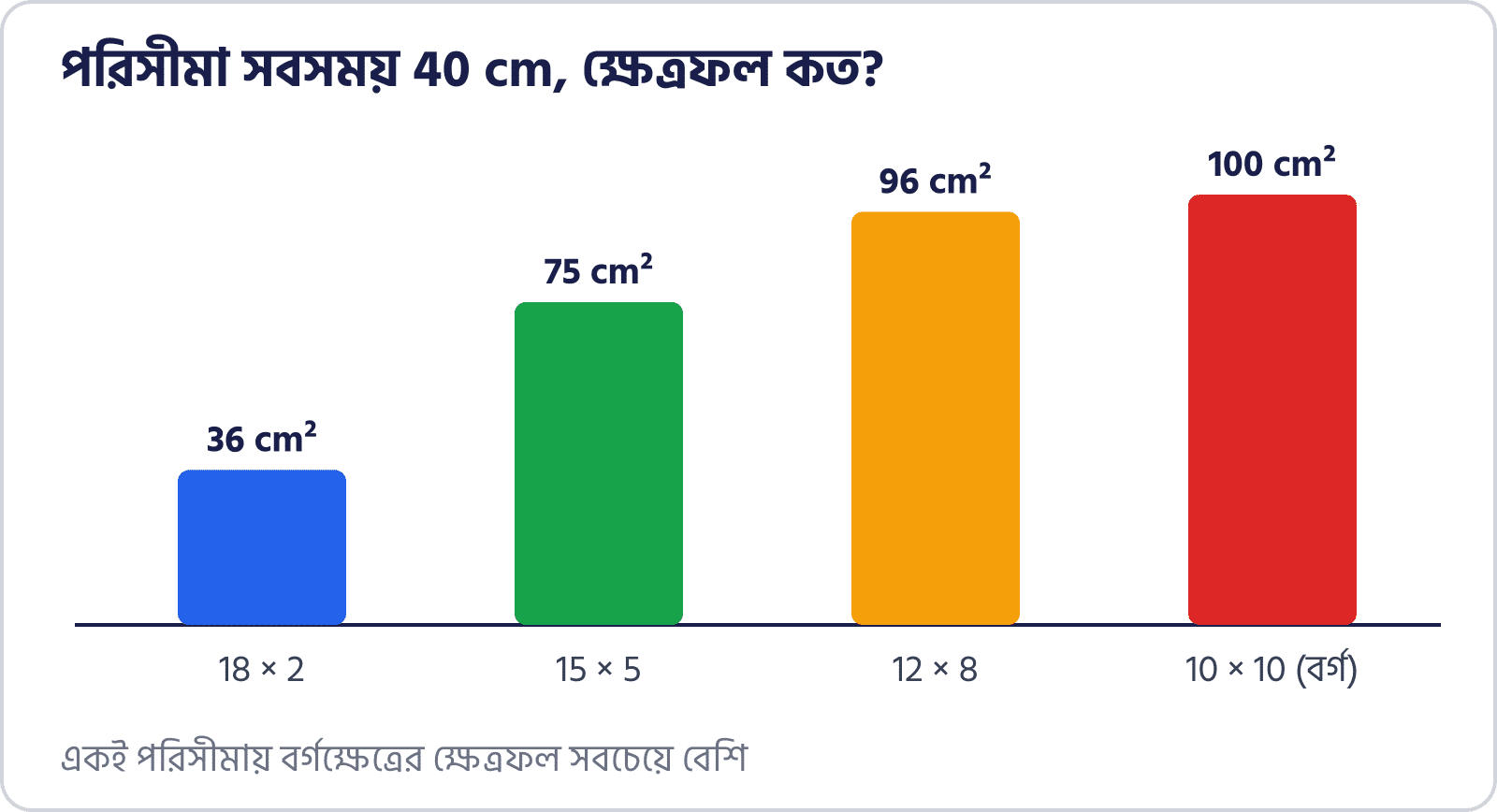
A rectangle is 18 m long and 12 m broad. What is the area of a square with the same perimeter?
Explanation
The rectangle's perimeter = $2(18 + 12) = 60$ m, so the square's side = $60 \div 4 = 15$ m and its area = $15^{2} = 225$ m². 216 is the rectangle's own area; for the same perimeter a square always has the larger area.
Key Points
- For a given perimeter the square has the largest area
- Side of the square = perimeter ÷ 4
Additional Information
0/12
📊 Topic Analysis
About this quiz
More for Clerkship 2024

WBPSC Clerkship 2024: Weekly Mock Test (22 November 2026): English, General Studies, Arithmetic

HCF and LCM Part 2 Practice Quiz: WBPSC Clerkship 2024

West Bengal Districts, Agriculture and Industry Quiz: Clerkship 2024

Leave a Comment
Commenting as ·