
Light and Lens Quiz: Clerkship 2024
A little practice. A step forward.
10 questions on reflection, refraction, lenses, defects of the eye and dispersion of light. 📖 Read the detailed topic
Which statement about the image formed by a plane mirror is correct?
A plane mirror forms a virtual image that cannot be caught on a screen. It is erect and the same size as the object, and left and right swap. A virtual, erect and smaller image comes from a convex mirror.
- A virtual image cannot be caught on a screen
- Image distance = object distance
- Left and right swap, not top and bottom
- "Laterally inverted" means side-swapped, not upside down
- Plane mirror = same size, same distance
Which mirror is used as the rear-view mirror of a vehicle?
A convex mirror spreads light out and forms a small, erect image, so a wide area behind the vehicle fits in a small mirror. A plane mirror has a narrow field of view. A concave mirror forms an inverted image of a distant object.
- Convex mirror = diverging
- Image is always virtual, erect and smaller
- Widest field of view
- A concave mirror is used for shaving, not for a vehicle's rear view
- Vehicle mirror is convex: it shows more area
| Mirror | Image | Use |
|---|---|---|
| Plane | Virtual, erect, same size | Periscope, kaleidoscope |
| Concave | Virtual, erect, magnified when the object is close | Shaving mirror, headlight |
| Convex | Always virtual, erect, smaller | Vehicle rear-view mirror |
The radius of curvature of a concave mirror is 40 cm. What is its focal length?
For a curved mirror the focal length is half the radius of curvature: $f = \frac{R}{2} = \frac{40}{2} = 20$ cm. 40 cm is the radius itself, and 80 cm comes from doubling it, which is wrong.
- $f = \frac{R}{2}$
- The focus lies midway between the pole and the centre of curvature
- A plane mirror has infinite focal length
- Mixing up radius of curvature and focal length
- Focal length = half the radius
Why does a pencil partly dipped in water look bent at the water surface?
Light from the pencil changes medium when it passes from water into air and bends; this is refraction, so the dipped part appears to be somewhere else. Dispersion splits light into colours and scattering sends it in all directions; neither happens here.
- Light's speed changes when the medium changes
- A pond looking shallower is also refraction
- Going from rarer to denser, the ray bends towards the normal
- Dispersion and refraction are different: dispersion splits colours
- Medium change = bending = refraction
The speed of light in a medium is $2 \times 10^{8}$ m/s. What is the refractive index of the medium? (Speed of light in vacuum is $3 \times 10^{8}$ m/s)
Refractive index $n = \frac{c}{v} = \frac{3 \times 10^{8}}{2 \times 10^{8}} = 1.5$, about that of ordinary glass. 0.67 comes from dividing the wrong way round, and n is never less than 1. 1.0 would be vacuum.
- $n = \frac{c}{v}$
- Refractive index has no unit
- n is always 1 or more
- Dividing v by c gives an answer below 1, which is impossible
- Vacuum speed on top, medium speed below
Refractive index of some media
Which phenomenon carries light from one end of an optical fibre to the other?
Inside the glass of the fibre, light meets the boundary from the denser to the rarer side at an angle greater than the critical angle, so all of it is reflected back. Repeated again and again, it travels along the fibre without leaking out. That is why signals pass even when the fibre is bent.
- Condition: light goes from denser to rarer medium
- The angle of incidence exceeds the critical angle
- Mirage and the sparkle of a diamond have the same cause
- The light does not leave the fibre, so it is not refraction
- Total internal reflection = a tunnel for light
What is the power of a convex lens of focal length 50 cm?
The focal length must be in metres: 50 cm = 0.5 m. Power $P = \frac{1}{f} = \frac{1}{0.5} = 2$ D, and the sign is positive for a convex lens. Forgetting to convert cm to m gives wrong answers like 50 D.
- $P = \frac{1}{f}$, with f in metres
- The unit of power is the dioptre (D)
- Convex lens +, concave lens −
- Putting f in centimetres into the formula
- First cm to m, then divide
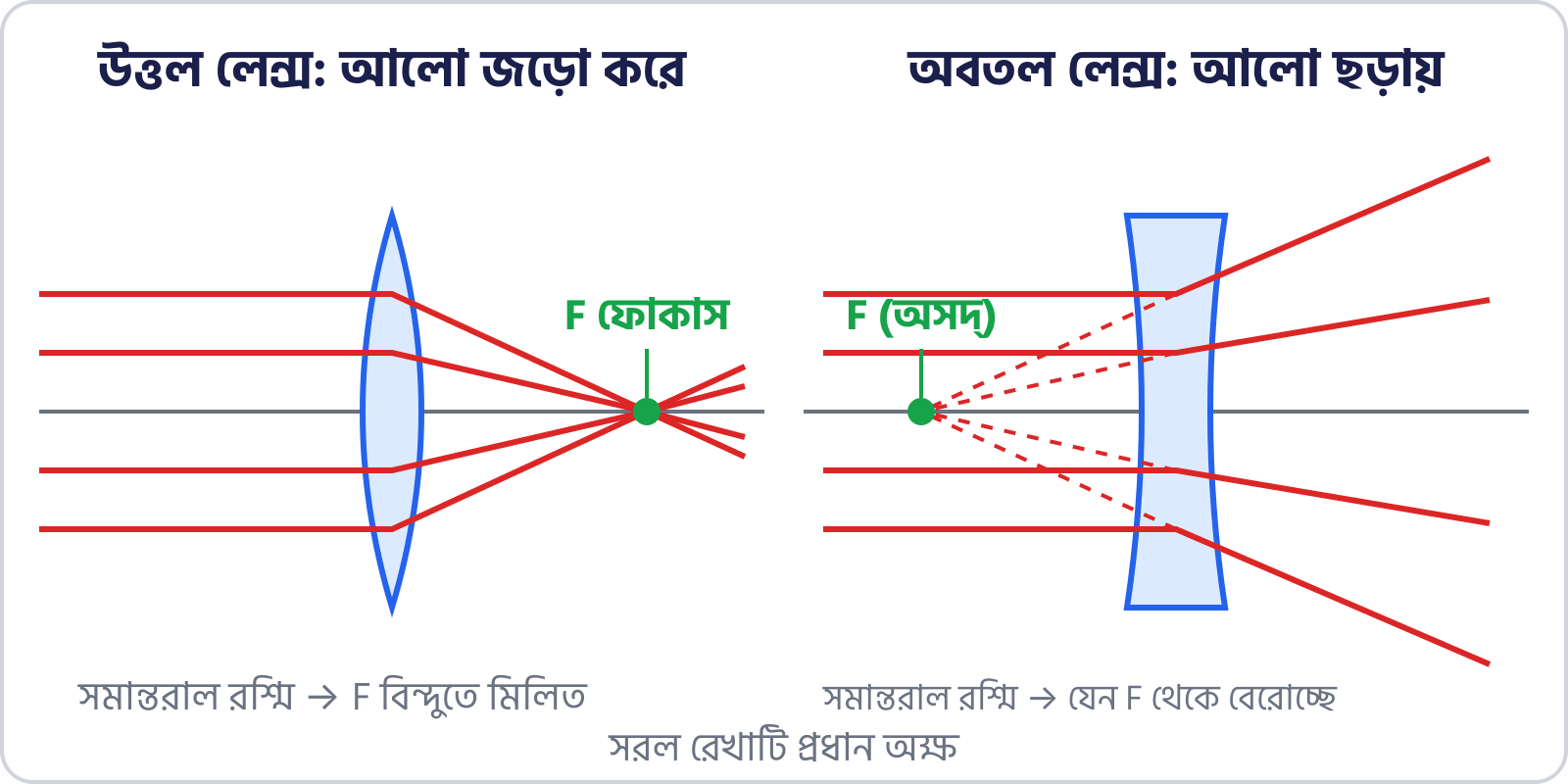
| Lens | Shape | Action | Power |
|---|---|---|---|
| Convex | Thick in the middle | Converging | Positive (+) |
| Concave | Thin in the middle | Diverging | Negative (−) |
Which lens is used in spectacles to correct myopia (short sight)?
In myopia the image of a distant object forms in front of the retina. A concave lens spreads the light and moves the image back onto the retina. A convex lens is for long sight, and a bifocal lens is for presbyopia with age.
- In myopia distant objects are blurred
- It occurs when the eyeball is too long
- The power is negative
- Swapping convex and concave
- Short sight needs spreading: concave
| Defect | Where the image forms | Lens |
|---|---|---|
| Myopia (short sight) | In front of the retina | Concave |
| Hypermetropia (long sight) | Behind the retina | Convex |
The sky appears blue because of which phenomenon?
Air molecules and tiny particles scatter light of shorter wavelength more, so blue light spreads in every direction and reaches our eyes. Red light is scattered the least, which is why the sun looks reddish at sunset. Refraction and reflection do not separate colours this way.
- Shorter wavelength = more scattering
- Red scatters least, so danger signals are red
- Without an atmosphere the sky would look black
- A rainbow is due to dispersion, the blue sky to scattering
- Blue scatters more, red scatters less
When white light passes through a prism, which colour bends the most?
In a prism, light of shorter wavelength has a higher refractive index and so bends more. Violet has the shortest wavelength of the seven colours, so its deviation is the greatest. Red has the longest wavelength and bends the least.
- Violet deviates the most, red the least
- In vacuum all colours travel at the same speed
- The seven colours are VIBGYOR
- It is wrong to think red bends the most: red bends the least
- VIBGYOR runs from most bent to least bent
| Colour | Bending | Approx. wavelength |
|---|---|---|
| Red | Least | About 700 nm |
| Yellow | Medium | About 580 nm |
| Violet | Most | About 400 nm |
📊 Topic Analysis
10 questions on reflection, refraction, lenses, defects of the eye and dispersion of light.


Leave a Comment
Commenting as ·