
Clerkship English Tenses Practice Quiz
A little practice. A step forward.
12 questions on tenses for the WBPSC Clerkship Part-I English paper, each answer explained. 📖 Read the detailed topic
She ___ to school every day.
'Every day' shows a habit, so the Present Indefinite is used. The subject 'She' is third person singular, so the verb takes s/es: goes. 'Go' goes with I/you/we/they, and 'going' or 'gone' need a helping verb (is, has).
- Habits take the Present Indefinite
- Third person singular subject: verb + s/es
- every day, always, usually are the signals
- After does or doesn't the verb gets no s: She does not go
- He, She, It: add s to the verb
He has lived in Kolkata ___ 2015.
2015 is a point in time, so 'since' goes with the Present Perfect. 'For' is used before a length of time (for ten years). 'From' usually pairs with 'to' or 'till', and 'ago' goes only with the Past Indefinite.
- since + a point in time (2015, Monday, morning)
- for + a length of time (5 years, two hours)
- both go with Perfect or Perfect Continuous
- 'Has lived 5 years ago' is wrong: ago never goes with the Present Perfect
- Since = start date, For = how long
| Word | Used before | Example |
|---|---|---|
| since | a point in time | since 2015, since Monday |
| for | a length of time | for ten years, for two hours |
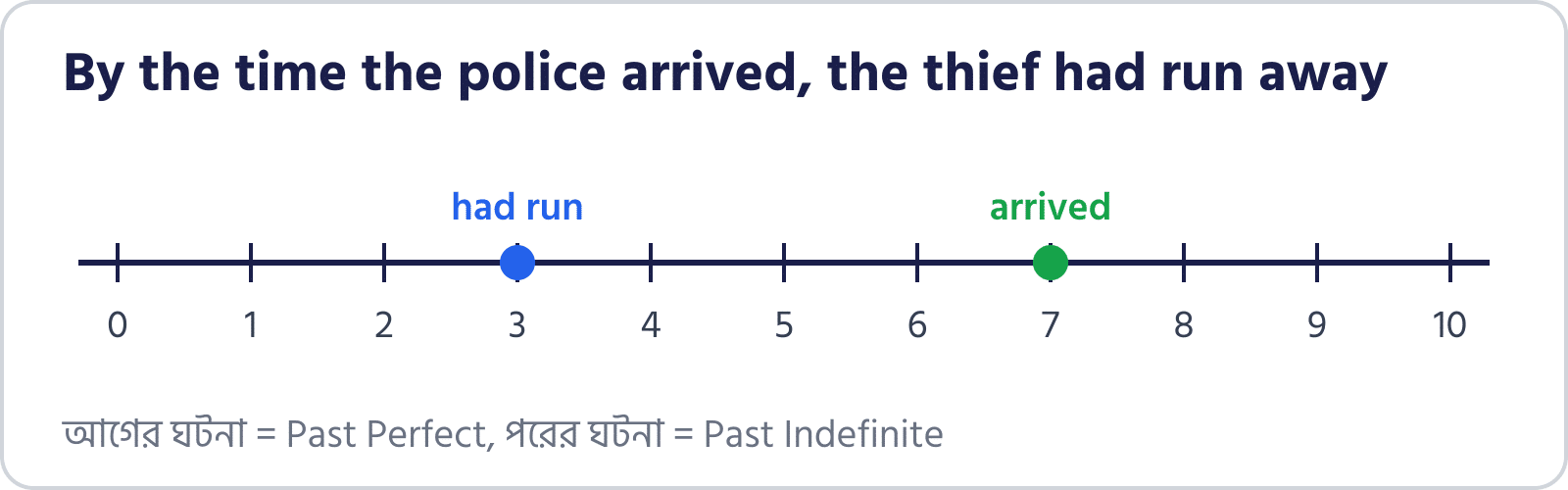
By the time the police arrived, the thief ___ away.
'By the time the police arrived' says the thief had already escaped before that. Of two past events, the earlier one takes the Past Perfect: had run. 'Has run' links to the present, 'runs' is a habit and 'will run' is future.
- Past Perfect = had + V3
- Of two past events: earlier = had + V3, later = V2
- by the time, before, already are the signals
- Don't put had on the later event (arrived)
- First had, then V2
Look! The baby ___.
'Look!' shows the action is going on right now, so the Present Continuous: is sleeping. 'Sleeps' is a habit, 'slept' is past and 'has slept' means the action is complete.
- Present Continuous = am/is/are + V-ing
- Look!, Listen!, now, at the moment are signals
- 'Always' with the Continuous shows annoyance: He is always complaining
- See Look or Listen? Think -ing
I ___ him yesterday.
'Yesterday' is a finished, definite past time, so the Past Indefinite: met. The Present Perfect (have met) cannot be used with a definite past time. 'Meet' is present and 'have been meeting' shows an ongoing action.
- yesterday, last week, in 2010, ago go with the Past Indefinite
- The Present Perfect never takes a definite past time
- 'I have met him yesterday' is a very common mistake
- A definite day or date means V2
| Tense | When | Example |
|---|---|---|
| Past Indefinite | definite past time | I met him yesterday. |
| Present Perfect | time not stated, result still matters | I have met him. |
If it rains tomorrow, we ___ the match.
When the if-clause has the Present Indefinite (rains), the main clause takes will + V1: a real future possibility. 'Would cancel' belongs to an imaginary case (If it rained...). 'Cancelled' and 'had cancelled' are past and cannot go with 'tomorrow'.
- If + Present Indefinite, ... will + V1
- No will in the if-clause
- 'Tomorrow' shows the future
- 'If it will rain' is wrong
- After If: Present, not will
The sun ___ in the east.
A universal truth or natural law takes the Present Indefinite: rises. 'Is rising' describes only this moment, and 'rose' and 'has risen' describe particular events, not a general truth.
- Universal truths take the Present Indefinite
- The Earth moves round the sun
- Water boils at 100°C
- A dated historical event takes V2: Gandhi was born in 1869
- Truth = always V1
She ___ for two hours when I called.
The waiting had been going on for two hours before the call, which is a past event. So the Past Perfect Continuous: had been waiting. 'Has been waiting' runs up to the present, 'waits' is a habit and 'will wait' is future.
- Past Perfect Continuous = had been + V-ing
- for + a length of time shows duration
- Don't mix has been and had been: a past second event needs had been
- had been + -ing = going on before a past point
Which sentence is correct?
'Know' is a stative verb (a state, not an action), so it is normally not used in the Continuous: He knows. 'Is knowing' is wrong, 'has know' is wrong because has needs V3 (known), and 'He knowing' has no helping verb.
- Stative verbs: know, like, love, want, believe, understand, belong
- They are normally not used with -ing
- See, think and have can be Continuous in other senses: I am having lunch
- State verbs: no -ing
| Stative verb (no -ing) | Example |
|---|---|
| know | He knows the answer. |
| like / love | She loves music. |
| want | I want water. |
| believe | They believe him. |
| belong | This book belongs to me. |
This time next week, I ___ on the beach at Digha.
At a particular time next week the action will be in progress, so the Future Continuous: will be sitting. 'Sit' is present, 'sat' is past and 'have sat' is the Present Perfect, which does not go with a future time.
- Future Continuous = will be + V-ing
- this time tomorrow or next week is the signal
- 'Will sit' only says it will happen, not that it is in progress
- Ongoing at a future moment = will be + -ing
Rahul ___ the book by the end of this month.
'By' with a future time means the action will be complete before that time: Future Perfect, will have + V3. 'Finished' and 'had finished' are past, and 'is finishing' is present continuous.
- Future Perfect = will have + V3
- by next month, by 2030, by the time he comes are signals
- No will in the 'by the time' clause: By the time he comes, I will have left
- by + future = will have + V3
| Tense | Form | Example |
|---|---|---|
| Future Indefinite | will + V1 | He will finish. |
| Future Continuous | will be + V-ing | He will be finishing. |
| Future Perfect | will have + V3 | He will have finished. |
'She had written the letter before he came.' What is the tense of 'had written'?
'Had' + V3 (written) is the Past Perfect, because the action was finished before another past event (he came). The Present Perfect has has/have, the Past Continuous has was/were + -ing, and the Past Indefinite is just V2.
- had + V3 = Past Perfect
- has/have + V3 = Present Perfect
- Don't call every V3 a Present Perfect: look at the helping verb first
- See had + V3? Past Perfect
📊 Topic Analysis
12 questions on tenses for the WBPSC Clerkship Part-I English paper, each answer explained.


Leave a Comment
Commenting as ·