
Decimals and Recurring Decimals Practice Quiz: WBPSC Clerkship 2024
A little practice. A step forward.
12 questions on decimals and recurring decimals for the WBPSC Clerkship 2024 arithmetic paper, with full working. 📖 Read the detailed topic
Express $0.\overline{7}$ as a common fraction.
One digit, 7, repeats, so the denominator is a single 9: $0.\overline{7} = \frac{7}{9}$. $\frac{7}{10}$ would be the terminating $0.7$, and $\frac{7}{99}$ is $0.\overline{07}$.
- One repeating digit gives denominator 9
- Two repeating digits give denominator 99
- $0.7$ and $0.\overline{7}$ are different
- As many 9s as repeating digits
What is the simplest fractional form of $0.\overline{45}$?
$0.\overline{45} = \frac{45}{99}$. The HCF of 45 and 99 is 9, so it reduces to $\frac{5}{11}$. $\frac{45}{100} = \frac{9}{20}$ is the terminating $0.45$, not the repeating one.
- Divide numerator and denominator by the HCF
- $\frac{5}{11} = 0.4545\ldots$
- Mixing up terminating $0.45$ with repeating $0.\overline{45}$
- $\frac{1}{11} = 0.\overline{09}$
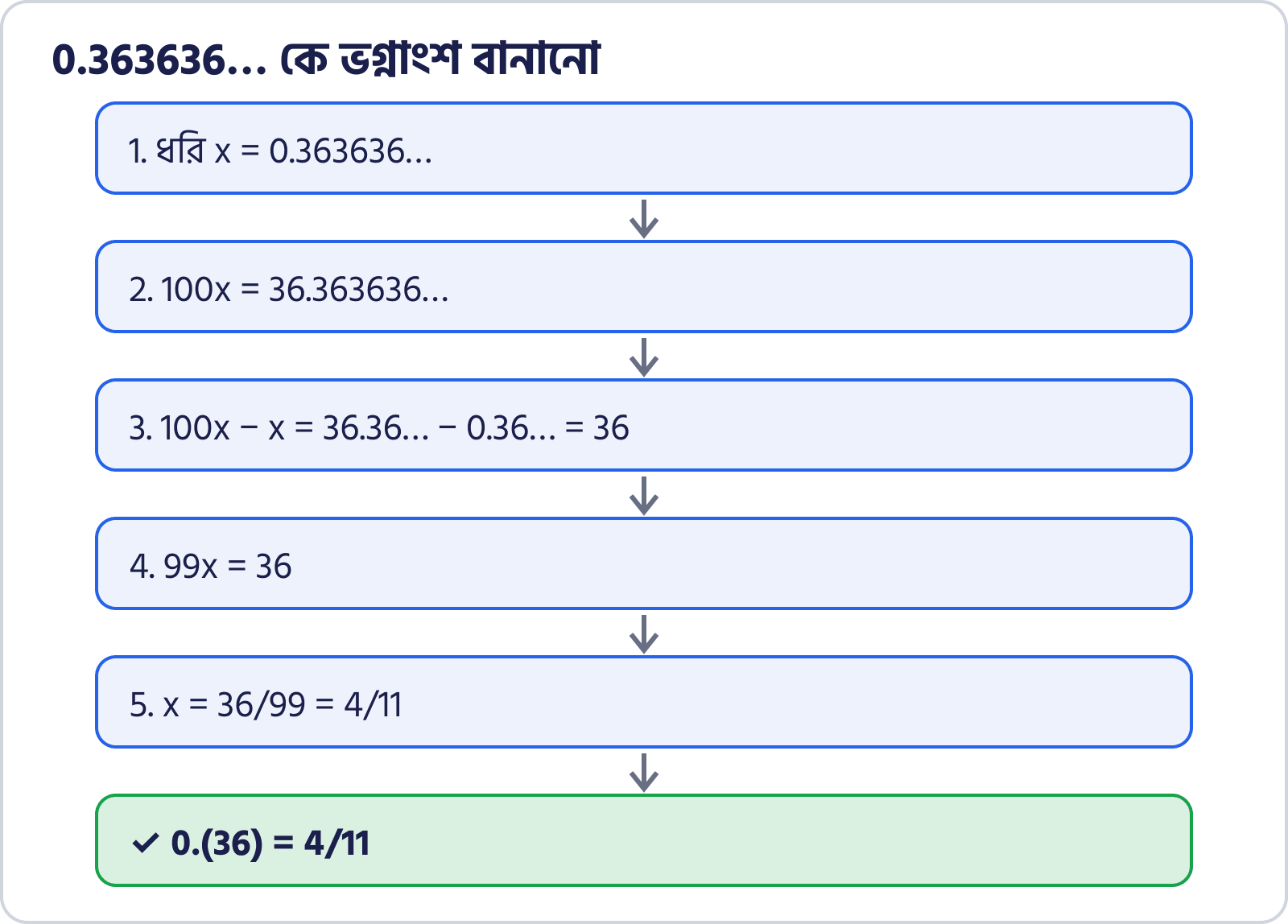
Convert $0.1\overline{6}$ into a fraction.
Mixed recurring: numerator $16 - 1 = 15$, denominator 90 (one 9 for the repeating digit, one 0 for the non-repeating digit). $\frac{15}{90} = \frac{1}{6}$. $\frac{8}{45}$ comes from forgetting to subtract and using $\frac{16}{90}$.
- Numerator = all digits − non-repeating digits
- Denominator = 9s then 0s
- Forgetting to subtract the non-repeating digits
- 9s first, then 0s
| Decimal | Numerator | Denominator | Fraction |
|---|---|---|---|
| $0.1\overline{6}$ | 16 − 1 = 15 | 90 | $\frac{1}{6}$ |
| $0.2\overline{3}$ | 23 − 2 = 21 | 90 | $\frac{7}{30}$ |
| $0.12\overline{5}$ | 125 − 12 = 113 | 900 | $\frac{113}{900}$ |
$0.2\overline{3}$ equals which fraction?
Numerator $23 - 2 = 21$, denominator 90, so $\frac{21}{90} = \frac{7}{30}$. Check: $7 \div 30 = 0.2333\ldots$. $\frac{23}{90}$ would be $0.2\overline{5}$.
- $\frac{7}{30} = 0.2\overline{3}$
- Reduce $ rac{21}{90}$ by 3
- Leaving 23 as the numerator
- Verify by dividing
| Fraction | Decimal |
|---|---|
| $\frac{7}{30}$ | $0.2\overline{3}$ |
| $\frac{23}{90}$ | $0.2\overline{5}$ |
| $\frac{23}{99}$ | $0.\overline{23}$ |
What is $0.\overline{36} + 0.\overline{63}$?
$\frac{36}{99} + \frac{63}{99} = \frac{99}{99} = 1$. Adding digit by digit and writing 0.99 is the trap: the repeating parts add up to a full 99 over 99.
- Add numerators over the same denominator
- $\frac{99}{99} = 1$
- Writing 0.99 instead of 1
- Repeating parts summing to 99 give 1
What is $0.6 \times 0.07$?
$6 \times 7 = 42$. Decimal places: $1 + 2 = 3$, so count three places from the right: $0.042$. 0.42 uses 2 places and 0.0042 uses 4.
- Places in the answer = sum of places in the factors
- Pad with a zero to fill the places
- Counting too few or too many places
- Count places, then place the point
- Multiply: $6 \times 7 = 42$
- Places: 0.6 (1) + 0.07 (2) = 3
- Write 42 in three places: $0.042$
What is $1.44 \div 0.12$?
Multiply both numbers by 100 to make the divisor a whole number: $144 \div 12 = 12$. Check: $12 \times 0.12 = 1.44$.
- Multiplying both numbers by the same power of 10 keeps the quotient
- Verify by multiplying back
- Misplacing the decimal point
- Make the divisor whole
| Step | Work |
|---|---|
| Multiply both by 100 | $144 \div 12$ |
| Divide | 12 |
| Check | $12 \times 0.12 = 1.44$ |
What is $\sqrt{0.0169}$?
$0.0169 = \frac{169}{10000}$, $\sqrt{169} = 13$ and $\sqrt{10000} = 100$, so the root is $\frac{13}{100} = 0.13$. Check: $0.13 \times 0.13 = 0.0169$. Four decimal places in the number means two in its root.
- Decimal places halve in a square root
- $13^2 = 169$
- Writing 0.013 (3 places)
- 4 places → 2 places
Which of these fractions has a terminating decimal?
$40 = 2^{3} \times 5$ has only the prime factors 2 and 5, so $\frac{7}{40} = 0.175$ terminates. 7 is a prime other than 2 and 5, and 12 and 15 each contain a 3, so the others repeat.
- Only 2 and 5 in the denominator means terminating
- Any other prime means recurring (unless cancelled)
- Judging before reducing to lowest terms
- 2 and 5 only = terminating
| Fraction | Factors of denominator | Decimal |
|---|---|---|
| $\frac{2}{7}$ | 7 | $0.\overline{285714}$ |
| $\frac{5}{12}$ | $2^{2} \times 3$ | $0.41\overline{6}$ |
| $\frac{4}{15}$ | $3 \times 5$ | $0.2\overline{6}$ |
| $\frac{7}{40}$ | $2^{3} \times 5$ | 0.175 |
Express $2.\overline{3}$ as an improper fraction.
$0.\overline{3} = \frac{1}{3}$, so $2.\overline{3} = 2 + \frac{1}{3} = \frac{7}{3}$. $\frac{23}{9} = 2.\overline{5}$ is wrong and $\frac{23}{10} = 2.3$ terminates.
- Keep the whole part aside and convert the decimal part
- $2\frac{1}{3} = \frac{7}{3}$
- Using 23 over 9
- Whole part + recurring part
Which of these numbers is the greatest?
Writing them out: $0.5$, $0.55$, $0.\overline{5} = 0.5555\ldots$, $0.\overline{54} = 0.5454\ldots$. In order: $0.5 \lt 0.5454\ldots \lt 0.55 \lt 0.5555\ldots$, so $0.\overline{5}$ is the greatest.
- Compare from the left, digit by digit
- Write each number to the same number of places
- Thinking 0.55 is larger because it looks finished
- Write all to 6 places
| Number | Up to 6 decimal places |
|---|---|
| 0.5 | 0.500000 |
| 0.55 | 0.550000 |
| $0.\overline{54}$ | 0.545454 |
| $0.\overline{5}$ | 0.555555 |
If sugar costs ₹42.40 per kg, what is the cost of 3.5 kg?
$3.5 \times 42.4$: $42.4 \times 3 = 127.2$ and $42.4 \times 0.5 = 21.2$, so the total is $127.2 + 21.2 = 148.4$, that is ₹148.40. The other options misplace a digit or the point.
- Split into whole and fractional parts
- Write the answer as rupees and paise
- Misplacing the decimal point (14.84, 148.04)
- 3.5 = 3 and a half
| Part | Work | Result |
|---|---|---|
| 3 kg | 42.4 × 3 | 127.2 |
| Half kg | 42.4 ÷ 2 | 21.2 |
| Total | 127.2 + 21.2 | 148.4 |
📊 Topic Analysis
12 questions on decimals and recurring decimals for the WBPSC Clerkship 2024 arithmetic paper, with full working.


Leave a Comment
Commenting as ·