
WBPSC Clerkship English: Subject-Verb Agreement Practice Quiz
A little practice. A step forward.
12 questions on subject-verb agreement, each answer explaining the rule and the trap. 📖 Read the detailed topic
Choose the correct word to fill the blank: Each of the boys ___ given a prize.
Each is always singular, so the verb must be singular: was. The noun boys after of only describes the group and is not the subject. Were, are and have are plural forms.
- Each, every, either and neither take a singular verb
- In each of + plural noun, the verb is singular
- Choosing a plural verb because of the plural noun after of
- Each, Every, Either, Neither: all four are singular
| Word | Verb | Example |
|---|---|---|
| Each of | singular | Each of the boys is |
| Every one of | singular | Every one of them was |
| Either of | singular | Either of the two is |
| Neither of | singular | Neither of them was |
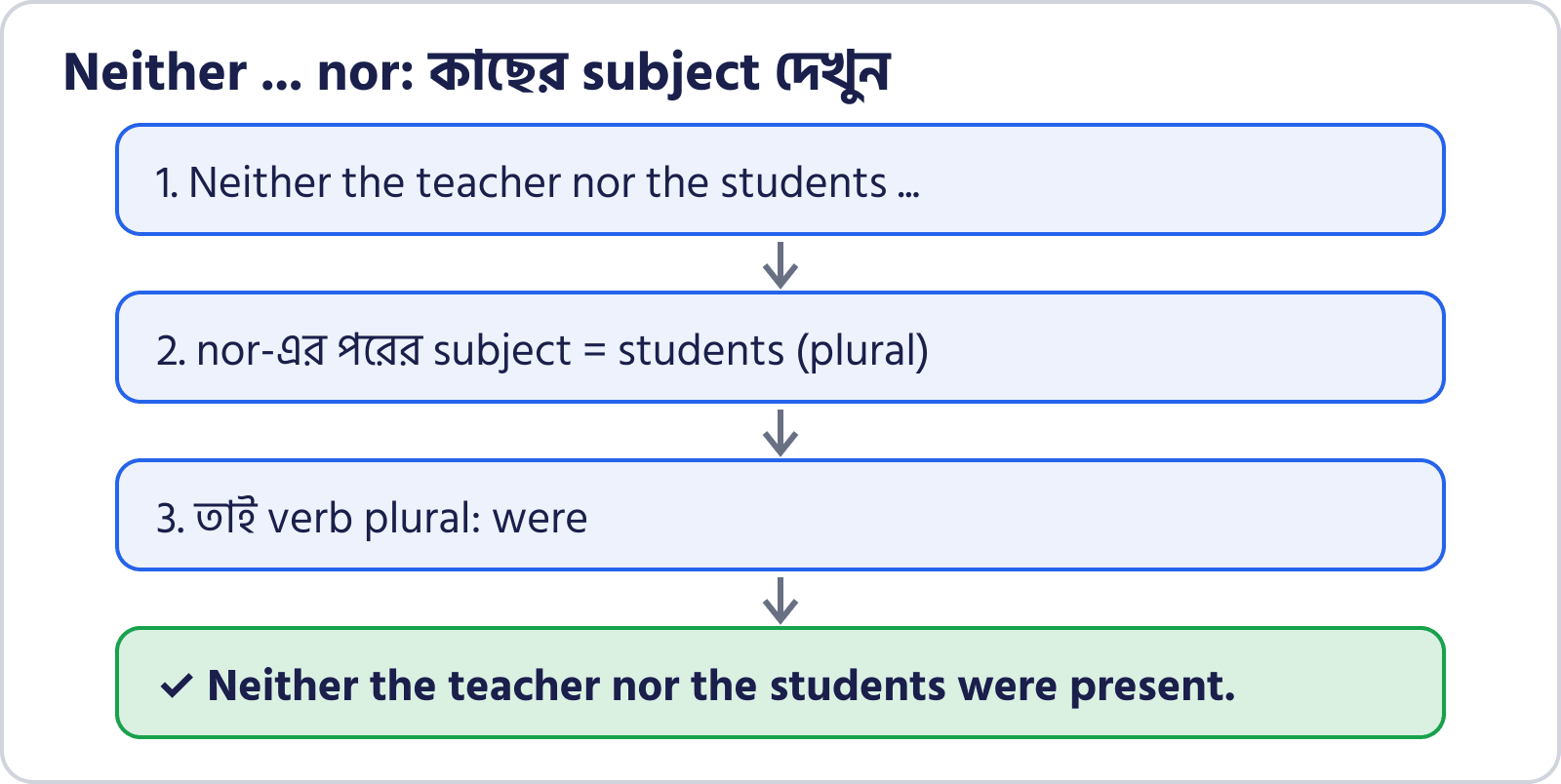
Choose the correct word to fill the blank: Neither the teacher nor the students ___ present.
With neither...nor the verb agrees with the nearer subject. The noun after nor is students (plural), so the verb is plural: were. Was, has been and is are all singular.
- Neither-nor, either-or, or, nor: the nearer subject decides
- A plural nearer subject needs a plural verb
- Using a singular verb because of the first subject, teacher
- The verb sits close to its nearest subject
Choose the correct word to fill the blank: Mathematics ___ my favourite subject.
Mathematics looks plural but names a single subject, so it takes a singular verb: is. Are, were and have been are plural forms.
- Mathematics, physics, economics and news are singular
- A final s does not make them plural
- Thinking the word is plural because it ends in s
- A subject name is one thing
| Word | Type | Example |
|---|---|---|
| mathematics, physics, economics, news | singular | The news is true. |
| scissors, trousers, spectacles, jeans | plural | My trousers are new. |
| the police, cattle, people | plural | The police are here. |
Choose the correct word to fill the blank: The teacher along with her students ___ going to the museum.
When along with comes in, the verb agrees with the first subject. The first subject is The teacher (singular), so the verb is is. Are, were and have been are plural.
- Along with, as well as and together with do not change the verb
- Read the sentence without the along with part
- Using a plural verb because of students
- Along with only accompanies the subject
Choose the correct word to fill the blank: A number of candidates ___ absent today.
A number of means many, so it behaves like a plural subject and the verb is are. Is, has been and was are singular.
- A number of + plural noun takes a plural verb
- The number of + plural noun takes a singular verb
- Mixing up A number of and The number of
- A number of = many; The number of = the count
| Pattern | Verb | Example |
|---|---|---|
| A number of + plural | plural | A number of seats are vacant. |
| The number of + plural | singular | The number of seats is 20. |
Choose the correct word to fill the blank: The number of vacancies ___ increased this year.
The number of refers to the count itself, so the subject is singular and the verb is has. Have, are and were are plural.
- The number of takes a singular verb
- The plural noun after of is only a description
- Choosing have because of vacancies
- The number = one count, so singular
Choose the correct word to fill the blank: Ten kilometres ___ a long distance to walk.
A distance, sum of money or period of time taken as one whole takes a singular verb: is. Are, were and have been are plural.
- Distance, money and time as one unit take a singular verb
- Five years is a long time
- Treating kilometres as separate things
- One measure = one unit = singular
Choose the correct word to fill the blank: The police ___ searching for the thief.
The police is always used with a plural verb: are. Is, has been and was are singular.
- The police takes a plural verb
- Cattle, people and poultry are plural too
- Treating police as a singular collective noun
- Police = plural, always
| Noun | Number | Example |
|---|---|---|
| police, cattle, people | plural | The cattle are grazing. |
| committee, jury, team | singular (acting as one) | The committee has decided. |
Choose the correct word to fill the blank: There ___ many reasons for the delay.
After There, the verb agrees with the noun that follows. The subject is reasons (plural), so the verb is are. Is, was and has are singular.
- There is not the subject
- The verb agrees with the following noun
- Always writing there is
- Look at the noun after there
Choose the correct word to fill the blank: One of my friends ___ a doctor.
In One of + plural noun the main subject is One (singular), so the verb is is. Are, were and have been are plural.
- One of + plural noun takes a singular verb
- The main subject is One
- Using are because of friends
- One = singular; friends only describes
Choose the correct word to fill the blank: Either he or I ___ responsible for the error.
With either...or the verb agrees with the nearer subject. The subject after or is I, so the verb is am. Is and are are wrong for I, and be does not fit a present-tense statement.
- Either-or: the nearer subject decides
- I takes am
- Using is because of the first subject, he
- I → am, he → is, you/they → are
| Subject | Present form of be |
|---|---|
| I | am |
| he, she, it | is |
| we, you, they | are |
Choose the correct word to fill the blank: He is one of those students who ___ always punctual.
The verb after who agrees with its antecedent, students (plural), so the verb is are. Is, was and has been are singular.
- Who, which and that take the number of the noun before them
- One of those + plural noun + who takes a plural verb
- Using a singular verb because of one
- Look at the plural noun just before who
📊 Topic Analysis
12 questions on subject-verb agreement, each answer explaining the rule and the trap.


Leave a Comment
Commenting as ·