
Clerkship 2024 Practice Quiz: Fractions
A little practice. A step forward.
12 questions on fractions with step-by-step explanations. 📖 Read the detailed topic
What is $\frac{3}{8} + \frac{5}{12}$?
The LCM of 8 and 12 is 24. $\frac{3}{8} = \frac{9}{24}$ and $\frac{5}{12} = \frac{10}{24}$, so the sum is $\frac{19}{24}$. Adding numerators and denominators separately ($\frac{8}{20}$) is wrong.
- Make the denominators equal before adding
- Use the LCM to keep numbers small
- Never add denominators
- First match the denominators, then add the numerators
Steps: LCM(8, 12) = 24 → 3×3 = 9, $5\times 2 = 10 \to \frac{9 + 10}{24} = \frac{19}{24}$.
Which is the largest of $\frac{3}{4}$, $\frac{4}{5}$, $\frac{5}{6}$ and $\frac{7}{8}$?
Look at each one's shortfall from 1: $\frac{1}{4}$, $\frac{1}{5}$, $\frac{1}{6}$, $\frac{1}{8}$. The smallest shortfall belongs to the largest fraction, $\frac{7}{8} (0.875)$. The others are 0.833, 0.8 and 0.75.
- When numerator and denominator differ by 1, the larger denominator gives the larger fraction
- Converting to decimals also works
- Thinking a bigger denominator means a bigger fraction
- Check how far each is below 1: the smaller the gap, the bigger the fraction
| Fraction | Decimal | Shortfall from 1 |
|---|---|---|
| $\frac{3}{4}$ | 0.75 | $\frac{1}{4}$ |
| $\frac{4}{5}$ | 0.8 | $\frac{1}{5}$ |
| $\frac{5}{6}$ | 0.833 | $\frac{1}{6}$ |
| $\frac{7}{8}$ | 0.875 | $\frac{1}{8}$ |
What is $\frac{5}{6}$ of 1800?
1800 ÷ 6 = 300, so $\frac{1}{6}$ is 300. $\frac{5}{6} = 300 \times 5 = 1500$. 1200 is $\frac{2}{3}$ of 1800 and 1080 is $\frac{3}{5}$ of it.
- 'Of' means multiply
- Divide by the denominator first, then multiply by the numerator
- Dividing by the numerator by mistake
- Divide to get one part, multiply to get many parts
What is $2\frac{1}{2} \div \frac{5}{6}$?
$2\frac{1}{2} = \frac{5}{2}$. Dividing means multiplying by the reciprocal: $\frac{5}{2} \times \frac{6}{5} = \frac{30}{10} = 3$. The 5s cancel, leaving $\frac{6}{2} = 3$.
- Convert the mixed number to an improper fraction first
- Flip the divisor and multiply
- Flipping the dividend instead of the divisor
- Divide = flip and multiply
Steps: $2\frac{1}{2} = \frac{2\times 2 + 1}{2} = \frac{5}{2} \to \frac{5}{2} \times \frac{6}{5} \to$ cancel to $\frac{6}{2} = 3$.
What is $\frac{3}{4} - \frac{2}{5} + \frac{1}{2}$?
The LCM of 4, 5 and 2 is 20. $\frac{3}{4} = \frac{15}{20}$, $\frac{2}{5} = \frac{8}{20}$, $\frac{1}{2} = \frac{10}{20}$. Then 15 − 8 + 10 = 17, so the answer is $\frac{17}{20}$. You would get $\frac{9}{20}$ only by subtracting the 10.
- Add and subtract numerators together once denominators match
- Convert all fractions to one common denominator in one go
- Mixing up the signs
- One LCM, one calculation
Which fraction lies between $\frac{1}{2}$ and $\frac{3}{4}$?
$\frac{1}{2} = \frac{4}{8}$ and $\frac{3}{4} = \frac{6}{8}$, so the fraction between them is $\frac{5}{8}$. $\frac{3}{8}$ and $\frac{1}{4}$ are smaller; $\frac{7}{8}$ is larger.
- Use a common denominator to compare
- The average of two fractions always lies between them
- Judging by the numerator alone
- Bring them to one denominator and look at the numerators
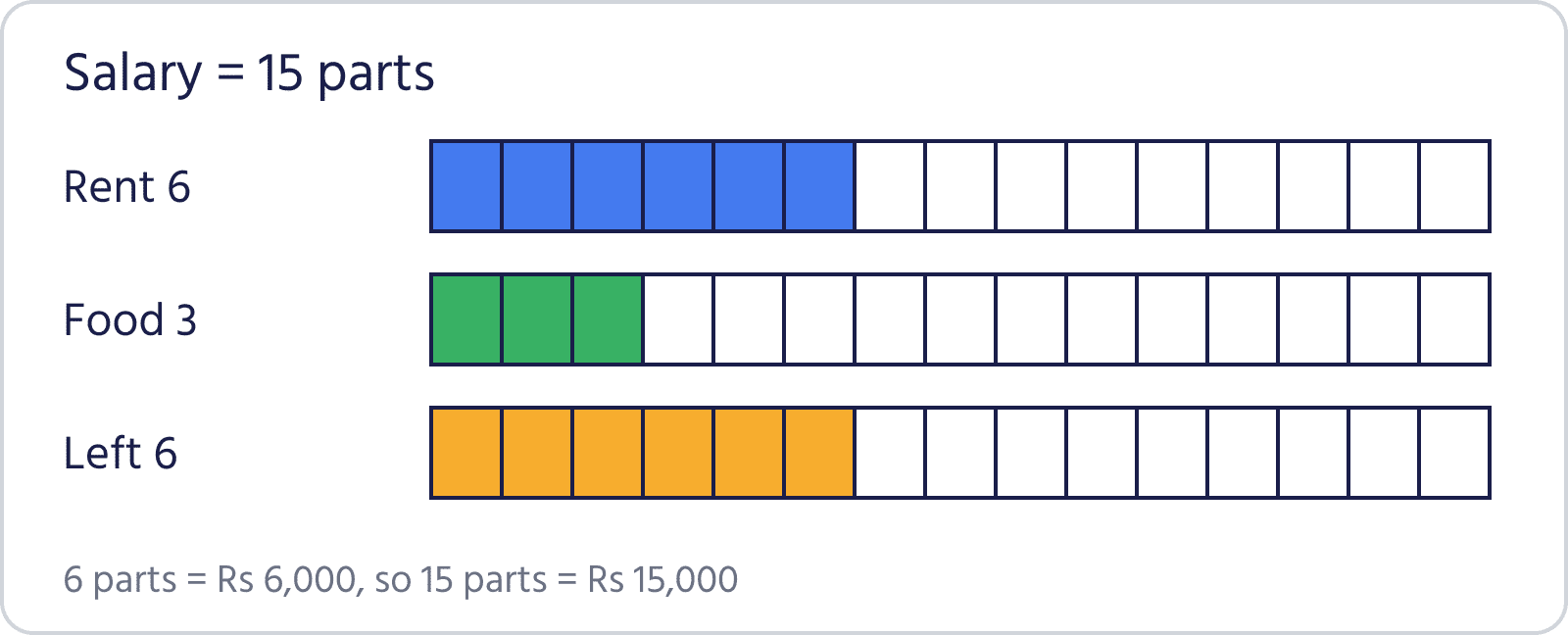
A man pays $\frac{2}{5}$ of his salary as rent and spends $\frac{1}{3}$ of the remainder on food. He is left with Rs 6,000. What is his salary?
After rent, $\frac{3}{5}$ remains. One third of that, $\frac{1}{5}$, goes on food. What is left is $\frac{3}{5} - \frac{1}{5} = \frac{2}{5}$. If $\frac{2}{5} =$ Rs 6,000 then $\frac{1}{5} =$ Rs 3,000, so the salary is Rs 15,000.
- 'Of the remainder' means take the fraction of what is left, not of the whole
- Taking the salary as 15 parts: rent 6, food 3, left 6
- Treating the food $\frac{1}{3}$ as a third of the whole salary
- Find the remainder first, then apply the next fraction
What is the sum of the reciprocals of $\frac{2}{3}$ and $\frac{3}{4}$?
The reciprocal of $\frac{2}{3}$ is $\frac{3}{2}$ and of $\frac{3}{4}$ is $\frac{4}{3}$. Adding: $\frac{3}{2} + \frac{4}{3} = \frac{9}{6} + \frac{8}{6} = \frac{17}{6}$. The original fractions add up to $\frac{17}{12}$, so the other options come from wrong methods.
- The reciprocal of $\frac{a}{b}$ is $\frac{b}{a}$
- A fraction times its reciprocal is 1
- Adding the original fractions ($\frac{17}{12}$) instead
- Flip it to get the reciprocal
The original fractions add to $\frac{2}{3} + \frac{3}{4} = \frac{17}{12}$, but the question asks for the reciprocals: $\frac{3}{2} + \frac{4}{3} = \frac{17}{6}$.
If $\frac{7}{8}$ of a number is 490, what is the number?
If $\frac{7}{8}$ is 490 then $\frac{1}{8}$ is 490 ÷ 7 = 70, and the whole is 70 × 8 = 560. Check: $\frac{7}{8}$ of 560 = 70 × 7 = 490.
- Whole = part × (denominator/numerator)
- Always verify by taking the fraction of your answer
- Multiplying 490 by $\frac{7}{8}$, which gives a smaller number
- Multiply by the flipped fraction to get the whole
A tank was $\frac{3}{4}$ full. After 30 litres were drawn out it was half full. What is the capacity of the tank in litres?
Water drawn out $= \frac{3}{4} - \frac{1}{2} = \frac{1}{4}$ of the tank. If $\frac{1}{4} = 30$ litres, the full tank = 30 × 4 = 120 litres. Check: $\frac{3}{4}$ of 120 = 90 and 90 − 30 = 60, which is half of 120.
- Turn the change itself into a fraction
- Change ÷ fraction = whole
- Matching 30 litres with $\frac{1}{2}$ or $\frac{3}{4}$ directly
- Write down what fraction changed first
Steps: $\frac{3}{4} - \frac{1}{2} = \frac{3}{4} - \frac{2}{4} = \frac{1}{4} \to \frac{1}{4} = 30$ L → whole = 120 L.
What is the value of $(\frac{1}{2} + \frac{1}{3}) \div (\frac{1}{2} - \frac{1}{3})$?
$\frac{1}{2} + \frac{1}{3} = \frac{5}{6}$ and $\frac{1}{2} - \frac{1}{3} = \frac{1}{6}$. Dividing: $\frac{5}{6} \div \frac{1}{6} = \frac{5}{6} \times 6 = 5$. You get $\frac{1}{5}$ by swapping dividend and divisor, and $\frac{5}{6}$ is merely the sum.
- Work out the brackets first
- Dividing fractions with the same denominator just divides the numerators
- Swapping the dividend and the divisor
- Brackets first, then divide
Note: $\frac{5}{6} \div \frac{1}{6} = 5 \div 1 = 5$, because both have the same denominator (6).
What must be added to $\frac{5}{6}$ to get $1\frac{1}{3}$?
$1\frac{1}{3} = \frac{4}{3} = \frac{8}{6}$. Then $\frac{8}{6} - \frac{5}{6} = \frac{3}{6} = \frac{1}{2}$. Check: $\frac{5}{6} + \frac{3}{6} = \frac{8}{6} = \frac{4}{3} = 1\frac{1}{3}$.
- Number to add = target − given number
- Convert the mixed number to an improper fraction before subtracting
- Forgetting the whole-number part of $1\frac{1}{3}$
- Subtract directly: target minus what you have
📊 Topic Analysis
12 questions on fractions with step-by-step explanations.


Leave a Comment
Commenting as ·