
Articles (a, an, the) Practice Quiz Round 2: WBPSC Clerkship 2024 English
A little practice. A step forward.
Twelve questions from the second lesson on articles: a few and the few, twice a day, play the violin, by train, such a. No timer; read the explanation after each answer. 📖 Read the detailed topic
He visits his village twice ___ month.
The meaning is 'two times every month'. In the sense of 'per', English uses a or an, and month begins with a consonant sound, so a. The would point to one particular month, which is not meant, and 'twice month' without an article is not English.
- a or an in the sense of 'per': once a week, ₹60 a kilo
- an before a vowel sound: 80 km an hour
- This a can be replaced by per without changing the meaning
- Put 'per' in the blank; if it fits, the answer is a or an.
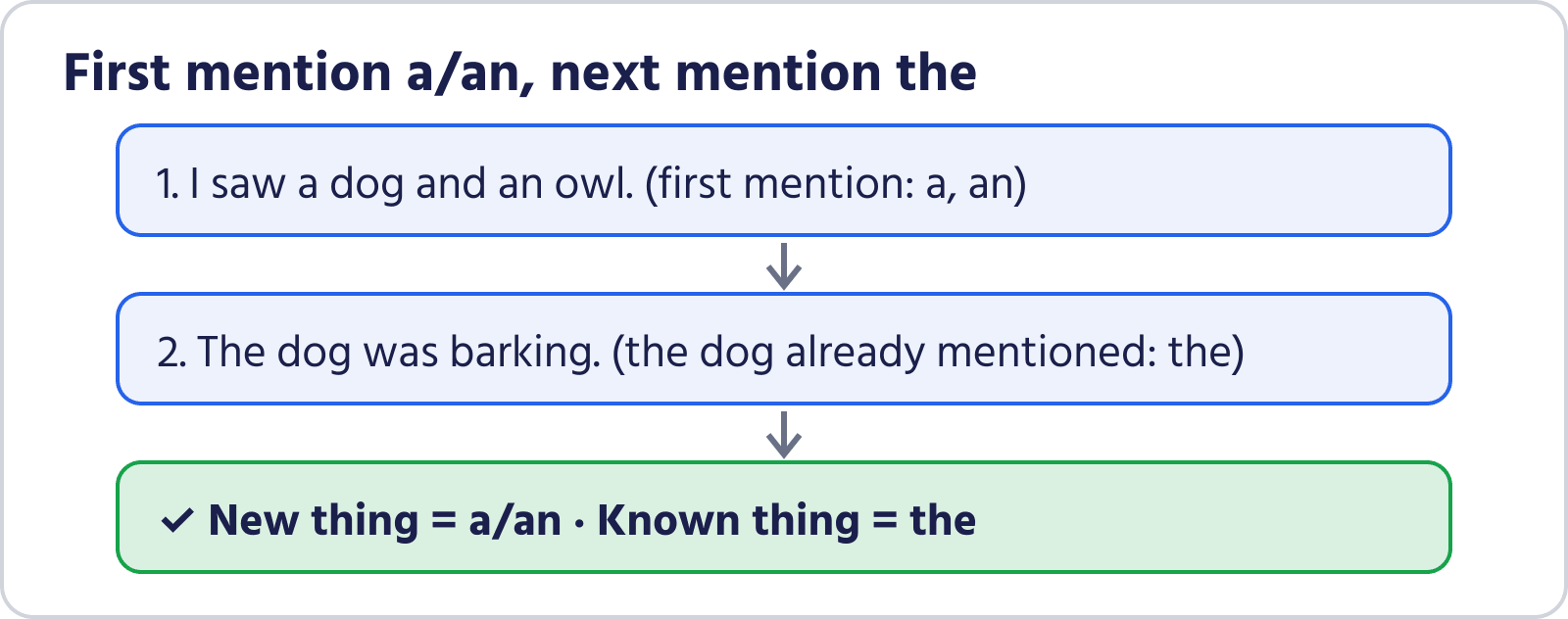
I met a boy and a girl at the station. ___ boy was carrying a heavy bag.
The first sentence has already introduced the boy with 'a boy'. The second sentence speaks of that same boy, so he is now definite: The boy. 'A boy' would mean some new boy, and a singular countable noun like boy cannot stand without an article.
- a or an at the first mention
- the when the same thing is mentioned again
- A singular countable noun does not stand alone
My sister plays ___ violin very well.
When we speak of playing a musical instrument, the comes before its name: play the violin, play the tabla. Games take no article (play cricket), which is why many wrongly choose 'no article' here. 'A violin' would mean any one violin, not the skill of playing it.
- play + musical instrument: the
- play + game: no article
- learn the guitar, practise the flute follow the same rule
- play cricket (no article) but play the violin (the): check whether a game or an instrument follows play.
We travelled to Siliguri by ___ train.
After by, the name of a vehicle shows the means of travel, not a particular vehicle, so no article is used: by train, by bus, by air. To use the or a, the preposition has to change: in the train, on a bus.
- by bus, by train, by car, by air: no article
- Walking: on foot
- With in or on an article is used: in the train
- by train (no article), but in the train or on the 6 o'clock train (a particular train).
What ___ interesting story it was!
In an exclamation, what is followed by a or an when the noun is singular and countable. Whether it is a or an depends on the sound of the word right after the article: interesting begins with a vowel sound, so an. Choosing a by looking at story is the mistake.
- What a fine day! What an idea!
- a or an: look at the first sound of the very next word
- No article with plural or uncountable nouns: What lovely flowers!
- Look at the word touching the article, not the noun further on.
___ honesty of the young clerk impressed everyone.
Honesty is the name of a quality; in a general sense it takes no article (Honesty is the best policy). Here 'of the young clerk' tells us whose honesty, so it is specific and takes The. The silent h may tempt you towards An, but honesty is uncountable, so a or an is not possible.
- Name of a quality in a general sense: no article
- the when an of-phrase makes it specific
- an honest man is right because man is countable
- Honesty is the best policy (no article), but The honesty of the clerk (the).
He has ___ few friends, so he never feels lonely.
'So he never feels lonely' shows that he does have some friends, a positive sense: a few. Few alone means 'almost none', which does not fit with never feeling lonely. The few is used when the sentence goes on to say which ones (the few friends he has).
- a few = some, a small number
- few = almost none
- the few = all of the small number there is
- few and a few differ by one a, but the meanings are opposite.
- With a, there are some; without a, there are hardly any.
| Form | Meaning | Example |
|---|---|---|
| few / little | almost none (negative) | He has few friends. There is little water. |
| a few / a little | some, though not many or much (positive) | He has a few friends. There is a little water. |
| the few / the little | all of the small number or amount there is | The few friends he has are sincere. The little water we had was used up. |
few goes with countable nouns, little with uncountable nouns
___ little milk that was in the jug has turned sour.
'That was in the jug' makes the milk specific, and the sentence says all of that small amount has gone sour. That sense needs the little. A little only means 'some', and little means 'hardly any'; neither is followed by such a defining clause.
- the little = all of the small amount there is
- a little = some, a small amount
- little goes with uncountable nouns: milk, water, money
| Form | Meaning | Example |
|---|---|---|
| few / little | almost none (negative) | He has few friends. There is little water. |
| a few / a little | some, though not many or much (positive) | He has a few friends. There is a little water. |
| the few / the little | all of the small number or amount there is | The few friends he has are sincere. The little water we had was used up. |
few goes with countable nouns, little with uncountable nouns
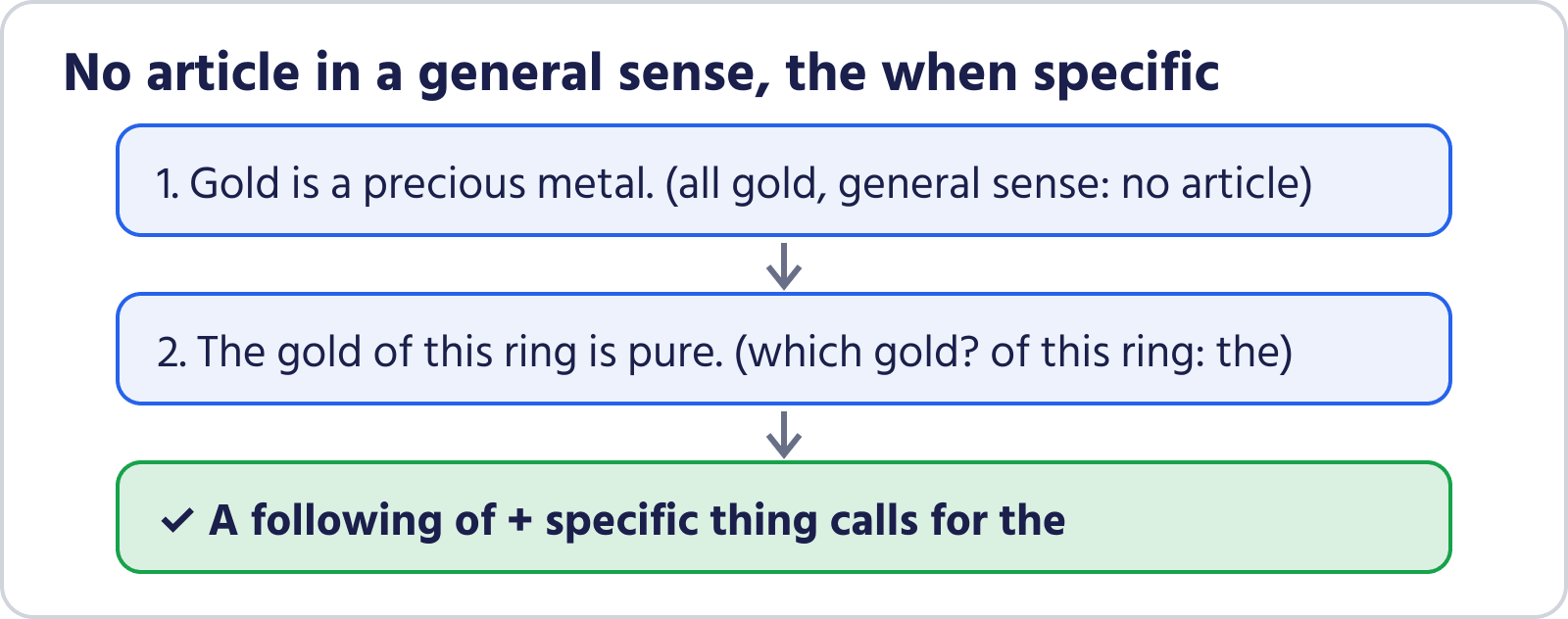
___ gold is a precious metal.
Gold is the name of a material, and the sentence speaks of all gold in general, so no article is used. A material noun is uncountable, so a or an is not possible. The would be right only for some particular gold: The gold of this ring is pure.
- Material noun in a general sense: no article (Gold, Iron, Water)
- the when specific: the water of this well
- The later a (a precious metal) belongs to metal, not to gold
Choose the correct sentence.
With such the order is such + a or an + adjective + noun: such a kind lady. So 'a such' and 'such kind a' are both wrong. Kind begins with a consonant sound, so it is a, not an.
- such a kind lady, such an honest man
- The same order with what and quite: What a day! quite a long way
- With so the order changes: so kind a lady
- such a kind lady, but so kind a lady: after such the article comes first, after so the adjective comes first.
The secretary and treasurer ___ absent from yesterday's meeting.
The appears only once (The secretary and treasurer), so one person holds both posts. The subject is one person, so the verb is singular, and yesterday's calls for the past tense: was. For two different persons it would be The secretary and the treasurer were absent.
- Article once = one person, singular verb
- Article twice = two persons, plural verb
- a black and white dog = one dog; a black and a white dog = two dogs
- Do not choose a plural verb just because of and; first count the articles.
- Count the articles: one the means one person.
| Sentence | How many | Verb |
|---|---|---|
| The secretary and treasurer was present. | one person, two posts | singular |
| The secretary and the treasurer were present. | two different persons | plural |
| I have a black and white dog. | one dog, two colours | – |
| I have a black and a white dog. | two dogs | – |
Kalidasa is called ___ Shakespeare of India.
A person's name normally takes no article. Here, however, Shakespeare himself is not meant; Kalidasa is being compared with him, and 'of India' makes the phrase specific. In such comparisons the comes before the name.
- the before a name used for comparison: the Shakespeare of India
- Normally no article before a name: Shakespeare wrote plays
- Here the name works like a common noun
- Do not pick 'no article' just because it is a name; of + a country or place after it signals a comparison, so the.
📊 Topic Analysis
Twelve questions from the second lesson on articles: a few and the few, twice a day, play the violin, by train, such a. No timer; read the explanation after each answer.


Leave a Comment
Commenting as ·