
Gupta Age Quiz: WBPSC Clerkship GK
A little practice. A step forward.
Ten questions on the Gupta emperors, their achievements, literature, science and coinage. 📖 Read the detailed topic
The Gupta era began in which year?
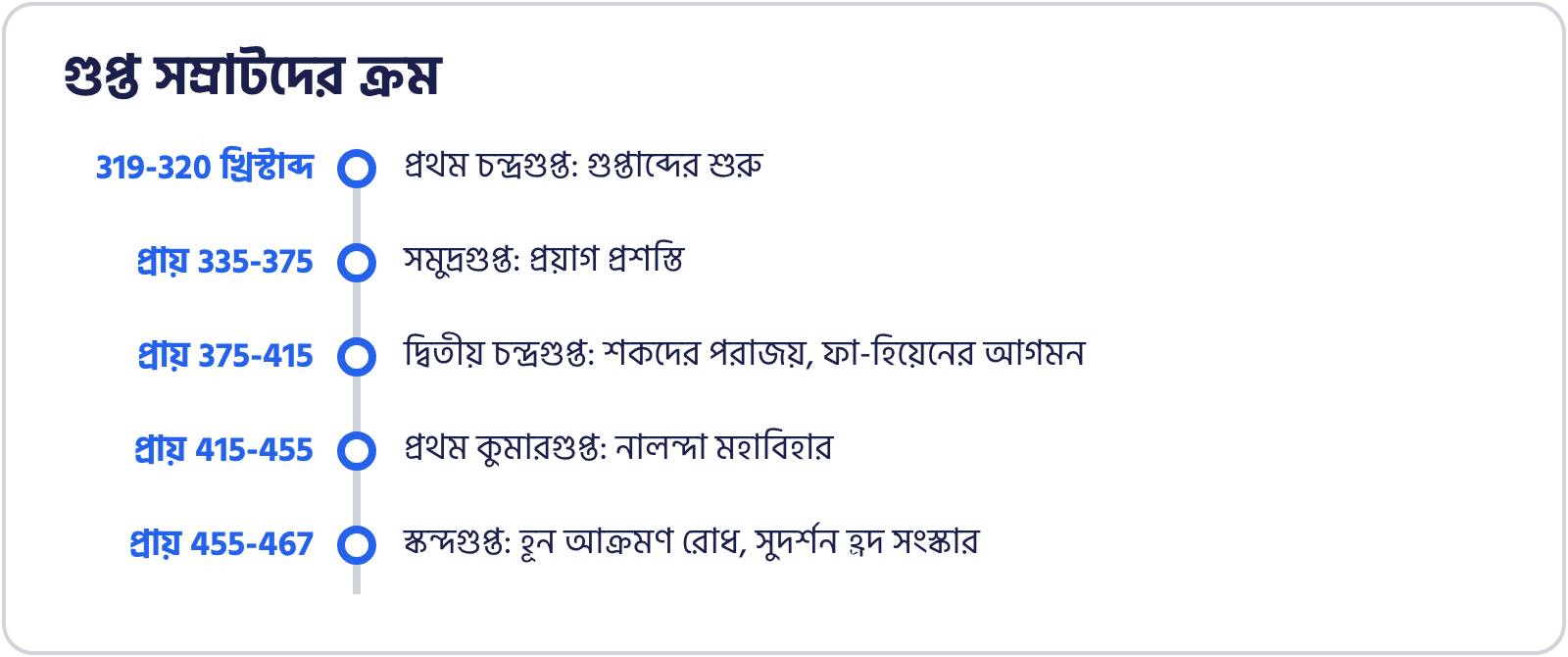
The Gupta era counts from 319-320 CE, the accession of Chandragupta I. 78 CE marks the Shaka era, 58 BCE the Vikrama Samvat, and 606 CE the accession of Harshavardhana.
- Gupta era = 319-320 CE
- Shaka era = 78 CE
- Vikrama Samvat = 58 BCE
- Shaka and Gupta eras are often mixed up
- Gupta 319, Shaka 78, Vikram 58 (BCE)
| Era | Starts |
|---|---|
| Vikrama Samvat | 58 BCE |
| Shaka era | 78 CE |
| Gupta era | 319-320 CE |
Who composed the Prayag Prashasti (Allahabad Pillar inscription)?
The Prayag Prashasti was composed by Harishena, court poet of Samudragupta. Kalidasa was a poet and dramatist, Banabhatta served Harshavardhana (Harshacharita), and Ravikirti wrote the Aihole inscription of the Chalukya king Pulakeshin II.
- Main source for Samudragupta's conquests
- Carved on an Ashokan pillar at Allahabad
- Written in Sanskrit
- Aihole (Ravikirti) and Prayag (Harishena) are different
- Samudra - Prashasti - Harishena
Which Gupta emperor did Vincent Smith call the 'Napoleon of India'?
Vincent Smith gave Samudragupta this title for his string of military victories. Chandragupta I laid the foundation of the empire but is not known as a conqueror, while Kumaragupta I and Skandagupta mainly defended the empire.
- Annexed northern kings, took submission from the south
- Performed the Ashvamedha sacrifice
- Issued veena-playing coins
- Napoleon = Samudra, both conquerors
The iron pillar at Mehrauli, Delhi is usually associated with which Gupta emperor?
The pillar carries an inscription praising a king named 'Chandra', usually identified as Chandragupta II. The word 'usually' is used because scholars differ slightly on the identification, but textbooks accept this answer.
- The iron has not rusted in many centuries
- It shows Gupta skill in metallurgy
- Iron + Chandra = Mehrauli
Which Chinese Buddhist pilgrim visited India during Chandragupta II's reign?
Fa-Hien came around 399-414 CE, collected Buddhist texts and described the peace of Gupta rule. Hiuen Tsang came in the 7th century under Harshavardhana and I-tsing in the late 7th century. Megasthenes was a Greek ambassador at the court of Chandragupta Maurya, not Chinese.
- Fa-Hien = Chinese, Gupta period
- Hiuen Tsang = Chinese, Harsha's period
- Megasthenes = Greek, Mauryan period
- The two Chandraguptas (Gupta and Maurya) and their visitors are easy to mix up
- Fa-Hien = first Chinese visitor of the three
| Traveller | Country | Period |
|---|---|---|
| Megasthenes | Greece | Chandragupta Maurya |
| Fa-Hien | China | Chandragupta II (Gupta) |
| Hiuen Tsang | China | Harshavardhana |
Who is regarded as the founder of the Nalanda Mahavihara?
Kumaragupta I is regarded as the founder of Nalanda. Later Gupta and other rulers enriched it. Ashoka and Harsha patronised Buddhism but are not credited with founding Nalanda, and Skandagupta is remembered for resisting the Hunas.
- Located in present-day Bihar
- Foreign students came to study here
- Hiuen Tsang studied here
- Kumara + Nalanda
Which Gupta emperor repulsed the Huna invasion from Central Asia?
Skandagupta repulsed the Hunas, though the long struggle drained the treasury. The Hunas did not enter India under Samudragupta or Chandragupta II. Pressure began late in Kumaragupta's reign, but the credit for the defence goes to Skandagupta.
- The Junagadh inscription records the repair of Sudarshana lake
- Later Huna leaders Toramana and Mihirakula attacked India
- The empire weakened and broke up afterwards
- Skanda - Huna
What is the title of the work written by Aryabhata?
Aryabhata wrote the Aryabhatiya in 499 CE, covering mathematics and astronomy. The Brihat Samhita was written by Varahamihira, and the Brahmasphutasiddhanta by the seventh-century mathematician Brahmagupta. The Surya Siddhanta is not tied to a single known author.
- Aryabhatiya dates to 499 CE
- He stated that the Earth rotates on its axis
- He gave a good approximation of pi
- Varahamihira (Brihat Samhita) and Brahmagupta (Brahmasphutasiddhanta) appear alongside
- Arya + Bhata = Aryabhatiya (the name matches)
| Scholar | Work |
|---|---|
| Aryabhata | Aryabhatiya |
| Varahamihira | Brihat Samhita, Panchasiddhantika |
| Brahmagupta | Brahmasphutasiddhanta |
What were the gold coins of the Gupta period called?
The gold coins of the Gupta emperors were called dinaras. The karshapana was a punch-marked silver coin of the Mauryan and earlier periods, the tanka a Delhi Sultanate coin, and the pana a unit of copper punch-marked coins.
- Samudragupta's veena-player and Ashvamedha coins are famous
- Gupta gold coins have been found in large numbers
- Mauryan karshapana and Gupta dinara belong to different periods
- Gupta + Dinara = gold
Who wrote the play 'Abhijnanashakuntalam'?
Abhijnanashakuntalam was written by Kalidasa. Vishakhadatta wrote Mudrarakshasa, Shudraka wrote Mricchakatika, and Amarasimha compiled the Sanskrit dictionary Amarakosha. By tradition Kalidasa graced the court of Chandragupta II.
- Kalidasa also wrote Meghaduta and Raghuvamsha
- Mudrarakshasa deals with Chanakya and Chandragupta Maurya
- Mricchakatika is a social drama
- The authors of Mudrarakshasa and Mricchakatika are easily confused
- Shakuntala = Kalidasa
| Author | Work |
|---|---|
| Kalidasa | Abhijnanashakuntalam, Meghaduta |
| Vishakhadatta | Mudrarakshasa |
| Shudraka | Mricchakatika |
| Amarasimha | Amarakosha |
📊 Topic Analysis
Ten questions on the Gupta emperors, their achievements, literature, science and coinage.


Leave a Comment
Commenting as ·