
Average Practice Quiz: WBPSC Clerkship 2024
A little practice. A step forward.
12 questions on averages from the arithmetic section, each with a worked explanation. 📖 Read the detailed topic
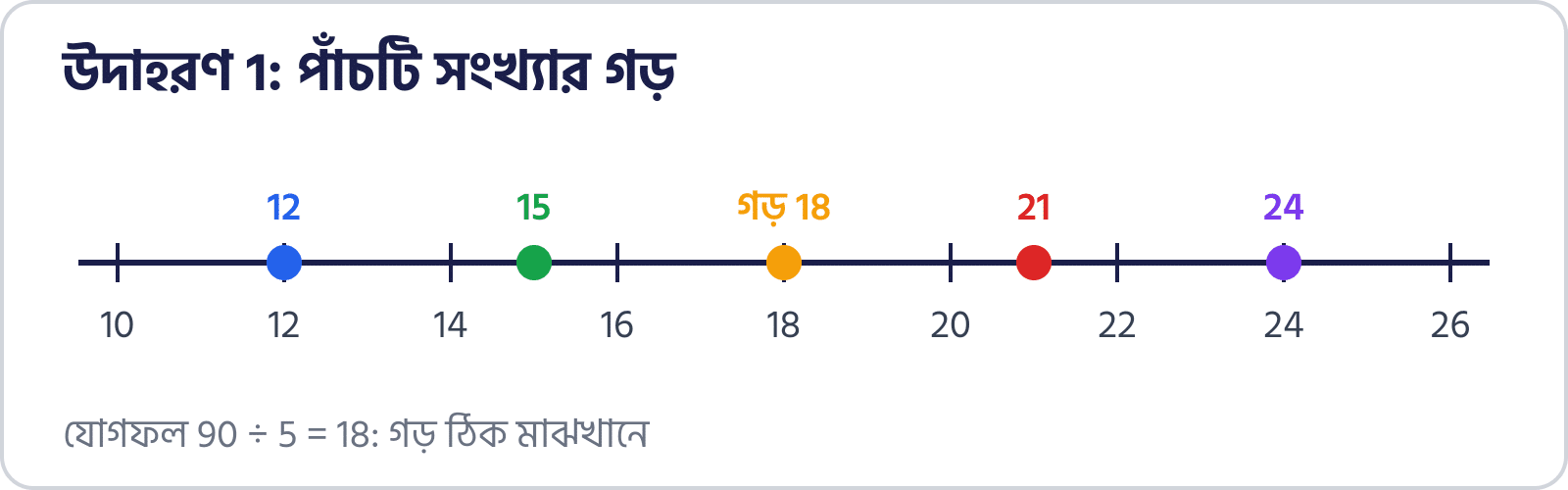
What is the average of the five numbers 18, 24, 30, 36 and 42?
The sum is $18 + 24 + 30 + 36 + 42 = 150$, so the average is $150 \div 5 = 30$. The numbers rise by a constant 6, so the average is simply the middle term, 30. With 28 or 32 the sum would not match.
- Average $=$ sum of the numbers $\div$ how many numbers
- For equally spaced numbers the average is the middle term
- Equal gaps: the middle number is the average, no adding needed
The average of 5 numbers is 20. If a sixth number is 32, what is the average of the six numbers?
The sum of the first five is $5 \times 20 = 100$. With the sixth, the sum is $100 + 32 = 132$, so the new average is $132 \div 6 = 22$. For 21 or 23 the sixth number would have to be 26 or 38.
- Sum $=$ average $\times$ number of items
- When an item is added, rebuild the sum first, then divide by the new count
- Go back to the total first, then change it
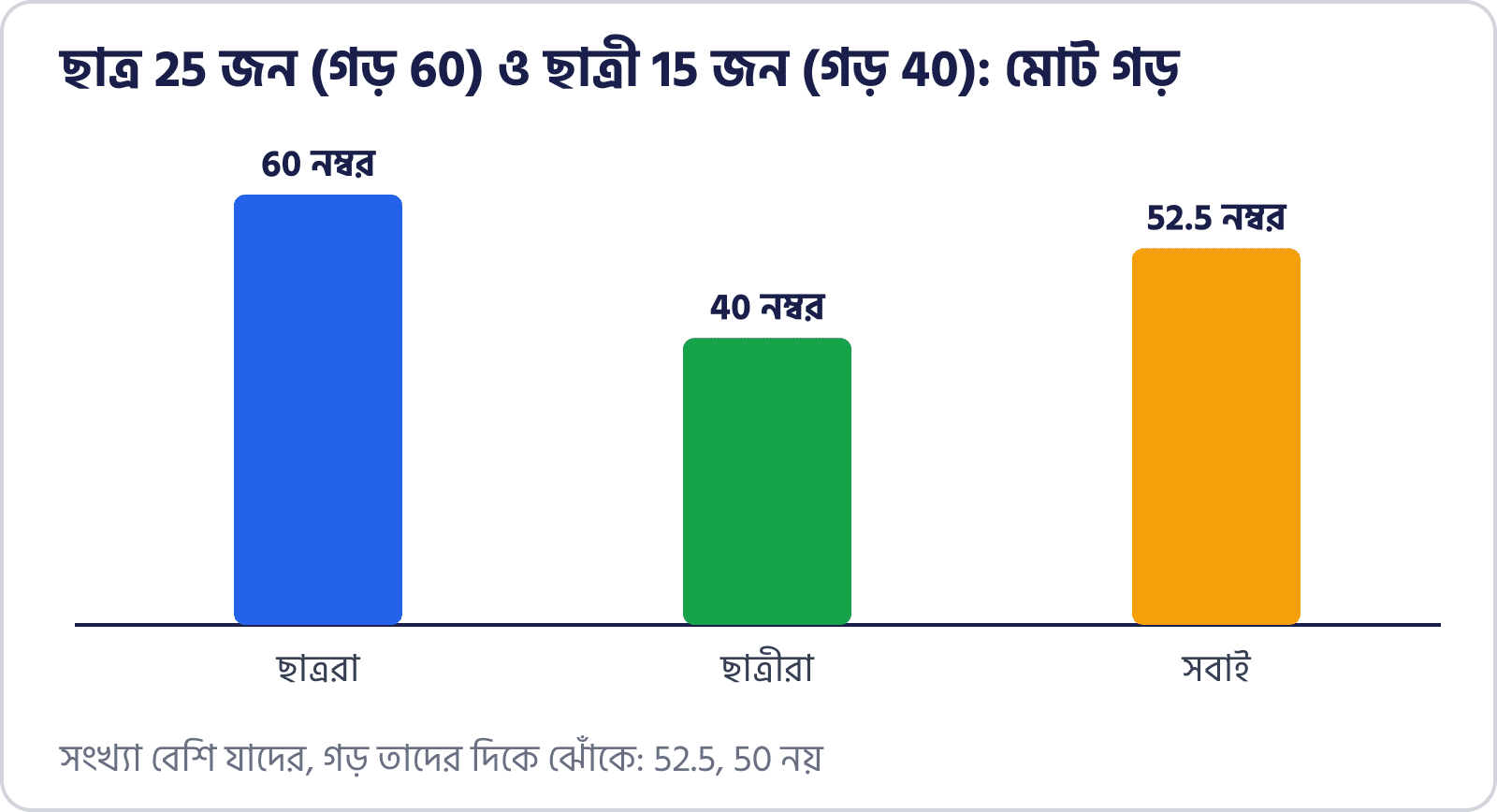
In a class, 25 boys average 60 marks and 15 girls average 40 marks. What is the average of all 40 students?
The boys' total is $25 \times 60 = 1500$ and the girls' is $15 \times 40 = 600$. Together $2100$ marks for $40$ students gives $2100 \div 40 = 52.5$. Taking the simple mean 50 of 60 and 40 is wrong because the two groups differ in size.
- Combined average $=$ total marks $\div$ total students
- Unequal group sizes rule out the simple mean
- Taking 50, the simple mean of 60 and 40, is wrong unless both groups are the same size
- The average leans toward the bigger group
What is the average of the first 20 natural numbers?
The average of the first $n$ natural numbers is $\frac{n+1}{2}$. With $n = 20$ it is $\frac{21}{2} = 10.5$. Check: the sum is $\frac{20 \times 21}{2} = 210$ and $210 \div 20 = 10.5$.
- Average of the first $n$ natural numbers $= \frac{n+1}{2}$
- Their sum is $\frac{n(n+1)}{2}$
- Average of the first and last term is the average of the whole run
| n | Sum | Average |
|---|---|---|
| 10 | 55 | 5.5 |
| 20 | 210 | 10.5 |
| 50 | 1275 | 25.5 |
The average of seven consecutive numbers is 20. What is the smallest of them?
The average of consecutive numbers is the middle one, so the fourth number is 20. Going down three steps gives 19, 18, 17, so the smallest is 17. Check: 17 to 23 sum to 140 and $140 \div 7 = 20$.
- For an odd count of consecutive numbers, the average is the middle term
- Smallest of seven $=$ middle $- 3$
- Seven numbers: step down 3 from the middle
The average of four numbers is 15. When one is removed, the average of the other three is 12. What is the number removed?
The total of four is $4 \times 15 = 60$ and the total of three is $3 \times 12 = 36$. The removed number is $60 - 36 = 24$.
- Removed number $=$ old total $-$ new total
- The gap between the two totals is the missing number
A candidate's average over five subjects is 72. How many marks must the sixth subject bring to make the six-subject average 75?
The five subjects total $5 \times 72 = 360$. A six-subject average of 75 needs $6 \times 75 = 450$, so the sixth subject must bring $450 - 360 = 90$. With 87 the total would be 447, an average of 74.5.
- Marks needed $=$ target total $-$ total so far
- Build the target total, subtract what you have
A traveller goes at 30 km per hour and returns along the same road at 20 km per hour. What is the average speed for the whole journey, in km per hour?
For equal distances, average speed $= \frac{2xy}{x+y} = \frac{2 \times 30 \times 20}{30+20} = \frac{1200}{50} = 24$. Check with a 60 km road: 2 hours out, 3 hours back, 120 km in 5 hours gives 24. The simple mean 25 is wrong because more time is spent at the slower speed.
- Equal distances: average speed $= \frac{2xy}{x+y}$
- Average speed $=$ total distance $\div$ total time
- Taking 25, the simple mean of 30 and 20, is wrong because the time spent at each speed differs
- Round-trip average speed is below the simple mean
The average age of 10 people is 30 years. If a 48-year-old leaves, what is the average age of the rest?
The total age is $10 \times 30 = 300$. Without the 48-year-old it is $300 - 48 = 252$ for 9 people, so the average is $252 \div 9 = 28$. Someone older than the average leaving pulls the average down, so it cannot stay 30 or rise.
- Removing a value above the average lowers the average
- New average $=$ (total $-$ removed) $\div$ (count $- 1$)
- An older person leaving pulls the average down
The average of three numbers is 14 and they are in the ratio $1 : 2 : 3$. What is the largest?
The total is $3 \times 14 = 42$. The ratio parts add up to $1 + 2 + 3 = 6$, so one part is $42 \div 6 = 7$. The numbers are 7, 14, 21 and the largest is 21.
- With a ratio and an average, find the total first
- One part $=$ total $\div$ sum of ratio parts
- Average times count is the total, then split by the ratio
After 10 innings a batter's average is 40 runs. If the batter scores 95 in the 11th innings, what is the new average?
The total after 10 innings is $10 \times 40 = 400$. After the 11th it is $400 + 95 = 495$, so the new average is $495 \div 11 = 45$. Shortcut: 95 is 55 above 40, and 55 shared among 11 innings lifts the average by 5.
- New average $=$ (old total $+$ new score) $\div$ (innings $+ 1$)
- Rise in average $=$ excess over the old average $\div$ new count
- Excess over the average, divided by the new count, is the rise
In a group of 7 people the average age is 24 years. When a 38-year-old is replaced by a new member, the average becomes 22. How old is the new member?
The old total is $7 \times 24 = 168$ and the new total is $7 \times 22 = 154$, a fall of $168 - 154 = 14$. So the new member is 14 younger than 38: $38 - 14 = 24$.
- In a replacement the head count stays fixed and only the total changes
- New member $=$ old member $\pm$ change in total
- If the average falls, the newcomer is younger than the one replaced
📊 Topic Analysis
12 questions on averages from the arithmetic section, each with a worked explanation.


Leave a Comment
Commenting as ·