
Indian History Quiz: Mixed Questions (WBPSC Clerkship 2024)
Indian History Quiz: Mixed Questions (WBPSC Clerkship 2024)
20 mixed questions on ancient, medieval and modern Indian history for the General Knowledge paper of WBPSC Clerkship 2024 Part-1, with explanations.
In which present-day state is Lothal, the port city of the Indus Valley Civilisation, located?
Lothal is in Ahmedabad district, Gujarat, where an ancient dockyard has been found. Rajasthan is wrong because its famous Indus site is Kalibangan. Rakhigarhi in Haryana is one of the largest sites but not a port. Harappa in Punjab is now in Pakistan.
- > Lothal: Gujarat, dockyard
- > Kalibangan: Rajasthan
- > Rakhigarhi: Haryana
- > Kalibangan (Rajasthan) and Rakhigarhi (Haryana) are well-known Indus sites, but not ports
- > Lothal = dockyard, in Gujarat
| Site | State | Feature |
|---|---|---|
| Lothal | Gujarat | Dockyard |
| Kalibangan | Rajasthan | Ploughed field |
| Rakhigarhi | Haryana | One of the largest sites |
| Dholavira | Gujarat | Water conservation |
Who led the excavation of Mohenjo-daro?
Rakhaldas Bandyopadhyay excavated Mohenjo-daro in 1922. Daya Ram Sahni began the Harappa excavation in 1921, so choosing him mixes up the two sites. John Marshall was then Director-General of the Archaeological Survey and supervised the work. Cunningham was the Survey's first head, long before these digs.
- > Harappa: Daya Ram Sahni (1921)
- > Mohenjo-daro: R. D. Banerji (1922)
- > John Marshall: Director-General, ASI
- > Harappa and Mohenjo-daro had different excavators; swapping the two names is the trap
- > Harappa = Sahni; Mohenjo-daro = Rakhaldas
| Site | Excavator | Year |
|---|---|---|
| Harappa | Daya Ram Sahni | 1921 |
| Mohenjo-daro | R. D. Banerji | 1922 |
| Chanhudaro | N. G. Majumdar | 1931 |
Into how many mandalas is the Rigveda divided?
The Rigveda has 10 mandalas and about 1028 hymns. It is not 8, 9 or 12; 9 is a common slip because the ninth mandala is wholly devoted to Soma. Mandalas 2 to 7 are regarded as the oldest (the family books), while the 1st and 10th were added later.
- > Rigveda = 10 mandalas, about 1028 hymns
- > Mandalas 2-7 are the oldest
- > Mandala 9: Soma; mandala 10: Purusha Sukta
- > The Soma mandala being the 9th tempts people to answer 9
- > Rigveda = ten directions = 10 mandalas
Who is the 24th and last Tirthankara of Jainism?
Mahavira (Vardhamana) is the 24th and last Tirthankara. Parshvanatha was the 23rd, so he is not the last. Rishabhanatha (Adinatha) was the first. Neminatha was the 22nd and is said to be a relative of Krishna.
- > 1st: Rishabhanatha
- > 22nd: Neminatha
- > 23rd: Parshvanatha
- > 24th: Mahavira
- > Parshvanatha is the earliest historically attested Tirthankara, but not the last
- > Last three: 22 Nemi, 23 Parshva, 24 Mahavira
| No. | Tirthankara | Symbol |
|---|---|---|
| 1st | Rishabhanatha | Bull |
| 22nd | Neminatha | Conch |
| 23rd | Parshvanatha | Snake |
| 24th | Mahavira | Lion |
Where did Gautama Buddha deliver his first sermon (Dharmachakra Pravartana)?
The Buddha gave his first sermon to five disciples at Sarnath (Rishipattana), called the Dharmachakra Pravartana. At Bodh Gaya he attained enlightenment but did not preach. Lumbini is his birthplace and he attained Mahaparinirvana at Kushinagar.
- > Birth: Lumbini
- > Enlightenment: Bodh Gaya
- > First sermon: Sarnath
- > Mahaparinirvana: Kushinagar
- > Bodh Gaya is so famous that people pick it for the first sermon
- > Birth, Enlightenment, Sermon, Nirvana = Lumbini, Bodh Gaya, Sarnath, Kushinagar
| Event | Place |
|---|---|
| Birth | Lumbini |
| Enlightenment | Bodh Gaya |
| First sermon | Sarnath |
| Mahaparinirvana | Kushinagar |
Approximately in which year BCE was the Kalinga War, after which Ashoka embraced Buddhism?
The Kalinga War took place around 261 BCE, in the eighth year of Ashoka's reign. 321 BCE is when the Mauryan Empire began, 326 BCE is Alexander's invasion and 185 BCE is the fall of the Mauryas, so those are wrong. Horrified by the war, Ashoka turned to Buddhism, as Rock Edict XIII records.
- > Kalinga War ≈ 261 BCE
- > Mauryan Empire begins ≈ 321 BCE
- > Rock Edict XIII describes the Kalinga War
- > 321, 326 and 261 are close numbers; events and years are easily mismatched
- > 261 = two-six-one, Ashoka's one war
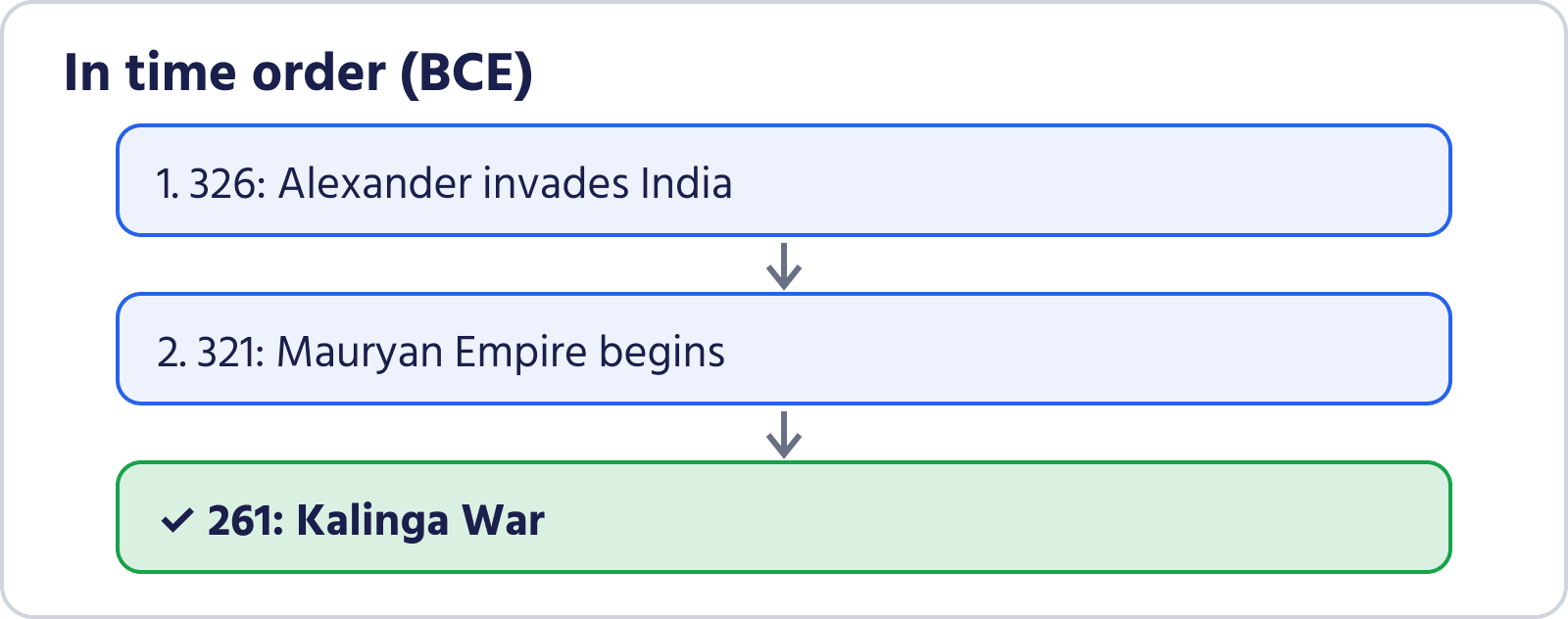
| Event | BCE |
|---|---|
| Alexander's invasion | 326 |
| Mauryan Empire begins | 321 |
| Kalinga War | 261 |
| End of Mauryas | 185 |
Who came to the court of Chandragupta Maurya as Seleucus's ambassador?
The Greek ambassador Megasthenes wrote about Mauryan rule in his book "Indica". The other three are Chinese pilgrims who visited India much later, in the Gupta and Harsha periods.
- > Megasthenes = Greek envoy, book "Indica"
- > Fa-Hien: under Chandragupta II
- > Xuanzang: under Harsha
- > The familiar Chinese pilgrim names distract from the Greek envoy
- > Mega-sthenes = Indica
| Traveller | Country | Era |
|---|---|---|
| Megasthenes | Greece | Chandragupta Maurya |
| Fa-Hien | China | Chandragupta II (Gupta) |
| Xuanzang | China | Harshavardhana |
| I-Tsing | China | Post-Gupta (7th century) |
Who wrote the "Arthashastra"?
The Arthashastra was written by Kautilya (Chanakya, Vishnugupta) and deals with statecraft and administration. Vishakhadatta wrote the play "Mudrarakshasa", Kalidasa "Abhijnanashakuntalam" and Banabhatta "Harshacharita". All four are authors, so the work-author pairs must be remembered.
- > Arthashastra = Kautilya (Chanakya)
- > Mudrarakshasa = Vishakhadatta
- > Abhijnanashakuntalam = Kalidasa
- > Harshacharita = Banabhatta
- > Chanakya is also the hero of Mudrarakshasa, which tempts people to pick Vishakhadatta
- > Artha (wealth, polity) = Kautilya
| Work | Author |
|---|---|
| Arthashastra | Kautilya |
| Mudrarakshasa | Vishakhadatta |
| Abhijnanashakuntalam | Kalidasa |
| Harshacharita | Banabhatta |
Which Gupta emperor did the historian Vincent Smith call the "Napoleon of India"?
Vincent Smith gave Samudragupta this title for his wide conquests. His deeds are recorded in the Allahabad Prashasti, composed by Harishena. Chandragupta I laid the foundation of the Gupta empire, Skandagupta held off the Huna invasions and Kumaragupta was a ruler of peace, so none of them is called this.
- > Samudragupta = "Napoleon of India"
- > Allahabad Prashasti: Harishena
- > Chandragupta I: founder-ruler of the Gupta empire
- > Chandragupta I took the imperial title, but the conquest fame belongs to his son
- > Samudra (sea) = conquest up to the seas = Napoleon
Who founded the Delhi Sultanate?
Qutb ud-Din Aibak founded the Delhi Sultanate (Slave dynasty) in 1206. Iltutmish was a later strong ruler who consolidated it rather than founded it. Balban and Alauddin Khalji came later still.
- > 1206: Aibak, Slave dynasty
- > Iltutmish: real organiser of the Sultanate
- > Khalji dynasty: 1290
- > Many call Iltutmish the real founder, but the first Sultan was Aibak
- > 1206 = Aibak
| Dynasty | First ruler | Year |
|---|---|---|
| Slave | Qutb ud-Din Aibak | 1206 |
| Khalji | Jalal ud-Din Khalji | 1290 |
| Tughlaq | Ghiyas ud-Din Tughlaq | 1320 |
| Sayyid | Khizr Khan | 1414 |
| Lodi | Bahlul Lodi | 1451 |
Which Sultan tried to shift the capital from Delhi to Daulatabad?
Muhammad bin Tughlaq moved the capital to Devagiri (renamed Daulatabad), but the plan failed. He also introduced token currency in copper and brass. Firuz Shah Tughlaq is known for canals and public works, Ghiyas ud-Din founded the dynasty, and Alauddin Khalji is famous for market price control.
- > Capital shift: Delhi to Daulatabad (Devagiri)
- > Token currency: Muhammad bin Tughlaq
- > Alauddin Khalji: market control
- > It is easy to mix up the three Tughlaq sultans
- > Daulatabad + token currency = Muhammad bin Tughlaq
In which year was the First Battle of Panipat (Babur vs Ibrahim Lodi) fought?
Babur defeated Ibrahim Lodi at the First Battle of Panipat in 1526 and laid the foundation of the Mughal Empire. 1527 is the Battle of Khanwa against Rana Sanga, so it is a trap. 1556 and 1761 are the years of the Second and Third Battles of Panipat.
- > Panipat I: 1526 (Babur vs Ibrahim Lodi)
- > Panipat II: 1556 (Akbar vs Hemu)
- > Panipat III: 1761 (Marathas vs Abdali)
- > 1526 and 1527 are adjacent; Khanwa came the year after Panipat
- > Panipat: 26, 56, 61
| Battle | Year | Sides |
|---|---|---|
| First Panipat | 1526 | Babur vs Ibrahim Lodi |
| Khanwa | 1527 | Babur vs Rana Sanga |
| Second Panipat | 1556 | Akbar (Bairam Khan) vs Hemu |
| Third Panipat | 1761 | Marathas vs Ahmad Shah Abdali |
Who fought against Akbar's army in the Battle of Haldighati in 1576?
Maharana Pratap of Mewar fought the Mughal army at Haldighati in 1576; the Mughal commander was Man Singh. Rana Sanga fought Babur at Khanwa (1527), so he is wrong. Hemu fought at the Second Battle of Panipat (1556) and Shivaji was a Maratha leader of the 17th century.
- > Haldighati 1576: Maharana Pratap
- > Rana Sanga: Khanwa 1527
- > Hemu: Second Panipat 1556
- > The two Ranas of Mewar, Sanga and Pratap, belong to different generations
- > Pratap on the yellow soil of Haldighati
Which ruler introduced the silver coin called the "Rupiya"?
Sher Shah Suri introduced the silver "Rupiya" and the copper "Dam". He also repaired the Grand Trunk Road. Alauddin Khalji fixed market prices, Akbar is known for the mansabdari system and Humayun was defeated by Sher Shah.
- > Rupiya (silver) and Dam (copper): Sher Shah
- > Repaired the Grand Trunk Road
- > Akbar: mansabdari
- > Akbar's coinage is famous, but the Rupiya came from Sher Shah
- > Sher Shah = Rupiya + GT Road
In which year was the Battle of Plassey (Siraj ud-Daulah vs the East India Company) fought?
The Battle of Plassey was fought on 23 June 1757; Robert Clive led the Company and Siraj ud-Daulah lost through Mir Jafar's betrayal. 1764 is the Battle of Buxar, which secured the Company's power. In 1756 Siraj captured Calcutta, and 1772 is when Warren Hastings took charge.
- > Plassey: 23 June 1757
- > Buxar: 1764
- > 1765: grant of the Diwani
- > 1756 (capture of Calcutta) and 1757 are adjacent, so the years are easily confused
- > Plassey 57, Buxar 64
| Event | Year |
|---|---|
| Siraj captures Calcutta | 1756 |
| Battle of Plassey | 1757 |
| Battle of Buxar | 1764 |
| Diwani of Bengal granted | 1765 |
| Warren Hastings becomes Governor | 1772 |
Where did the Revolt of 1857 begin on 10 May?
On 10 May 1857 the sepoys at Meerut rebelled and marched to Delhi, so the Revolt began at Meerut. Mangal Pandey's incident at Barrackpore came earlier, in March, but was an isolated event. Delhi was the main centre of the revolt, not its starting point, and at Kanpur Nana Saheb led it.
- > 10 May 1857: Meerut
- > Mangal Pandey: Barrackpore, March 1857
- > Delhi: Bahadur Shah Zafar
- > Barrackpore came first, but the Revolt's start in date and place is Meerut
- > May in Meerut
| Centre | Leader |
|---|---|
| Delhi | Bahadur Shah Zafar, Bakht Khan |
| Kanpur | Nana Saheb, Tatya Tope |
| Jhansi | Rani Lakshmibai |
| Lucknow | Begum Hazrat Mahal |
Who was the first president of the Indian National Congress, founded in 1885?
Womesh Chunder Bonnerjee presided over the first session (Bombay, December 1885). A. O. Hume was one of the founders and the first general secretary, not the president. Dadabhai Naoroji was president three times, first in 1886. Surendranath Banerjee became president in 1895.
- > 1885: first president W. C. Bonnerjee
- > Hume: first general secretary
- > Dadabhai Naoroji: 1886, 1893, 1906
- > Hume was a founder, so many assume he was the first president
- > First president = Bonnerjee, a Bengali
Which Viceroy announced the Partition of Bengal in 1905?
The Partition of Bengal took effect on 16 October 1905 under Lord Curzon. After the strong Swadeshi movement it was annulled in 1911, when Lord Hardinge was Viceroy. Ripon is known for local self-government, Dalhousie for the Doctrine of Lapse and Bentinck for abolishing sati.
- > Partition of Bengal: Curzon, 1905
- > Annulled: 1911, Hardinge
- > Abolition of sati: Bentinck, 1829
- > Dalhousie and Ripon are not linked to the partition of Bengal
- > Curzon cut Bengal
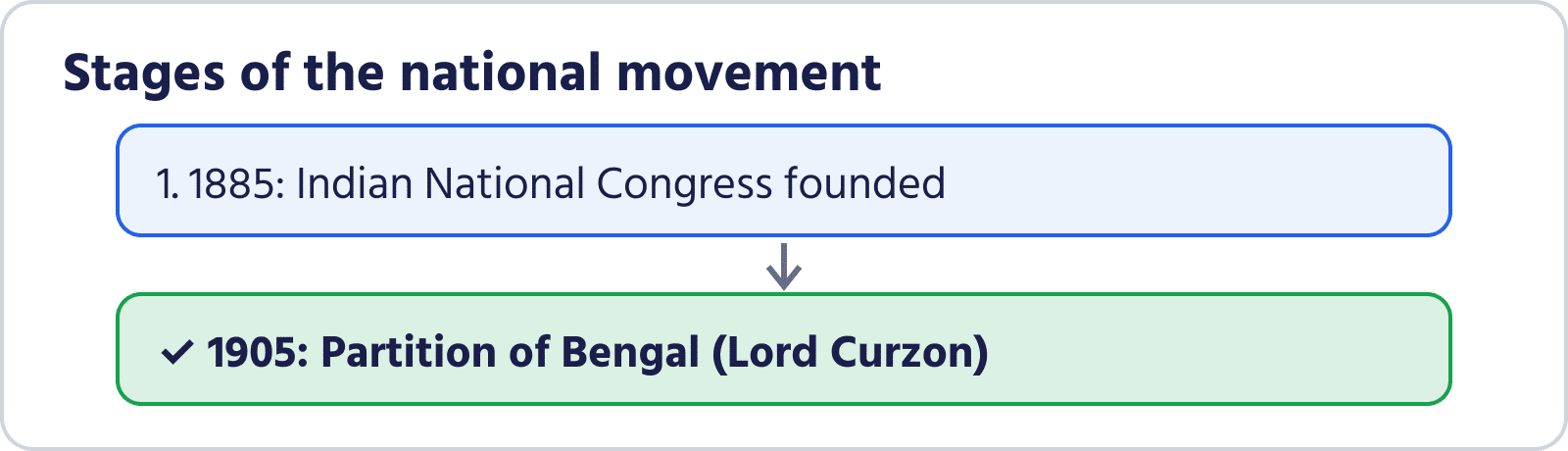
| Viceroy/Governor-General | Famous for |
|---|---|
| Lord Bentinck | Abolition of sati (1829) |
| Lord Dalhousie | Doctrine of Lapse, railways |
| Lord Ripon | Local self-government (1882) |
| Lord Curzon | Partition of Bengal (1905) |
In which year did the Jallianwala Bagh massacre in Amritsar take place?
On 13 April 1919, on General Dyer's orders, an unarmed crowd was fired upon at Jallianwala Bagh, during a gathering protesting the Rowlatt Act. The Champaran Satyagraha was in 1917, the Kheda Satyagraha in 1918, and Gandhi started the Non-Cooperation Movement in 1920.
- > Jallianwala Bagh: 13 April 1919
- > Rowlatt Act: 1919
- > Non-Cooperation Movement: 1920
- > 1919 and 1920 are adjacent; the massacre came before Non-Cooperation
- > Nineteen, thirteen (1919, 13 April)
| Event | Year |
|---|---|
| Champaran Satyagraha | 1917 |
| Kheda Satyagraha | 1918 |
| Jallianwala Bagh | 1919 |
| Non-Cooperation Movement | 1920 |
Where did Gandhi's 1930 march to break the salt law end?
Gandhi marched from Sabarmati Ashram to Dandi in Gujarat and broke the salt law there on 6 April 1930, starting the Civil Disobedience Movement. Sabarmati was the starting point, not the end. Champaran (1917) and Bardoli (1928) are sites of other movements.
- > Dandi March: 12 March to 6 April 1930
- > Start: Sabarmati; end: Dandi
- > Began the Civil Disobedience Movement
- > Sabarmati is the famous ashram, but it was the start of the march, not its end
- > Dandi = where the salt was lifted

| Place | Movement | Year |
|---|---|---|
| Champaran | Indigo farmers' satyagraha | 1917 |
| Bardoli | No-tax satyagraha | 1928 |
| Dandi | Salt Satyagraha | 1930 |
📊 Topic Analysis
20 mixed questions on ancient, medieval and modern Indian history for the General Knowledge paper of WBPSC Clerkship 2024 Part-1, with explanations.




Leave a Comment
Commenting as ·