
SI Units and Physical Quantities Quiz: Clerkship 2024
SI Units and Physical Quantities Quiz: Clerkship 2024
Test what you read in the notes with 10 questions. 📖 Read the detailed topic
Which is the SI unit of length?
The base SI unit of length is the metre (m). The centimetre belongs to the CGS system and the foot to the FPS system. The kilometre is only a multiple of the metre, so it is not a base unit. When a question says "SI", look for the base unit of that system.
- > The SI unit of length is the metre (m)
- > CGS uses the centimetre, FPS uses the foot
- > Kilometre and centimetre are multiples/sub-multiples of the metre
- > Kilometre and centimetre are familiar, so they are mistaken for the base unit
- > SI is the modern metric system built on metre, kilogram and second
How many base units are there in the SI system?
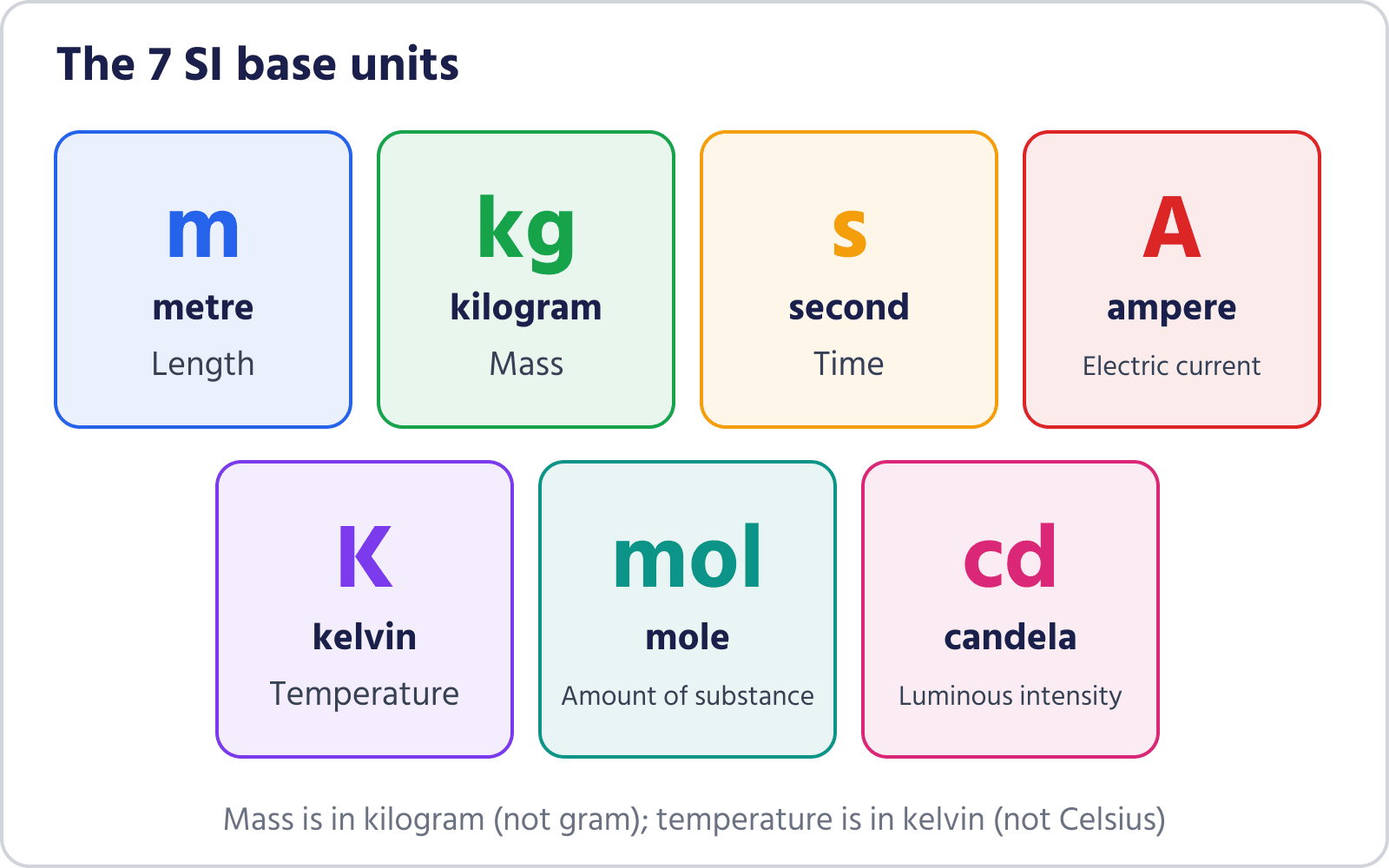
SI has seven base units: metre, kilogram, second, ampere, kelvin, mole and candela. Every other unit is a derived unit built from them. Five or six comes from forgetting the mole and the candela, and nine is not the count in any standard list.
- > There are exactly 7 base units
- > Length, mass, time, current, temperature, amount of substance, luminous intensity
- > Newton, joule, watt and so on are derived units
- > Forgetting the mole and candela and answering 5 or 6
- > Length–mass–time first, then electricity–heat–matter–light: seven in all
| Quantity | SI unit | Symbol |
|---|---|---|
| Length | metre | m |
| Mass | kilogram | kg |
| Time | second | s |
| Electric current | ampere | A |
| Temperature | kelvin | K |
| Amount of substance | mole | mol |
| Luminous intensity | candela | cd |
Which is the SI unit of force?
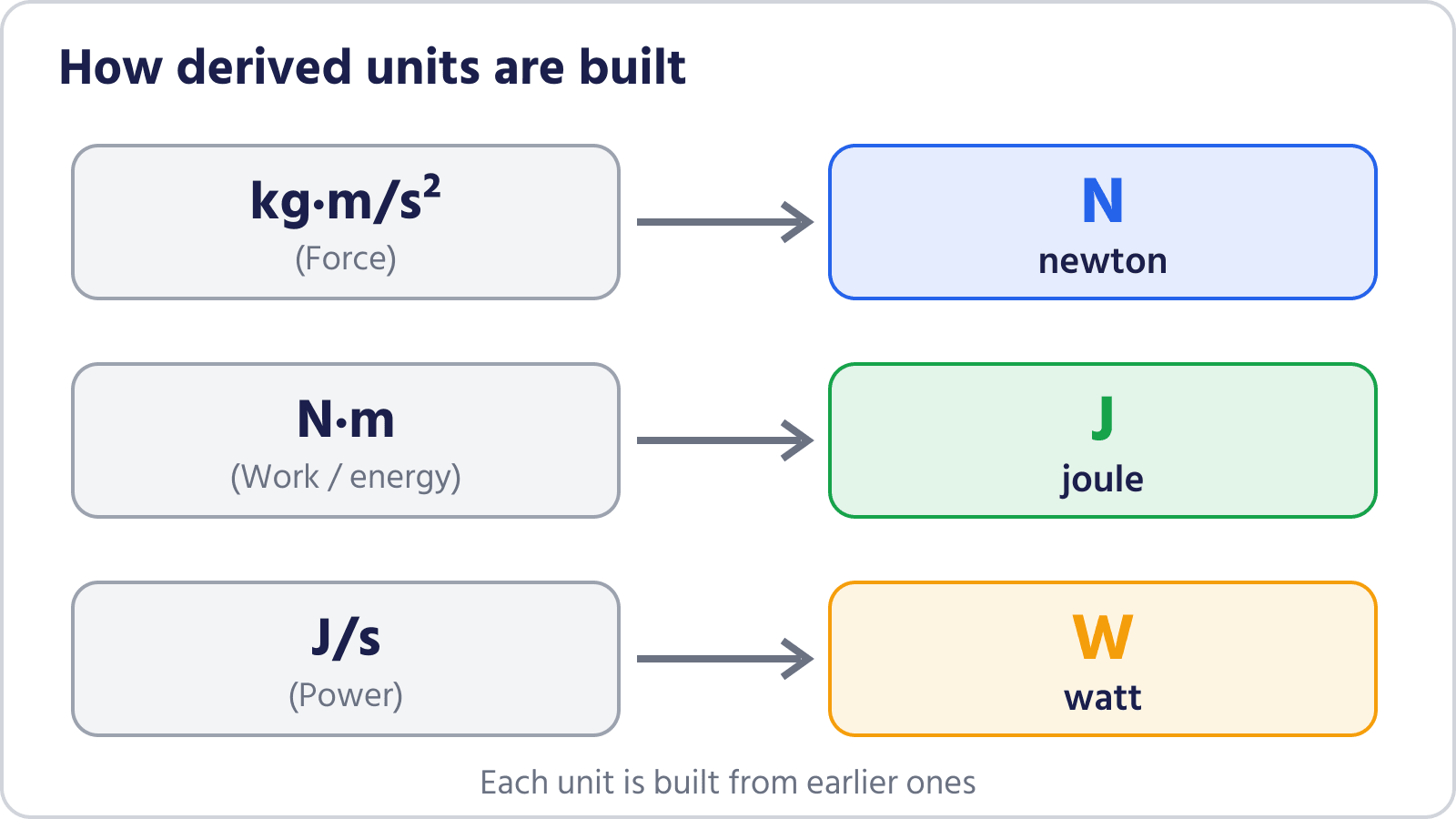
The SI unit of force is the newton (N), where 1 N = 1 kg·m/s². The joule is the unit of work and energy, the watt of power and the pascal of pressure. All four are derived units, so they are easily confused when listed together.
- > Force = newton (N)
- > 1 N = 1 kg·m/s²
- > Joule = energy, watt = power, pascal = pressure
- > Mixing up force and pressure: pressure is in pascal, force in newton
- > Newton is the push; force ÷ area = pascal
| Quantity | Unit | Relation |
|---|---|---|
| Force | newton (N) | kg·m/s² |
| Work / energy | joule (J) | N·m |
| Power | watt (W) | J/s |
| Pressure | pascal (Pa) | N/m² |
Which is the SI unit of work or energy?
The SI unit of work and energy is the joule (J), where 1 J = 1 N·m. The watt is the unit of power, the rate of doing work (1 W = 1 J/s). The newton is the unit of force and the hertz of frequency, so neither fits here.
- > Work and energy are measured in joules (J)
- > 1 J = 1 N·m
- > Watt = joule per second, the unit of power
- > Work vs power: confusing joule and watt is the most common error
- > Joule is the total work done; watt is the rate of work
| Quantity | Unit | How it arises |
|---|---|---|
| Work / energy | joule (J) | force × displacement |
| Power | watt (W) | joule ÷ second |
| 1 watt | = | 1 joule per second |
Which is the SI unit of temperature?
The SI unit of temperature is the kelvin (K), not the Celsius degree. Celsius and Fahrenheit are everyday scales. The calorie is an old unit of heat energy, not of temperature. On the kelvin scale, 0 K is absolute zero.
- > The SI unit of temperature is the kelvin (K)
- > K = °C + 273 (approximately)
- > Calorie measures heat, not temperature
- > Celsius is so familiar that it is mistaken for the SI unit
- > No degree sign with kelvin: write 300 K, not 300°K
Which is the SI unit of frequency?
The SI unit of frequency is the hertz (Hz), where 1 Hz is one oscillation per second. The watt is the unit of power, the ohm of resistance and the tesla of magnetic field. None of these counts oscillations.
- > Frequency is measured in hertz (Hz)
- > 1 Hz = 1/s
- > Tesla = magnetic field, ohm = resistance
- > Tesla and ohm sound technical and tempting, but they measure other quantities
- > Hertz = how often per second something repeats
Which is the SI unit of electric current?
Electric current is one of the seven base quantities, and its unit is the ampere (A). The volt is the unit of potential difference, the ohm of resistance and the coulomb of charge. These three are derived units, and 1 C = 1 A·s.
- > Current is measured in amperes (A), a base unit
- > Volt = potential difference, ohm = resistance, coulomb = charge
- > 1 C = 1 A·s
- > Coulomb is linked to current, so it is wrongly taken as its unit
- > Current is I, but its unit ampere has the symbol A
Which is the SI unit of pressure?
The SI unit of pressure is the pascal (Pa), where 1 Pa = 1 N/m². The newton is the unit of force and the joule of energy. The bar is used for weather and tyre pressure, but it is not an SI unit; 1 bar = 10⁵ Pa.
- > The SI unit of pressure is the pascal (Pa)
- > 1 Pa = 1 N/m² = force ÷ area
- > The bar is a common unit, not an SI unit
- > The bar is so familiar that it is mistaken for the SI unit
- > Pascal measures pressure: force ÷ area
| Quantity | Unit | Relation |
|---|---|---|
| Force | newton (N) | kg·m/s² |
| Pressure | pascal (Pa) | N/m² |
| Pressure (common) | bar | 1 bar = 10⁵ Pa |
1 kilometre = how many metres?
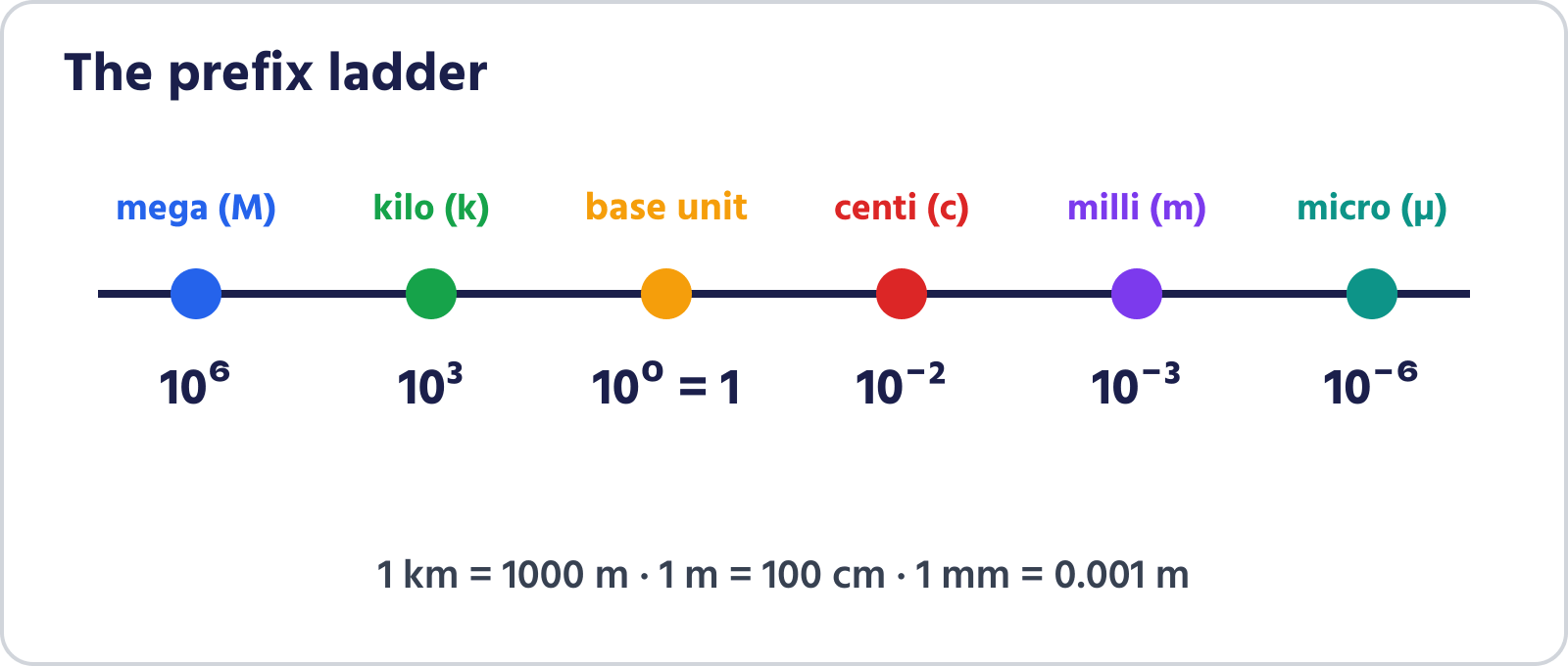
The prefix "kilo" means 10³, a thousand times, so 1 km = 1000 m. The figure 100 comes from the trap of 1 m = 100 cm (centi). Neither 10 nor 10,000 matches a common prefix.
- > kilo (k) = 10³
- > 1 km = 1000 m
- > centi = 10⁻², milli = 10⁻³
- > Remembering "1 m = 100 cm" and picking 100
- > Kilo means thousand: a kilogram is 1000 grams
| Prefix | Value | Example |
|---|---|---|
| kilo (k) | 10³ | 1 km = 1000 m |
| mega (M) | 10⁶ | 1 MW = 10⁶ W |
| centi (c) | 10⁻² | 1 cm = 0.01 m |
| milli (m) | 10⁻³ | 1 mm = 0.001 m |
| micro (µ) | 10⁻⁶ | 1 µm = 10⁻⁶ m |
Which is the SI unit of power?
Power is the rate of doing work, so its SI unit is the watt (W) = joule per second. The joule is the unit of total work or energy. The newton is the unit of force and the hertz of frequency. Doing the same work in less time means more power.
- > The SI unit of power is the watt (W)
- > 1 W = 1 J/s
- > Power = work ÷ time
- > Mixing up joule and watt: energy is in joules, power in watts
- > Watt means "how fast": a 60 W bulb uses 60 J every second
| Quantity | Unit | How it arises |
|---|---|---|
| Work / energy | joule (J) | force × displacement |
| Power | watt (W) | joule ÷ second |
| 1 watt | = | 1 joule per second |
📊 Topic Analysis
Test what you read in the notes with 10 questions.




Leave a Comment
Commenting as ·