
Clerkship Arithmetic Quiz: Profit and Loss
A little practice. A step forward.
12 profit, loss and discount sums with a worked solution for each. 📖 Read the detailed topic
If the cost price is ₹640 and the selling price is ₹720, what is the profit per cent?
Profit = 720 − 640 = ₹80. Profit per cent is always taken on the cost price: $\frac{80}{640} \times 100 = 12.5$%.
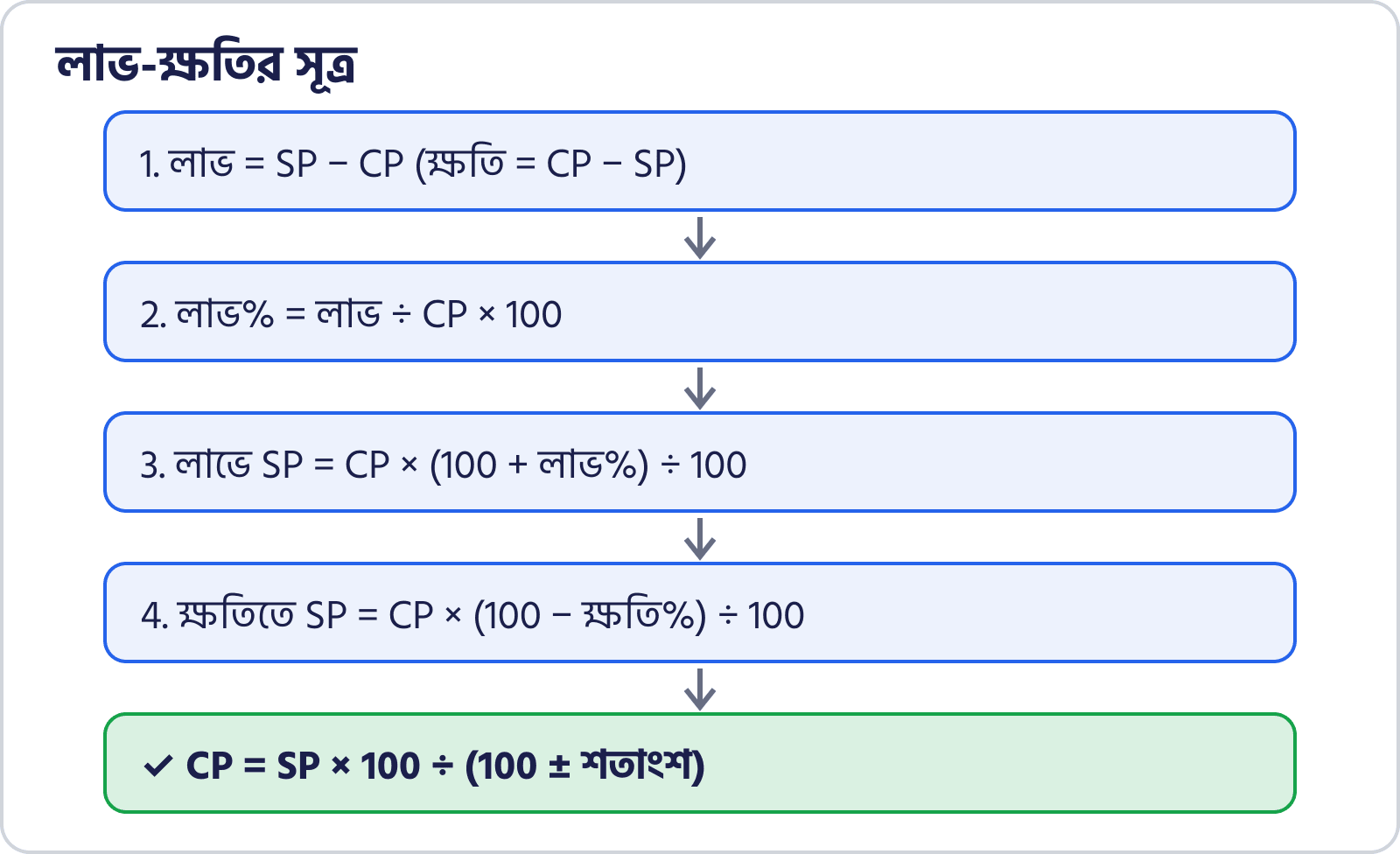
- Profit = SP − CP
- Profit% = $\frac{\text{Profit}}{\text{CP}} \times 100$
- Per cent is on the cost price
An article bought for ₹500 is sold at a loss of 12%. What is the selling price?
With a loss, SP = CP $\times \frac{100 - 12}{100}$ = $500 \times \frac{88}{100}$ = ₹440. ₹560 is what a 12% profit would give.
- For a loss multiply by $\frac{100 - \text{loss}}{100}$
- Loss = ₹60, so SP is below CP
- 12% profit gives ₹560, 12% loss gives ₹440: mind the direction
An article sold for ₹1,150 at a profit of 25%. What was its cost price?
CP = SP $\times \frac{100}{100 + 25}$ = $1150 \times \frac{100}{125}$ = ₹920. ₹862.50 takes 25% off the selling price and ₹1,437.50 adds 25% to it; both are wrong because the per cent is on the cost price.
- For a profit: CP = SP $\times \frac{100}{100 + \text{profit}}$
- Check: 125% of 920 = 1150
- Taking 25% off the SP directly is wrong
A thing bought for ₹2,400 is sold for ₹2,100. What is the loss per cent?
Loss = 2400 − 2100 = ₹300. Loss% = $\frac{300}{2400} \times 100 = 12.5$%. Dividing 300 by the selling price 2100 gives 14.29%, which is wrong.
- Loss = CP − SP
- Always divide by the cost price
- Dividing by the SP is the commonest slip
A discount of 15% is given on an article marked ₹800. What is the selling price?
Discount = 15% of 800 = ₹120. SP = 800 − 120 = ₹680. ₹120 is only the discount, not the selling price.
- Discount is on the marked price
- SP = marked price − discount
- You pay 85% of the marked price
Two successive discounts of 10% and 20% are equal to a single discount of:
Take the marked price as 100: after 10% off it is 90, then 20% of 90 = 18 more, leaving 72. Total discount = 100 − 72 = 28%. Simply adding 10 + 20 = 30 is wrong because the second discount is on the reduced price.
- Net = $a + b - \frac{ab}{100}$
- Here 10 + 20 − 2 = 28
- Successive discounts cannot be added
| Discounts | Net discount |
|---|---|
| 10% and 10% | 19% |
| 10% and 20% | 28% |
| 20% and 20% | 36% |
If the selling price of 15 articles equals the cost price of 18 articles, what is the gain per cent?
Let each cost ₹1; the cost of 18 is ₹18 = the selling price of 15. SP of one = $\frac{18}{15} = 1.2$, so the gain is ₹0.2 or 20%.
- Gain% = $\frac{18 - 15}{15} \times 100$
- More bought than sold: a gain
Two articles are each sold for ₹1,800, one at a 10% profit and the other at a 10% loss. What is the overall result?
Equal profit and loss per cent on equal selling prices always gives a loss of $\frac{x^{2}}{100}$% = $\frac{10^{2}}{100}$ = 1%. Check: CP of the first = 1800 ÷ 1.1 ≈ 1636.36, of the second = 1800 ÷ 0.9 = 2000; total cost 3636.36, total sale 3600, a loss of about 1%.
- Same SP, same x% gain and loss: loss $\frac{x^{2}}{100}$%
- Never a gain or zero
- The profit and the loss do not cancel out
An article sold at a 20% profit fetches ₹960. At what price should it be sold to gain 25%?
CP = $960 \times \frac{100}{120}$ = ₹800. SP for 25% profit = $800 \times \frac{125}{100}$ = ₹1,000. Finding the cost price first is the key to this type.
- First the CP, then the new SP
- The CP stays, only the per cent changes
An article sold at a 20% loss fetches ₹640. At what price would it give a 10% profit?
CP = $640 \times \frac{100}{80}$ = ₹800. SP for a 10% profit = $800 \times \frac{110}{100}$ = ₹880. ₹800 is the cost price itself, not a profit price.
- For a loss: CP = SP $\times \frac{100}{100 - \text{loss}}$
- Then apply the profit rate
After a 20% discount on a marked price of ₹1,500, there is still a 20% profit. What is the cost price?
SP = 80% of 1500 = ₹1,200. This is 120% of the cost, so CP = $1200 \times \frac{100}{120}$ = ₹1,000. Check: 120% of 1000 = 1200.
- Discount is on the marked price, profit on the cost
- Two different bases
- Using one base for both is wrong
A trader marks goods 40% above the cost price and allows a 10% discount. What is the profit per cent?
Take CP as 100; the marked price is 140. After 10% discount SP = $140 \times 0.9 = 126$. Profit = 26, i.e. 26%. Taking 40 − 10 = 30 is wrong because the discount is on the marked price.
- Taking CP as 100 keeps it easy
- Marked price = CP + mark-up
- 40% − 10% = 30% is wrong
📊 Topic Analysis
12 profit, loss and discount sums with a worked solution for each.



Leave a Comment
Commenting as ·