
Heat and Temperature Quiz: Clerkship GS
A little practice. A step forward.
10 questions on heat and temperature, each with an explanation. 📖 Read the detailed topic
What is the SI unit of temperature?
The SI unit of temperature is the kelvin (K). Joule and calorie are units of heat energy, not temperature. Celsius is common but not the SI base unit.
- No 'degree' is used with kelvin
- SI unit of heat is the joule
- $K = C + 273$
- Heat and temperature are different: heat is energy, temperature measures hotness
- Heat = joule, temperature = kelvin
| State | Celsius (°C) | Fahrenheit (°F) | Kelvin (K) |
|---|---|---|---|
| Melting ice | 0 | 32 | 273 |
| Human body | 37 | 98.6 | 310 |
| Boiling water | 100 | 212 | 373 |
What is the normal body temperature of a healthy person on the Fahrenheit scale?
The average body temperature of a healthy person is 37°C, which is 98.6°F. Using $F = \frac{9}{5} \times 37 + 32 = 98.6$. The other values lie near normal but are not the average.
- 37°C = 98.6°F
- $F = \frac{9}{5}C + 32$
- A fever rises above this
- Not 97.6 or 99.6: remember 98.6
- 37 Celsius = 98.6 Fahrenheit
At what temperature do the Celsius and Fahrenheit scales show the same reading?
Setting the readings equal gives $C = \frac{9}{5}C + 32$, which solves to $C = -40$. So −40°C = −40°F. At 0°C the Fahrenheit reading is 32, and −273 is close to absolute zero in Celsius.
- −40°C = −40°F
- 0°C = 32°F
- Absolute zero is about −273°C
- The scales do not agree at 0°C
- The scales meet at minus forty
Equation: $C = \frac{9}{5}C + 32$ gives $-\frac{4}{5}C = 32$, so $C = -40$.
By which method does heat reach the Earth from the Sun?
Most of the space between the Sun and Earth is empty, with no medium. In radiation, heat travels as electromagnetic waves and needs no medium. Conduction and convection both need a medium, so they cannot carry it.
- Radiation needs no medium
- Conduction in solids, convection in fluids
- Radiation travels at the speed of light
- Convection never works without a medium
- No medium = radiation
| Method | Medium | Example |
|---|---|---|
| Conduction | Solid | A spoon in hot tea warms up |
| Convection | Liquid and gas | Water heating on a stove, sea breeze |
| Radiation | None needed | Sunlight, warmth near a fire |
At which temperature is the density of water highest?
As water cools it contracts and gets denser down to 4°C. Below 4°C it expands again and the density falls. This is why ice (0°C) floats and the bottom water of a lake does not freeze.
- Water is densest at 4°C
- Ice floats on water
- Fish survive at the bottom of frozen lakes
- Density is not highest at 0°C; ice is lighter than water
- Water is heaviest at four degrees
Why do regions near the sea have a moderate climate?
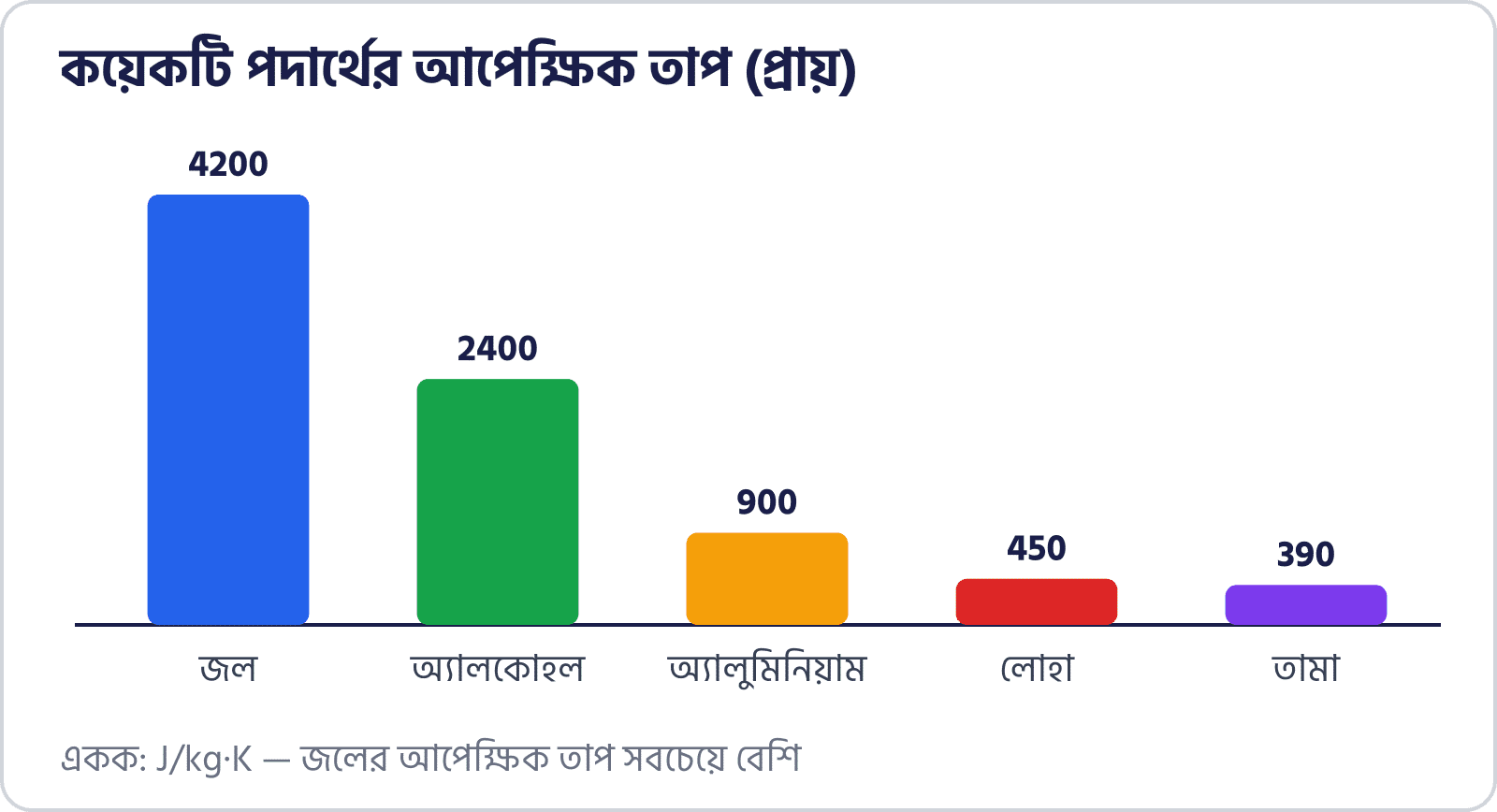
Water has a much higher specific heat than most substances, so its temperature changes slowly even when it absorbs or loses a lot of heat. This reduces day-night and summer-winter differences near the coast. Density, boiling point and transparency are not the reason.
- Specific heat of water is about 4200 J/kg·K
- Water heats and cools slowly
- Water is used as a coolant in engines
- Desert sand has low specific heat, so deserts swing widely between day and night
- High specific heat = changes slowly
Why does steam at 100°C burn more severely than boiling water at 100°C?
When 100°C steam condenses on the skin it releases about 2260 kJ of latent heat per kg, which boiling water does not carry. This extra heat causes the more severe burn. The other reasons are not the main one.
- Latent heat of vaporisation of water is about 2260 kJ/kg
- Latent heat of melting ice is about 336 kJ/kg
- During a change of state the temperature stays constant
- Both are at 100°C; the difference is the latent heat
- Steam = an extra store of heat
| Change | Latent heat (approx.) |
|---|---|
| Ice → water (melting) | 336 kJ/kg |
| Water → steam (vaporisation) | 2260 kJ/kg |
What is absolute zero on the Celsius scale (approximately)?
Absolute zero (0 K) is the lowest theoretical temperature, where the thermal motion of molecules nearly stops. From $K = C + 273$ we get $0 = C + 273$, so $C = -273$. No temperature can be lower.
- 0 K = −273.15°C (about −273°C)
- The Kelvin scale has no negative values
- 0°C = 273 K
- 0°C is not zero kelvin; it is 273 K
- Kelvin = Celsius + 273
Which liquid is used in a clinical thermometer and what is its range?
A clinical thermometer uses mercury and reads about 35°C to 42°C (94°F to 108°F), since body temperature stays within this range. Water is not used because it expands irregularly. The 0–100°C and −10 to 110°C ranges belong to laboratory thermometers.
- The tube has a kink in it
- The kink stops mercury from falling back
- Mercury freezes at −39°C and boils at 357°C
- A laboratory thermometer has a much wider range
- Clinical = 35 to 42
Which colour of surface absorbs thermal radiation best?
A black surface absorbs thermal radiation best and also emits it best. White and shiny surfaces reflect most of the radiation. That is why white or light clothes feel cooler in summer, while black clothes keep you warmer in winter.
- Black = good absorber and good emitter
- White and shiny = good reflectors
- The inside walls of a thermos flask are shiny
- A good absorber is a poor reflector
- Black absorbs, white returns
| Surface | Absorption | Reflection |
|---|---|---|
| Black, rough | Highest | Lowest |
| White | Low | High |
| Shiny silver | Lowest | Highest |
📊 Topic Analysis
10 questions on heat and temperature, each with an explanation.


Leave a Comment
Commenting as ·