
Pala and Sena Period Quiz: Clerkship History
A little practice. A step forward.
10 questions on the Pala and Sena period of Bengal, each with an explanation. 📖 Read the detailed topic
Who was the founder of the Pala dynasty?
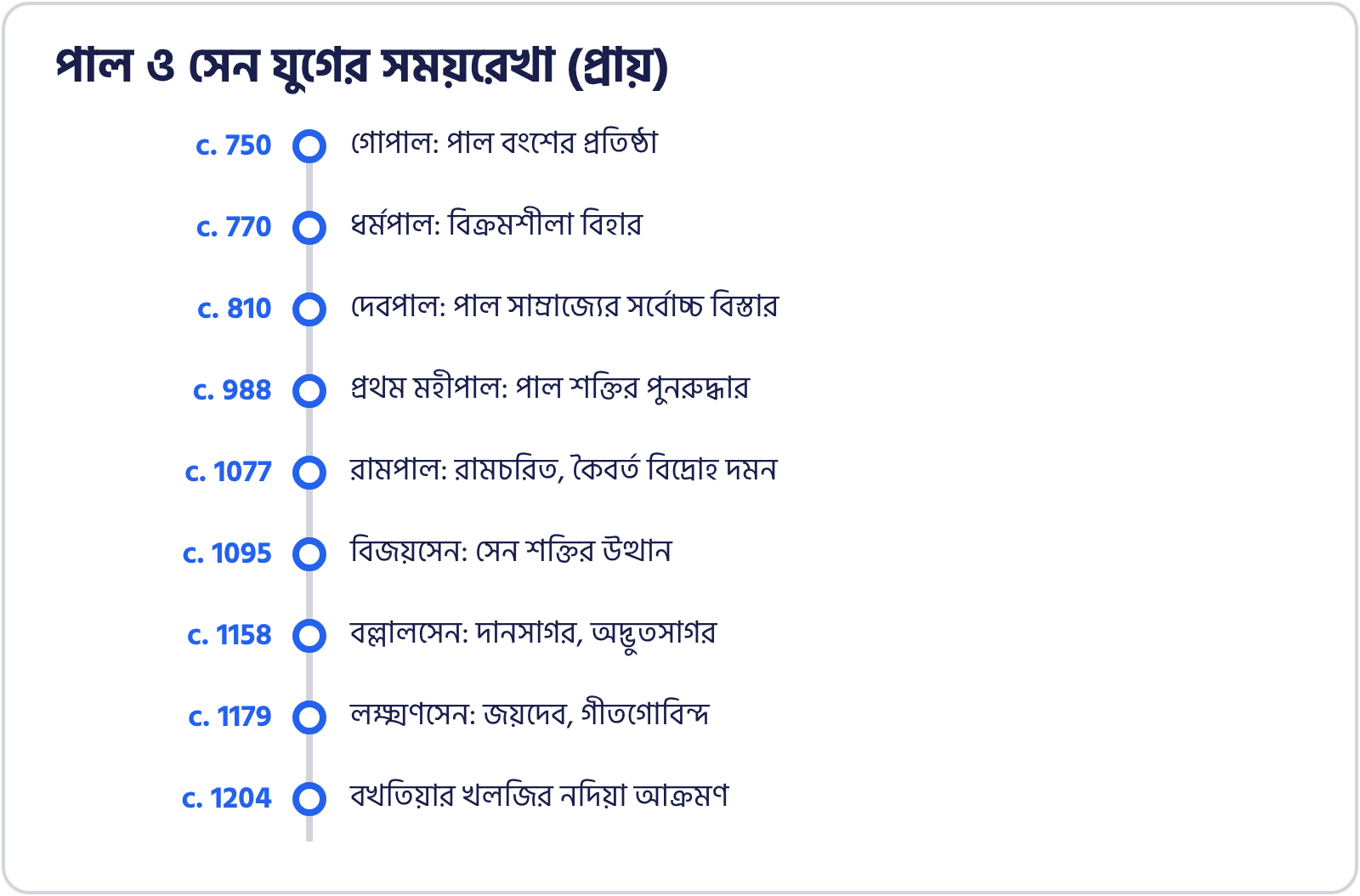
Gopala founded the Pala dynasty around 750 CE. Dharmapala and Devapala were his successors who expanded the empire, and Ramapala ruled much later, reviving Pala power for a time.
- Gopala became king around 750 CE
- The Palas ruled Bengal and Bihar for about four centuries
- Gopala = the first
How did Gopala become the ruler of Bengal?
Bengal was in matsyanyaya, a state of anarchy where the strong preyed on the weak. To end it the chieftains chose Gopala as king. He was not a hereditary heir, and there is no evidence of conquest or a marriage alliance.
- Matsyanyaya means anarchy
- A main source is Dharmapala's Khalimpur copper plate
- মাৎস্যন্যায় মানে আইনহীন অবস্থা, কোনো রাজার নাম নয়
- Gopala was elected to stop matsyanyaya
Who founded the Vikramshila Mahavihara?
Dharmapala founded Vikramshila, in the Bhagalpur region of present-day Bihar. Devapala patronised Nalanda but did not found Vikramshila, and Mahipala and Ramapala ruled much later.
- Dharmapala ruled about 770–810 CE
- He also built Somapura Mahavihara (Paharpur)
- A major centre of Buddhist learning
- Dharma + Vikram: Dharmapala and Vikramshila
The tripartite struggle between the Palas, Pratiharas and Rashtrakutas was for control of which city?
Kannauj was the symbol of power in north India, so the Palas, Gurjara-Pratiharas and Rashtrakutas fought over it in the 8th and 9th centuries. Pataliputra, Ujjain and Mathura were not the focus of this struggle.
- Dharmapala took part in the struggle
- The Pratiharas finally held Kannauj
- ত্রিপক্ষীয় সংঘর্ষ পাটলিপুত্র নিয়ে নয়, কনৌজ নিয়ে
- Three powers, one prize: Kannauj
Which work was written by Sandhyakar Nandi?
Sandhyakar Nandi was a court poet of the Pala king Ramapala and wrote the Ramacharita, a Sanskrit poem with double meanings that tells of Rama of the epic and of Ramapala together. Gita Govinda is by Jayadeva, and Danasagara and Adbhutasagara are linked to Ballalasena.
- Ramacharita is the main source for Ramapala's life and the Kaivarta revolt
- Ramapala founded the city of Ramavati
- Rama + charita = Ramapala + Ramacharita
The Shailendra king Balaputradeva of Suvarnadvipa (Sumatra) got permission to build a monastery at Nalanda from which Pala king?
At Balaputradeva's request Devapala granted villages for his monastery, as the Nalanda copper plate of Devapala records. The Pala empire was at its largest under Devapala (about 810–850). Dharmapala, Gopala and Ramapala are not linked with this event.
- Devapala was the son of Dharmapala
- It shows Pala links with Southeast Asia
- Deva + Nalanda: Devapala and Nalanda
Which Sena king's achievements are described in the Deopara Prashasti?
The inscription found at Deopara in Rajshahi was composed by Umapatidhara and describes the king Vijayasena. Vijayasena (about 1095–1158) made the Sena kingdom independent and strong. Samantasena was the earliest ancestor of the line but is not the hero of the inscription.
- Vijayasena's capital was Vijayapura
- He expanded at the cost of the Palas and Varmans
- সামন্তসেন বংশের আদি পুরুষ, কিন্তু দেওপাড়া প্রশস্তির নায়ক বিজয়সেন
- Deopara = Vijayasena, author Umapatidhara
Which Sena king is associated with the composition of Danasagara and Adbhutasagara?
Ballalasena (about 1158–1179) was a scholar-king. He wrote the Danasagara and began the Adbhutasagara, which his son Lakshmanasena completed. Tradition says he introduced the Kulin system in Bengal.
- Adbhutasagara was completed by Lakshmanasena
- The Kulinism tradition is linked with Ballalasena
- Ballala = dana + adbhuta
Who wrote the poem Gita Govinda?
The Gita Govinda was written by Jayadeva, a court poet of Lakshmanasena, as a Sanskrit lyric on the love of Radha and Krishna. Dhoyi and Halayudha were also linked to that court but wrote other works, and Sandhyakar Nandi belonged to the Pala age.
- Dhoyi wrote the Pavanaduta
- Jayadeva, Dhoyi, Umapatidhara, Sharana and Govardhana were at Lakshmanasena's court
- Halayudha wrote the Brahmanasarvasva
- ধোয়ী ও জয়দেব দুজনেই লক্ষ্মণসেনের সভাকবি, কিন্তু গীতগোবিন্দ জয়দেবের
- Gita + Govinda = Jayadeva
Who was the Sena king of Nadia when Bakhtiyar Khalji attacked it?
Around 1204 CE Bakhtiyar Khalji attacked Nadia with a small force, and the aged Lakshmanasena was king. He withdrew to East Bengal, where Sena rule lasted for some time. Ballalasena and Vijayasena were earlier kings, and Madanapala belonged to the late Pala line.
- Lakshmanasena ruled about 1179–1206
- Lakshmanavati (Gauda) was named after him
- Turkish rule began in Bengal
- The last major Sena king, Lakshmana, met Nadia's fall
📊 Topic Analysis
10 questions on the Pala and Sena period of Bengal, each with an explanation.


Leave a Comment
Commenting as ·